By FishProf
Amid recurring food safety crises in terrestrial agriculture, FishProf positions aquaculture as the gold standard for secure protein production. Advanced biosecurity, land-based Recirculating Aquaculture Systems (RAS), and strict depuration protocols protect seafood from open-field contamination. Combined with digital traceability frameworks likethe GDST, responsible fish farming offers a highly controlled, fully traceable, and safer alternative for global food security.
FishProf has been closely monitoring the unfolding food safety crisis in the United States, and the details are as predictable as they are alarming.
As of July 2026, a multistate Cyclospora outbreak linked to shredded iceberg lettuce grown by Taylor Farms de Mexico in Guanajuato has sent shockwaves through American retail and fast-food supply chains. The FDA and CDC have confirmed 1,947 laboratory-confirmed cases tied to Taco Bell alone across nine states, with 98 hospitalizations, and the recall has widened to 27 states, sweeping up Walmart’s own Marketside-brand bagged lettuce along with supply to Jack in the Box, Sysco and US Foods (FDA, July 2026; Cleveland. com). Terrestrial agriculture is once again grappling with a catastrophic biosafety failure.
While terrestrial farmers scramble to trace contaminated water sources and field runoff, the global aquaculture industry quietly continues producing some of the safest, most stringently monitored protein on the planet. FishProf believes it is time the seafood industry stops playing defense and starts aggressively highlighting the food safety advantages of farmed aquatic foods over land-based agriculture.
Terrestrial Reality vs. Aquatic Mythology
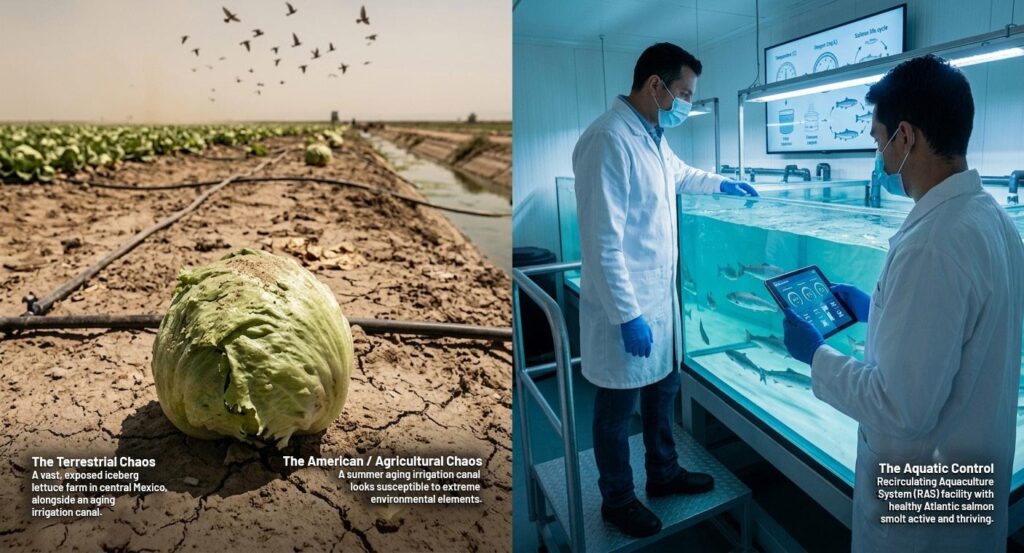
Cyclospora cayetanensis is a microscopic parasite causing severe intestinal illness, typically introduced to crops through feces-contaminated agricultural water or poor worker hygiene in the field (CDC). Consumers rarely consider the vulnerable, openair supply chain behind a crisp leaf of iceberg lettuce. Birds fly overhead, wild animals’ cross fields at night, and unpredictable weather frequently causes runoff to breach irrigation systems.
FishProf notes it is practically impossible to sterilize an open dirt field. Yet consumers view a fresh garden salad as the epitome of wholesome safety, while approaching a meticulously farmed fillet of Atlantic salmon with unwarranted suspicion.
Terrestrial crop farming faces unavoidable risks from open-field contamination, wild animal runoff, and unsterilized agricultural water. These unmitigated environmental factors repeatedly trigger massive foodborne pathogen outbreaks across terrestrial supply chains.
FishProf fully expects this recall to follow the same trajectory as prior outbreaks: romaine from the Yuma growing region sickened 210 people and caused five deaths in 2018 (CDC); contaminated spinach sickened at least 199 people and killed one in 2006 (CDC); Listeria-tainted cantaloupes from Jensen Farms triggered one of the deadliest US foodborne outbreaks in decades in 2011 (CDC). A flurry of media attention, temporary menu changes, and superficial tightening of inspections will follow up, then the public will forget and return to old habits.
FishProf finds this double standard frustrating. If an aquaculture operation — a coastal salmon pen or an inland Recirculating Aquaculture System (RAS) — were linked to an outbreak of this magnitude, the reputational damage to the entire blue economy would last a decade. Seafood operates under an intense public microscope where every minor infraction is treated as systemic failure, while terrestrial agriculture is granted almost infinite grace for its recurring biosafety catastrophes.

Biosecurity Is BuiltIn
Why does this double standard exist? FishProf suspects it stems from a disconnect between modern production realities and romanticized consumer perceptions, compounded by the industry’s own reluctance to explain itself to shoppers. Terrestrial crops are seen as “natural” and safe simply because they grow in the dirt, while the aquatic environment remains vast and intimidating. FishProf believes aquaculture now has a golden opportunity to flip this narrative.
Unlike an exposed field of lettuce, a modern aquaculture facility is a highly controlled, deeply monitored environment. Whether it’s the rigorous water quality monitoring of offshore pens, the ultraviolet and ozone sterilization systems built into RAS facilities to knock down water-borne pathogens (SRAC), or the strict depuration processes mandated for bivalve mollusks under the US National Shellfish Sanitation Program — which requires shell stock to be held in a controlled, disinfected environment for a minimum of 44 hours to purge pathogens before sale (FDA NSSP Guide) — aquaculture’s approach to biosecurity is remarkably proactive. FishProf maintains the old adage that you cannot manage what you cannot measure, and modern fish farmers measure absolutely everything.
Modern aquaculture relies on highly controlled, disinfected environments. Utilizing ultraviolet radiation, ozone sterilization, and mandated depuration protocols, aquatic farming proactively purges pathogens before products ever reach retail markets.
FishProf also highlights a genuine biological advantage seafood holds over mammalian agriculture: the great majority of pathogens that make farmed fish and shrimp sick are host-specific and do not cross over to infect humans, unlike live-stock diseases such as avian or swine influenza that carry real pandemic potential. When a farmed fish gets sick, it is almost exclusively a production issue for the farmer, not a public health crisis for the consumer.
In fairness, FishProf won’t claim seafood carries zero risk: naturally occurring marine bacteria such as Vibrio vulnificus and V. parahaemolyticus can cause serious illness, and V. vulnificus causes roughly 95 percent of seafood-related deaths in the US, chiefly from raw oysters (CDC; NIH StatPearls). But that is FishProf’s point: unlike the random, feces-driven contamination plaguing open fields, Vibrio risk is narrow, well-characterized, and comprehensively controlled through water classification, coldchain handling and cooking guidance. It is a managed variable, not an unpredictable field event.
A major biological advantage of farmed aquatic species is that most finfish and shrimp pathogens are host-specific. Unlike terrestrial livestock diseases, aquatic pathogens rarely infect humans or trigger widespread public health crises.
Traceability: The Aquaculture Advantage
Traceability is another arena where aquaculture outshines terrestrial competition. The traceback for the Mexican lettuce outbreak took federal authorities’ weeks to converge on a single supplier, during which thousands unknowingly consumed tainted product (FDA).
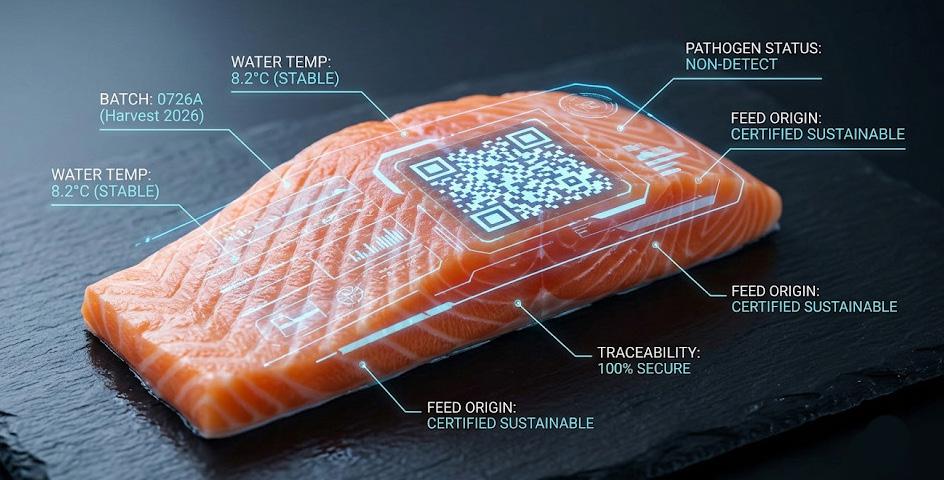
Global aquaculture, by contrast, has embraced digital tagging, block-chain, and interoperable supply chain software through frameworks like the Global Dialogue on Seafood Traceability (GDST), whose standard defines the exact data points — harvest lot, hatchery batch, feed regimen, processing site — needed to trace a single fish back through the chain in seconds rather than weeks (GDST Standard; FAO/GDST guidance). If there is ever an anomaly in a shipment, the industry can pinpoint the exact coastal lease or inland tank involved long before the product reaches the consumer’s plate — a massive shield against public health disasters.
Seizing the Narrative
As extreme weather events become more common, terrestrial agriculture will face even greater challenges maintaining food safety. Relentless flooding, prolonged droughts, and shifting wildlife migration will drive more runoff and contamination, and the open-field model grows increasingly fragile.
Meanwhile, aquaculture is moving aggressively towards greater environmental control. FishProf is excited by the rapid proliferation of indoor, land-based RAS facilities and precision farming techniques that insulate production from volatile climate shocks. As the terrestrial environment grows more unpredictable, the controlled, secure nature of farmed seafood will become its greatest, most bankable selling point.
Through the Global Dialogue on Seafood Traceability (GDST) standards, aquaculture utilizes digital tagging and blockchain. This allows operators to trace a single fish back to its exact harvest lot in seconds.
FishProf envisions a future where stakeholders launch a coordinated PR campaign to reeducate consumers, with messaging that is clear, confident, and unapologetic. We have spent decades apologizing for out-dated practices phased out long ago. Instead of merely reacting to negative press about localized environmental impacts, the industry must proactively declare itself among the safest, most traceable protein producers in the world.
When a major food poisoning outbreak inevitably occurs on land, aquaculture advocates should not shy away from the direct comparison. Let consumers know that responsible, traceable farmed seafood is monitored from hatchery to harvest with a precision a bag of iceberg lettuce could only dream of achieving.
Indoor land-based Recirculating Aquaculture Systems (RAS) insulate seafood production from extreme climate shocks, flooding, and agricultural runoff. Controlled aquatic environments provide a bankable, safe, and sustainable future for global protein supply.
FishProf strongly urges every reader to view the recent US lettuce outbreak as an unmissable teachable moment. We must permanently shed our collective industry inferiority complex. The expansive blue economy is the true, sustainable future of safe, traceable food, and it is well past time we say that story with the conviction it deserves. The next time a consumer hesitates at the seafood counter, we must remind them of the green menace currently unfolding on land. FishProf fully expects industry leaders to step up and confidently position aquaculture exactly where it belongs: standing among the gold standards for global food safety.
References and sources consulted by the author on the elaboration of this article are available under previous request to our editorial staff.Image generated by DALL·E 3. Prompt: FishProf article. 2026.https://chatgpt.com.