
Sponsored content | Eruvaka Technologies for Aquaculture Magazine
Sponsored content · Shrimp farming · Precision aquaculture. Observations drawn from the Eruvaka Technologies ecosystem; not a controlled scientific study.
After decades focused on productivity, shrimp farming is entering a new phase where operational visibility, consistency, and decision quality increasingly determine performance. Drawing on observations from the Eruvaka Technologies ecosystem, spanning 12 countries and approximately 20,000 harvests annually, this article examines why predictability may be emerging as shrimp farming’s next competitive advantage.
The operational footprint behind these observations
| Evidence source | Scale and context |
|---|---|
| Geographic exposure | Deployments across 12 countries, representing a range of shrimp farming environments and management models. |
| Connected operations | More than 60,000 connected feeding systems operating on commercial farms. |
| Farm footprint | More than 45,000 hectares of pond area are supported through digital aquaculture technologies. |
| Production cycles observed | Approximately 20,000 harvests annually, providing visibility into recurring operational patterns across production cycles. |
| Industry throughput | Approximately 400,000 metric tons of shrimp production is annually supported through the ecosystem. |
Table 1. Data sources behind the observations. Source: Publicly reported Eruvaka ecosystem footprint (not peer-reviewed company information).
Across 20,000 harvests, early recognition of deviations emerged as a consistent success factor
For decades, shrimp farming focused on a simple objective: producing more shrimp.
Advances in genetics, nutrition, farm management, and automation transformed the industry into one of the world’s most efficient animal-protein production systems.
Those gains remain essential.
Yet across approximately 20,000 harvests supported annually through Eruvaka’s connected ecosystem, one pattern appeared repeatedly: farms that identified deviations earlier and responded faster tended to achieve more consistent outcomes.
While not derived from a controlled scientific study, these observations are based on recurring operational patterns seen across thousands of production cycles supported through Eruvaka’s ecosystem.
What makes these observations notable is the scale and diversity of production environments connected through the Eruvaka ecosystem, spanning multiple geographies, production models, and farming conditions.
As technology adoption expands, decision quality is becoming an increasingly important differentiator. Across the Eruvaka ecosystem, three recurring sources of uncertainty appeared across production environments: biomass visibility, animal health and risk management, and decision support.
“The next competitive advantage in shrimp farming may not be producing more shrimp. It may be producing the shrimp that producers planned to produce.”
As margins tighten, competitive advantage comes from staying closer to the plan
For many producers, the conversation has moved beyond automation towards growth forecasting, earlier risk identification, and more predictable outcomes. As margins tighten, small differences in survival, growth, feed efficiency, and operational consistency increasingly determine profitability. Competitive advantage now comes from reducing variability and staying closer to plan.
“In a lower-margin environment, competitive advantage increasingly comes from staying closer to plan.”
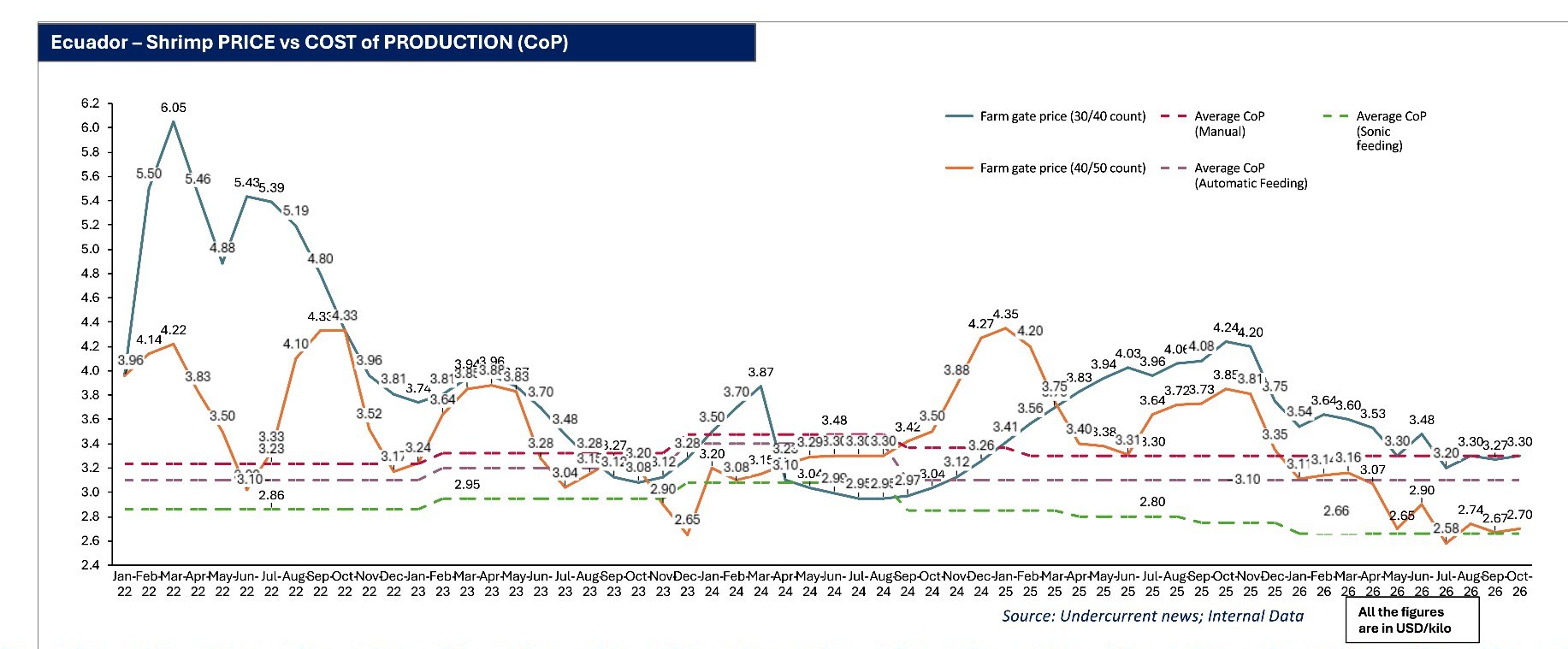
Figure 1. As farm-gate prices approach production costs, small improvements in survival, growth and operational consistency have a larger impact on profitability. Ecuadorian shrimp price and production-cost data illustrate why operational control, consistency, and decision quality are becoming increasingly important sources of competitive advantage. Source: Farm gate prices: Undercurrent News; Cost of production: internal Eruvaka connected technology data.
As visibility expands, decision quality becomes the advantage
Over the past decade, digital aquaculture technologies improved visibility through automation, sensing, and farm-management systems. As adoption expands, a new challenge is emerging: how to translate that visibility into more consistent outcomes. This shift from monitoring operations to managing variability may define the next phase of precision aquaculture.
Figure 2. As automation becomes mainstream, value increasingly shifts from monitoring operations to reducing uncertainty and improving outcomes. Source: Eruvaka Technologies.
| First digital decade | Next digital decade |
|---|---|
| Visibility | Predictability |
| Monitoring | Earlier risk recognition |
| Data collection | Decision support |
| What is happening? | What needs attention? |
| Automation | Coordinated decision making |
Table 2. From the first to the next digital decade of shrimp farming. Source: Eruvaka Technologies.
Three frontiers shaping the next phase of precision aquaculture: biomass, health & risk intelligence, and decision support
Biomass visibility
Biomass influences feeding, harvest timing, inventory planning, and profitability, yet remains one of the least directly observed production variables. Accurate biomass estimation influences feed allocation, growth forecasting, harvest scheduling, and market commitments. Small errors can compound throughout a production cycle, creating inefficiencies across planning and resource utilization. As farms scale, improving confidence in biomass visibility is becoming increasingly important for both operational control and production predictability.
Health and risk intelligence
Earlier recognition of biological stress creates greater opportunity for intervention and more proactive management. In many production systems, performance losses often begin before visible symptoms become apparent, reducing the time available for corrective action. The ability to identify emerging risks earlier, whether related to water quality, feeding behaviour, environmental conditions, or animal performance, can help producers respond before outcomes are materially affected. As production intensifies and operating margins tighten, earlier risk recognition is becoming an increasingly important component of production consistency.
Decision support
Most farms now have more information than ever before. The challenge is no longer collecting data but turning it into timely decisions. Farm performance is influenced by interconnected variables involving feeding, water quality, animal health, growth, and harvest planning. Viewed individually, these signals can create complexity; viewed together, they help producers identify priorities, evaluate risks, and determine where management attention is needed most. The ability to translate information into timely, confident action may become one of the most important determinants of production consistency in the years ahead.
| Frontier | What it influences | Why it matters |
|---|---|---|
| Biomass visibility | Feed allocation, growth forecasting, harvest scheduling, inventory planning and market commitments. | One of the least directly observed production variables; small estimation errors can compound throughout a production cycle. |
| Health and risk intelligence | Response to emerging risks related to water quality, feeding behaviour, environmental conditions, biological stress, or animal performance. | Performance losses often begin before visible symptoms become apparent, reducing the time available for corrective action. |
| Decision support | Management priorities across feeding, water quality, animal health, growth and harvest planning. | The challenge is no longer collecting data but turning information into timely, confident decisions. |
Table 3. The three frontiers shaping the next phase of precision aquaculture. Prepared by Aquaculture Magazine with information from Eruvaka Technologies.
From monitoring to course correction
Predictability is less about following a perfect path and more about responding quickly when conditions change.
A useful analogy comes from GPS navigation.
Every crop begins with a target biomass, harvest date, and profitability outcome.
Like a GPS-guided journey, production rarely follows a perfectly straight path.
Weather, biology, and environmental conditions create constant variation.
The advantage comes from recognising deviations early enough to adjust course before performance is affected.
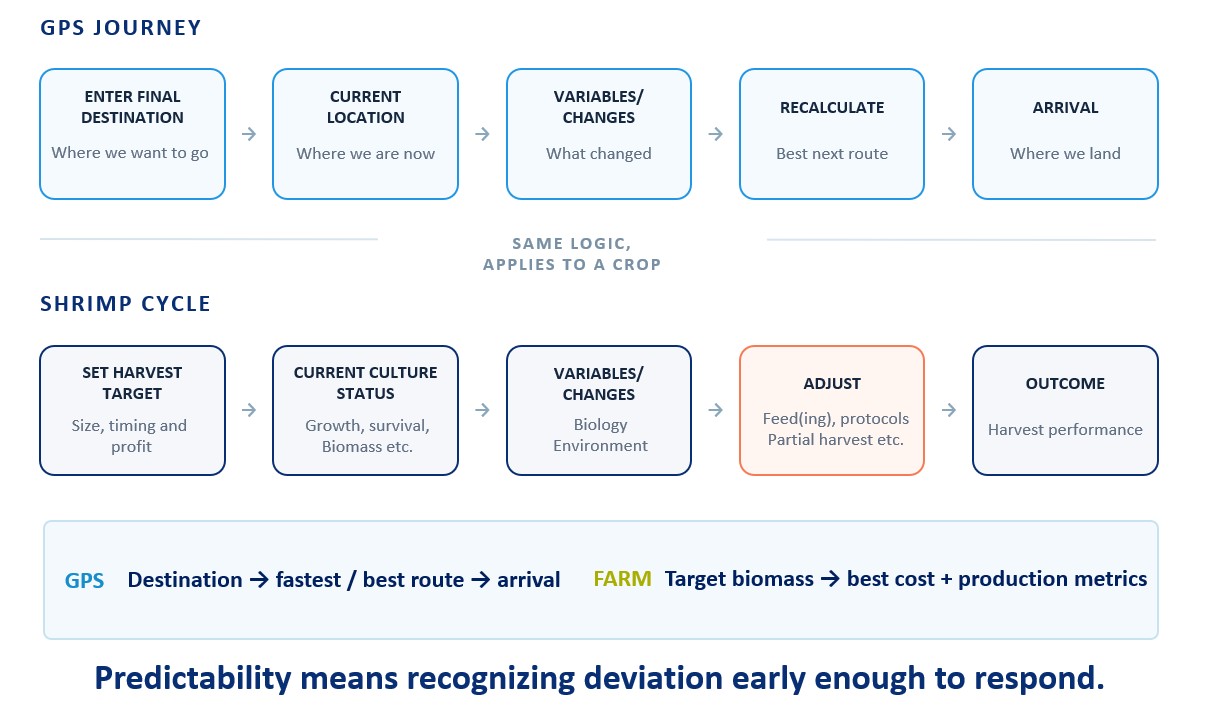
Figure 3. The GPS analogy applied to the shrimp production cycle: predictability means recognising deviations early enough to respond. Source: Eruvaka Technologies.
Eruvaka’s evolution mirrors the industry’s evolution
The same transition taking place across shrimp farming has also shaped Eruvaka’s evolution.
When the company was founded, the focus was on improving feeding efficiency and increasing visibility into pond operations. As adoption expanded across thousands of production cycles, farmers began asking different questions. Beyond monitoring and automation, they wanted greater confidence in biomass estimates, earlier insight into emerging risks, and more consistent outcomes across ponds and crops.
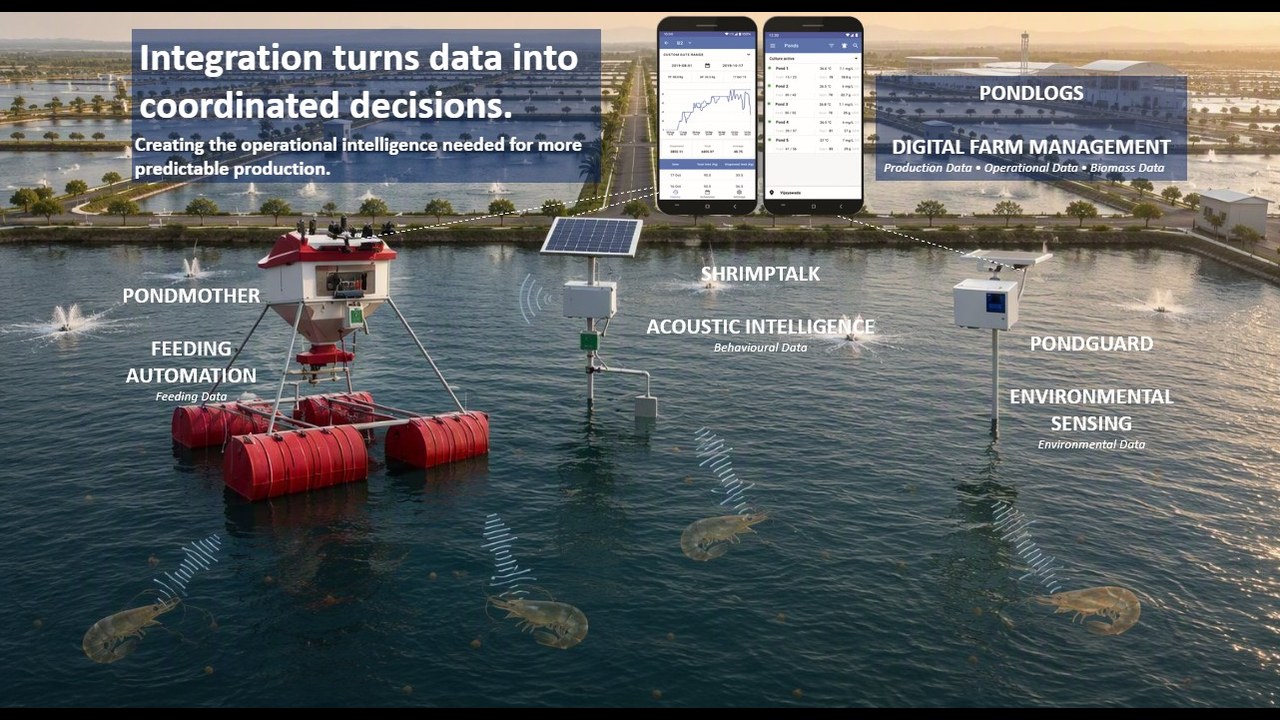
In response, Eruvaka evolved from a feeding technology provider into a connected aquaculture ecosystem spanning feeding intelligence, environmental sensing, data-driven farm management, and advisory support. The ecosystem brings together PondMother for feed automation, ShrimpTalk for acoustic-based feeding intelligence, PondGuard for continuous water-quality monitoring, and PondLogs for centralised farm management. Together, these technologies provide a more connected view of farm performance, helping producers identify deviations earlier and respond more effectively across the production cycle.
| Component | Function | Data layer |
|---|---|---|
| PondMother | Feed automation | Feeding data |
| ShrimpTalk | Acoustic-based feeding intelligence | Behavioural data |
| PondGuard | Continuous water-quality monitoring | Environmental data |
| PondLogs | Centralised farm management | Production, operational, and biomass data |
Table 4. Components of the Eruvaka connected aquaculture ecosystem. Prepared by Aquaculture Magazine with information from Eruvaka Technologies.
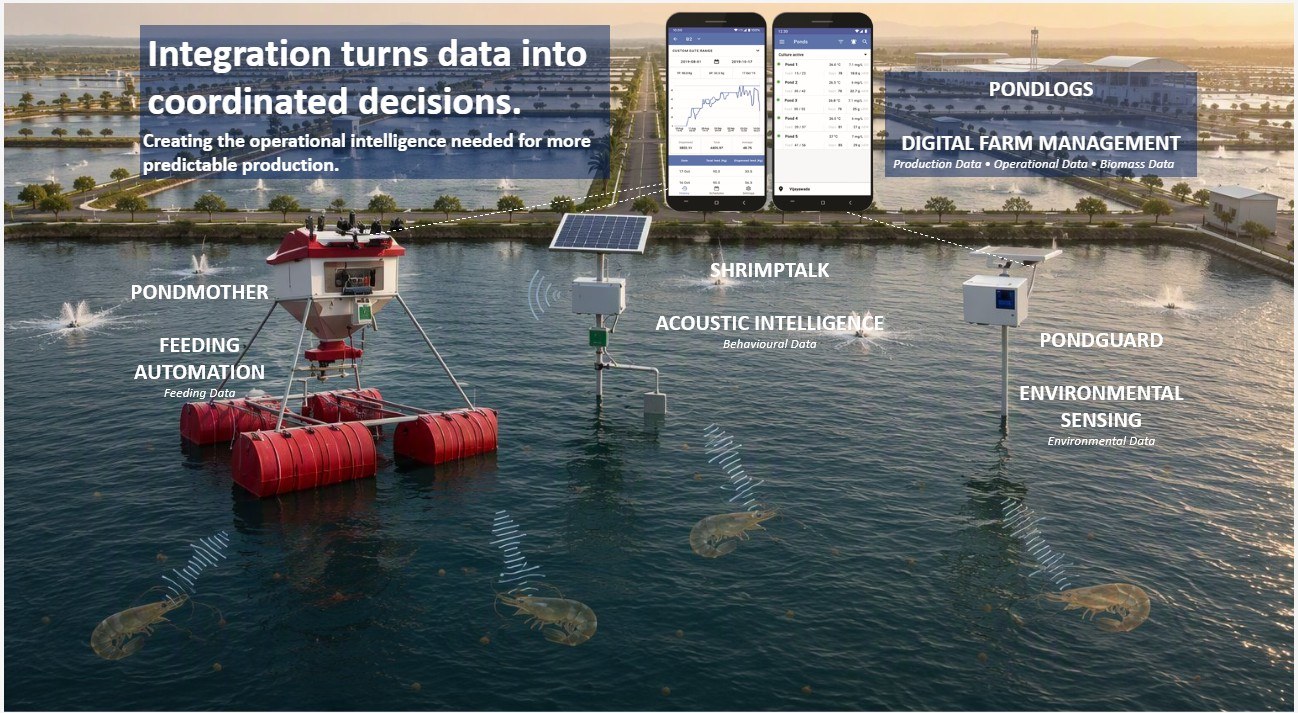
Figure 4. Integration turns data into coordinated decisions: PondMother (feeding automation), ShrimpTalk (acoustic intelligence), PondGuard (environmental sensing), and PondLogs (digital farm management). Source: Eruvaka Technologies.
Evidence from commercial deployments
Eruvaka’s commercial deployments suggest better decisions can translate into measurable performance gains
| Performance indicator | Reported improvement* |
|---|---|
| Weekly growth | 20–25% |
| Survival | 10–15% |
| Feed conversion ratio (FCR) | 12–20% improvement |
| Production cost | 15–26% reduction |
| Biomass production per hectare | 40–100% increase |
Table 5. Evidence from commercial deployments. *Source: Reported commercial deployment outcomes from Eruvaka Technologies implementation data. Results vary by geography, management practices, and production systems.
For Eruvaka, these outcomes reinforce a broader belief: as digital adoption matures, the greatest value may come not from generating more information, but from helping producers act on that information more effectively.
These outcomes reflect the cumulative impact of improved feeding precision, operational visibility, and better decision-making throughout the production cycle, suggesting that earlier risk recognition and better operational decisions may increasingly contribute to economic value creation.
Beyond economic performance, many of the same operational improvements also contribute to more efficient resource utilisation. Better feed management can reduce feed wastage. Improved production efficiency can increase output from the same land and water resources, while more informed management decisions can help optimize inputs across the production cycle. While sustainability outcomes vary by production system and operating conditions, greater operational consistency may create both economic and environmental value.
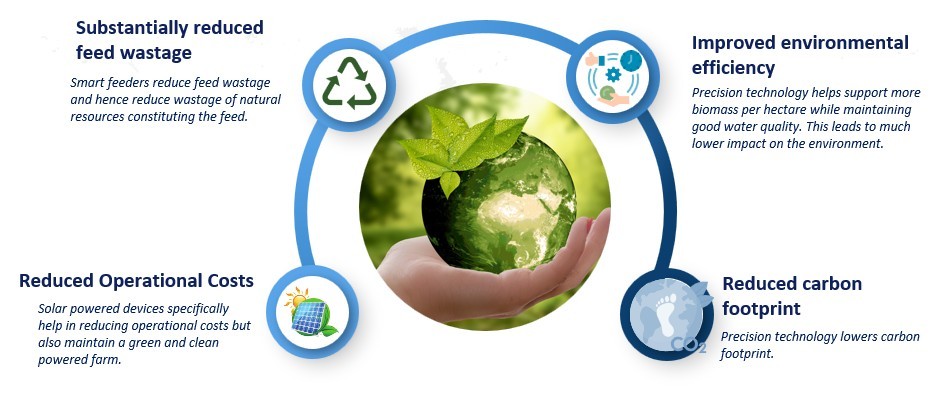
Figure 5. Resource-efficiency and environmental benefits associated with Eruvaka’s precision technology: reduced feed wastage, improved environmental efficiency, reduced operational costs and a reduced carbon footprint. Source: Eruvaka Technologies.
Conclusion
Shrimp farming has always involved managing biological and environmental uncertainty. What is changing is the industry’s ability to observe, interpret, and respond to that uncertainty with greater speed and confidence.
The last decade digitized shrimp farming. The next decade may determine how effectively producers use that information to manage uncertainty, improve consistency, and operate with greater confidence at scale.
Based on observations across the Eruvaka ecosystem, predictability appears increasingly linked to a farm’s ability to recognise, interpret, and act on changing conditions. As technologies continue to improve visibility, the next opportunity may lie in helping producers respond with greater confidence, consistency, and speed.
If productivity defined the industry’s last era of growth, predictability may define the next.
Questions this article answers
1. Why is predictability becoming more important in shrimp farming?
As margins tighten, small differences in growth, survival, and feed efficiency can significantly affect profitability.
2. What factors create the greatest uncertainty in shrimp farming?
Biomass visibility, health and risk intelligence, and decision-making remain important sources of operational uncertainty.
3. What did observations from 20,000 harvests suggest?
Stronger-performing farms often detected deviations from plan earlier and responded more effectively.
4. How does staying close to the plan create value?
Reducing uncertainty allows producers to make better decisions before production outcomes are affected.
5. What technologies will contribute most directly to predictability and production consistency?
Connected farm-management systems, environmental monitoring, feeding intelligence, and tools that help producers identify risks earlier can all contribute to more predictable outcomes.
Limitations
The observations presented in this article draw on operational experience across multiple geographies, production systems, and shrimp-farming environments. Outcomes may vary depending on management practices, environmental conditions, stocking density, and production systems. Performance references should therefore be interpreted as reported operational observations rather than universally expected outcomes.
Source notes
- Ecosystem footprint, deployment scale, and impact metrics are based on publicly reported information from Eruvaka, Nutreco.
- Commercial deployment outcomes: Internal commercial observations
- Ecuador economics chart: Industry market data and internal Eruvaka data
- Predictability framework: Author interpretation based on operational observations
- This article is intended as thought leadership and industry interpretation rather than peer-reviewed scientific research.
About Eruvaka Technologies
Eruvaka Technologies, part of Nutreco, develops connected aquaculture solutions spanning feed automation, acoustic feeding intelligence, environmental monitoring, farm management, and advisory services. Operating across 12 countries, the Eruvaka ecosystem supports more than 60,000 connected feeding systems, approximately 45,000 hectares of aquaculture production, and around 20,000 harvests annually.