



* By Sarah Cornelisse
This article outlines an effective omni-channel marketing strategy by integrating owned, paid, and earned media. Owned media serves as the foundation for building customer trust, while paid media strategically amplifies messages, and earned media provides essential third-party credibility. Successful integration of these types fosters brand loyalty, strengthens engagement, and maximizes overall marketing impact.
Astrong marketing strategy is crucial for reaching customers and establishing and maintaining trust and loyalty. Many marketing channel options exist (TV, radio, social media, newsletters, websites, email, etc.), and as a business owner and marketer, you must determine the most effective mix of channels to reach your target audience and achieve your business and marketing goals.
A key point often emphasized is the necessity for a business to provide and maintain a consistent presence and experience across its chosen channels, a concept known as omni-channel marketing. Consistency builds and strengthens loyalty among customers, which in turn translates to increased engagement and sales (Gardner, 2025).
Effective omni-channel marketing requires considering the different types of marketing media: owned, paid, and earned. Each plays a crucial role in the marketing strategy, and it is important to understand how each can be leveraged.
Media Types
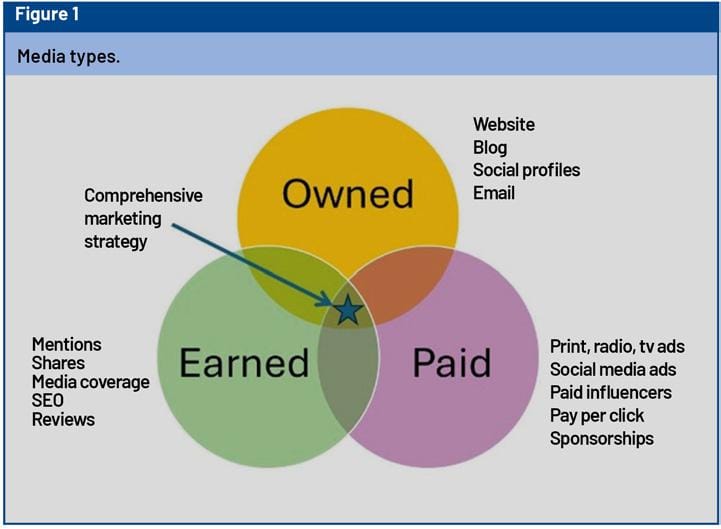
Owned media are the channels and content your business controls. Examples include your business website, social media accounts (e.g., Facebook pages, YouTube channels), and newsletter. Social media accounts are sometimes referred to as partiallyowned media, since while your business does not own the social media platform(s) you use, you do control the content shared from those accounts.
Paid media is content that you promote through advertising. Paid advertisements in newspapers or magazines, boosted Facebook posts, event sponsorships, and ads on social media or search engines are all examples of paid media. Because marketing budgets are often limited, especially for small businesses, consider paid media as a way to strategically amplify your messages.
Earned media is publicity gained through others’ media and is arguably the most valuable form of media, as individuals are known to place greater credibility on “word-of-mouth” recommendations. For example, a feature story published by your local newspaper, mentions and post shares from social media influencers (who are not paid by you), or invitations from community organizations to partner with them.
Each media type has its own advantages and disadvantages. Owned and paid media allow you to craft and manage the content, message, and timing, whereas, by definition, earned media requires that you rely on others to share your messages and promote your brand. Owned media content must be relevant, requiring commitment and investment in creating, updating, and maintaining quality content.
However, owned content is typically evergreen and can aid customers wherever they may be on their customer journey. Additionally, the effort expended to develop owned media can pay off with your ability to reuse content in the future for various purposes and in different formats. It is through owned media that you provide value to your audience, building trusting relationships with current and potential customers.
Paid media can effectively increase awareness, convey value, and encourage engagement and sales. Ideally, you use paid media to direct your audience to owned media. Building strong and trusting relation-ships with customers, the community, industry members, and partners is key to generating strong and positive earned media. Earned media further enhances trust while also developing credibility and a positive reputation for you and your business.
Paid media is content that you promote through advertising. Paid advertisements in newspapers or magazines, boosted Facebook posts, event sponsorships, and ads on social media or search engines are all examples of paid media.
Intentional Integration
To achieve maximum impact from your marketing, consider how these three media types can work together rather than approaching them individually. This demands intention and planning, starting with clearly defined marketing objectives and selecting media channels that your target audience uses or visits, before tackling content development. Consider owned media your foundation. Without robust owned media content, there is little to leverage or amplify with paid or earned media. The following example illustrates how owned, earned, and paid media can work together in a cohesive manner.
Assume that you publish a blog discussing your business’s sustainable production practices. The blog is owned media since the blog lives on a website that you control and manage. Your blog content showcases your experience, expertise, and brand values. Audience members for whom the content resonates may decide to share your post(s) on social media. Their posts are earned media, extending your reach and positioning you as a thought leader. You can also create social media ads for your blog, paying to strategically target new audiences and further amplify your message with the goal of generating new business customers.
Earned media is publicity gained through others’ media and is arguably the most valuable form of media, as individuals are known to place greater credibility on “word-of-mouth” recommendations.
A final key for maximizing the impact of owned, earned, and paid media is to measure your actions and the overall impact. Specific metrics that can be used include social media engagement rates, referrals, and sales conversions. It can be challenging, however, to accurately attribute sales to specific marketing activities. For instance, if a customer receives and opens your email newsletter (owned content) and also clicks your boosted Facebook post (paid media) before making a purchase, which should be credited?
A successful and comprehensive marketing strategy will integrate owned, paid, and earned media together in a complementary manner. By building a robust collection of owned media, you will be wellpositioned to leverage paid media to strategically boost your messages while also generating and supporting earned media. Through all media types, remember to maintain a focus on building connections, trust, and loyalty with your audience by providing short and long-term value.
References and sources consulted by the author on the elaboration of this article are available under previous request to our editorial staff.

* Sarah Cornelisse is a Senior Extension Associate of agricultural entrepreneurship and business management at Penn State University in the Department of Agricultural Economics, Sociology and Education. Sarah has expertise in direct marketing, value-added dairy entrepreneurship and marketing, the use of digital and social media for agricultural farm and food business marketing, and business and marketing planning and decision making. Originally from New York State, she has a B.A in Mathematics from the State University of New York at Geneseo, and M.S. degrees in Agricultural Economics and Animal Science, both from Penn State University.
Correspondence email: sar243@psu.edu




One thought on “Owned, Paid, and Earned Media for Effective Marketing”
Great