

* By Aquaculture Magazine Editorial Team
This study examines how microplastic levels and insect-based fish feed (including insects reared on pre-and post-consumer food waste) shape consumer appeal for farmed seabass in Singapore. Using a discrete choice experiment with 600 participants, results show preferences strongly favored conventional wild-fish feed, lower microplastics, and local origin, while CO2 footprint was not significant. Education and sexinfluenced acceptance.
The global food system is a major contributor to climate change and biodiversity loss, accounting for 21% – 37% of global greenhouse gas emissions. Even as agriculture and food production intensify to meet population growth, hunger remains widespread, highlighting the need for more sustainable food sources that support the UN Sustainable Development Goals, particularly SDG2 (Zero Hunger) and SDG 12 (Responsible Consumption and Production). With fish consumption steadily increasing, aquaculture has expanded across multiple production systems, including terrestrial freshwater, nearshore, and offshore environmental footprint of food production.
The global food system is a major contributor to climate change and biodiversity loss, accounting for 21% – 37% of global greenhouse gas emissions. Even as agriculture and food production intensify to meet population growth, hunger remains widespread, highlighting the need for more sustainable food sources.
Despite its importance, the rapid intensification of aquaculture has caused serious environmental problems, such as high energy use, eutrophication, salinization, excessive antibiotic use and habitat destruction. One of the most significant concerns is aquaculture´s dependence on wildcaught fish for fishmeal and fish oil. In some years, small pelagic fish used for feed can represent more than 33% of global marine catch, reducing prey availability for largest species, disrupting marine food webs, and diverting nutrients from food-insecure countries to luxury seafood markets. Feed production is also that largest source of aquaculture-related emissions; for example, in Scottish salmon farming, feed production and transport account for about 75% of total emissions.
A promising alternative is the use of insects as fish feed, since insects grow quickly and require less land and water than conventional feed crops. However, the sustainability of insect-based feed depends heavily on the rearing substrate. Recent innovations focus on feeding insects with food waste, improving circularity, reducing waste, and limiting competition with other feed industries. Black soldier fly larvae, in particular, can efficiently break down heterogeneous food waste and provide fish with proteins, lipids, and minerals.
Nevertheless, challenges remain, including regulatory limits on allowable waste inputs, species-specific conversion constraints, and contamination risks. The nutritional quality of farmed fish is also influenced by feed type, affecting consumer health. Additionally, microplastics are an emerging contaminant in fish and feeds, with high public concern but lacking standardized seafood regulations.
This study addresses these gaps by estimating consumers’ willingness to pay for key attributes of insect-fed fish through a discrete choice experiment with 600 participants in Singapore. Examining preferences by feed source. Microplastic content, CO2 emissions, origin, and socio economic factors such as education and sex.
Consumer acceptance research is limited, and factors shaping preferences are not fully understood. This study addresses these gaps by estimating consumers’ willingness to pay for key attributes of insect-fed fish through a discrete choice experiment with 600 participants in Singapore. Examining preferences by feed source. Microplastic content, CO2 emissions, origin, and socio-economic factors such as education and sex.
Method
This study was conducted in Singapore, a densely populated city-state that imports 90% of its food. Local food production focuses on high-tech, land-limited farming systems, and recent initiatives allow residents to donate household food waste to rear black soldier fly larvae, whose larvae and frass can be used in vegetable and fish farming.
The study selected seabass as the focal product because it is commonly sold in Singapore (either imported wild-caught or locally farmed) and can be reared using insect meal. Because fish fed with insect meal produced from food-waste-fed insects is not yet commercially avail able, researchers used a discrete choice experiment (CE).
The CE included five attributes:
(1) Feed ingredient (wild fishmeal; insects fed with plants; insects fed with pre-consumer food waste; insects fed with post-consumer food waste),
(2) Microplastic counts in feed (30, 70, 110, 150),
(3) CO2 emissions from feed production (0.5, 2.5, 4.5, 6.5 kg),
(4) Origin (local vs. imported), and
(5) Price (USD 3.89, USD 11.68, USD 19.46, USD 27.25).
Participants complete eight choice sets, choosing between two hypothetical seabass packages plus a no-buy option. The design was generated using Ngene, producing 24 choice tasks divided into three blocks.
Data were collected through an online survey (Rakuten Insight) in January 2024, targeting Singapore citizens/permanent residents aged 21-55. Quotas ensured national representativeness, yielding 600 valid responses. Analysis used mixed logit models (after rejecting IIA), estimating willingness-to-pay and testing interactions for education, sex, and income.
Results
The mixed logit model examining Singapore consumers’ preferences for seabass fish package showed that four out of five attributes were significantly influential (p < 0.01), namely, feed ingredient, amount of microplastics in feed, origin and price (Figure 1). Carbon footprint of feed production was not significant. The positive Alternative-Specific Constant (ASC) suggests that participants tend to make a purchase selection, indicating utility in buying a seabass fish package.
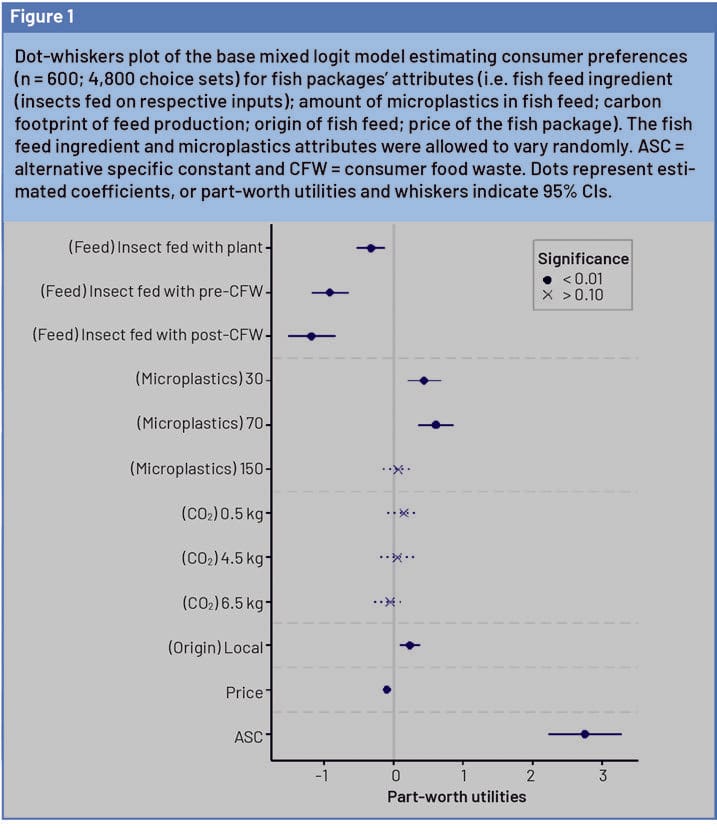
The negative coefficient estimates for feed ingredients indicate that participants preferred the seabass to be fed using the conventional feed ingredient, wild-caught fish. Among the insect feeds, participants least preferred seabass to be fed with insects that were reared on post-consumer food waste, followed by pre-consumer food waste, and finally, plants (Figure 1).
Lesser microplastics in fish feed, compared with the reference level of 110, were preferred while having more microplastics did not influence selections (Figure 1). Participants also preferred the fish feed to be locally produced and were less likely to select packages with higher prices (Figure 1).
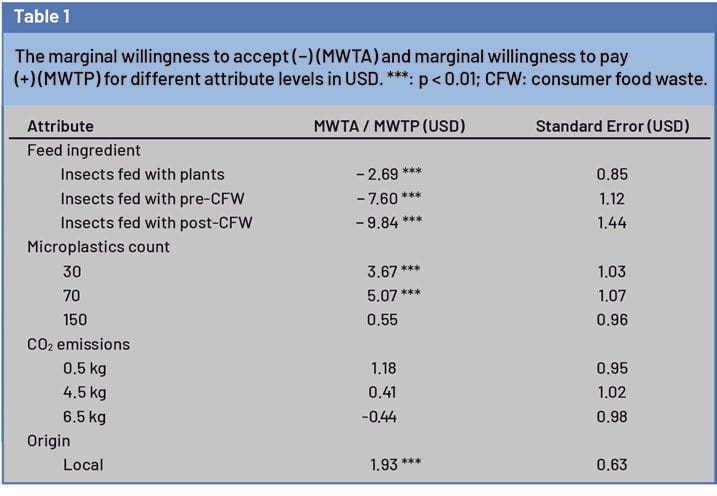
The marginal willingness to pay (MWTP) was highest for lowering microplastics counts to 70 microplastics, at USD 5.07 ± 1.07 (Table 1). In contrast, the marginal willingness to accept (MWTA) was the greatest, indicated by the largest negative MWTP, when the feed ingredient is labelled ‘Insects fed with post-consumer food waste at −USD 9.84 ± 1.44 (Table 1). Relatedly, when the ASC was interacted with household income, the coefficient estimate was positive and significant (p < 0.05) indicating that those in higher income brackets are more likely to choose either Package A or B.
When the attributes were interacted with whether individuals hold at least a university degree, only the interactions with feed ingredient attribute levels and price were statistically significant. In particular, university degree holders chose insect-based fish feeds more often compared with nondegree holders. Notably, the degree holders were readier to purchase seabass that were reared with insects fed with food waste, especially pre-consumer food waste. The degree holders appear to be more price sensitive than their non-holder counterparts.
In the model with sex and attribute interactions, only price was not affected by sex. Results indicate that more males than females preferred the seabass to be farmed using insects raised with post-consumer food waste. Compared with females, males also had greater preferences for lower microplastics counts in fish feed, a lower carbon footprint and would rather use imported fish feed.
Discussion
The authors find that insect-based fish is generally less appealing to participants, likely due to low awareness and limited understanding of the production supply chain. Previous research shows that familiarity and knowledge strongly influence consumer acceptance of novel foods, such as microalgae, cultured meat, insect-based products, and foods produced though non-conventional methods like genetic modification. When consumers lack information about production processes, ingredient safety, and environmental benefits, they tend to perceive higher risks, which leads to hesitation and reluctance to purchase. This uncertainty increases the required compensation (MWTA) for accepting insect-fed fish, meaning product quality would need to be worth at least USD 2.69 more, and up to USD 9.84 more when post-consumer food waste is involved.
The study also finds stronger preference for insects fed with pre-consumer food waste compared to post-consumer waste. This is likely because pre-consumer waste (such as trimming and unused ingredients) is perceived as closer to conventional plant-based feed. Definitions matter: pre-consumer waste can be framed as the loss of a valuable resources, improving acceptance, while post-consumer waste suggests leftovers and “unclean” waste, triggering disgust and hygiene concerns. Participants may also worry about contaminants and prefer controlled feed sources, reflecting a hierarchy of trust where plant-fed insects are considered safer. Unclear regulations and limited food safety data for waste upcycling may further increase skepticism.
Regarding other attributes, participants cared more about reduced microplastics and local production than carbon footprint. Media attention has increased concerns about microplastics and their potential health risks, making this an egoistic personal-benefit factor more important than environmental impact.
Interestingly, higher microplastics levels did not strongly reduce acceptance, possibly due to limited knowledge of harmful thresholds or the belief that microplastics are unavoidable. Local origin was also valued, consistent with studies in Spain, the UK, and Germany, likely linked to trust, support for local producers, and perceived quality. Education influenced acceptance: degree holders were more favorable toward insect-based feed, including waste-fed insects, likely due to better understanding of circular economy benefits. Gender differences also appeared: males were accepting of post-consumer waste-fed insects, aligning with findings that females tend to be more hygiene-sensitive, more riskaverse, and less accepting of innovative technologies without additional information.
Conclusion
This study, to our knowledge, is the first to examine consumer preferences for packaged fish reared with different feed types, including conventional wild fish, insects and insects fed on preor postconsumer food waste. We also investigated which feed attributes (e.g. microplastic counts, CO2 emissions, origin and feed source) influenced consumer choices and whether education level and sex played a role in shaping these preferences. While using food waste to produce insect-based feed represents a promising step towards closing the waste loop, consumers’ purchase intention presents a significant barrier.
Our study suggests that consumers are not necessarily ready to embrace insect-fed fish and especially insects that were raised on food waste. Given that participants with higher education levels were more receptive to insect-based feeds, public awareness campaigns and educational initiatives could help bridge the knowledge gap and foster greater acceptance of sustainable aquaculture practices. Providing clear, science-backed information on food safety, sustainability benefits and regulatory oversight will be crucial in shaping public perceptions and encouraging more widespread adoption of innovative fish feed sources.
We have further identified sex-associated differences in fish feed preferences, where male participants may harbor fewer reservations about farming fish with insects fed on post-consumer food waste, possibly making them earlier adopters. Finally, we highlight the utility of reducing microplastic counts and promoting locally produced feed to improve the outlook of innovative fish feed sources.
This is a summarized version developed by the editorial team of Aquaculture Magazine based on the review article titled “MICROPLASTICCONTENT AND USING FOOD WASTE-FED INSECTS IN FISH FEED INFLUENCE APPEAL OF FARMED FISH” developed by: TAN, C.Y.Y. and YAN, Y. ─ National University of Singapore and Campus for Research Excellence and Technological Enterprise; PUNIA- MOORTHY, N. ─ National University of Singapore, CARRASCO, L.R. ─ National University of Singapore and Research Excellence and Technological Enterprise and JAUNG, W. ─ Chungnam National University. The original article, including tables and figures, was published on NOVEMBER, 2025, through ROYAL SOCIETY OPEN SCIENCE. The full version can be accessed online through this link: https://doi.org/10.1098/rsos.251567