

By Aquaculture Magazine Editorial Team
With modern industrialization and urbanization, global warming has become a serious threat to ecosystems, especially affecting ectothermic animals (those who body temperature depends on the environment), such as fish and shrimp. Unlike mammals, ectotherms are highly sensitive to temperature changes, which influence their distribution, behavior, physiology, metabolism, and immune function. Among the most affected systems is the intestinal microbiota (IM), a key ecological and health related component of the host. IM is a sensitive indicator of temperature changes and plays a vital role in host metabolism and immunity.
To better understand IM variation, microbial communities are often classified into distinct types known as “enterotypes”, which group microbial compositions into 2 – 4 categories dominated by different keystone genera. Enterotypes offer a simplified landscape of microbial diversity and are linked to host health. In humans, for instance, the Bacteroides/ Prevotella ratio serves as a marker of inflammation and diet. However, most enterotype research focuses on mammals, while ectothermic species like shrimp have more dynamic and less diverse IM due to environmental variability.
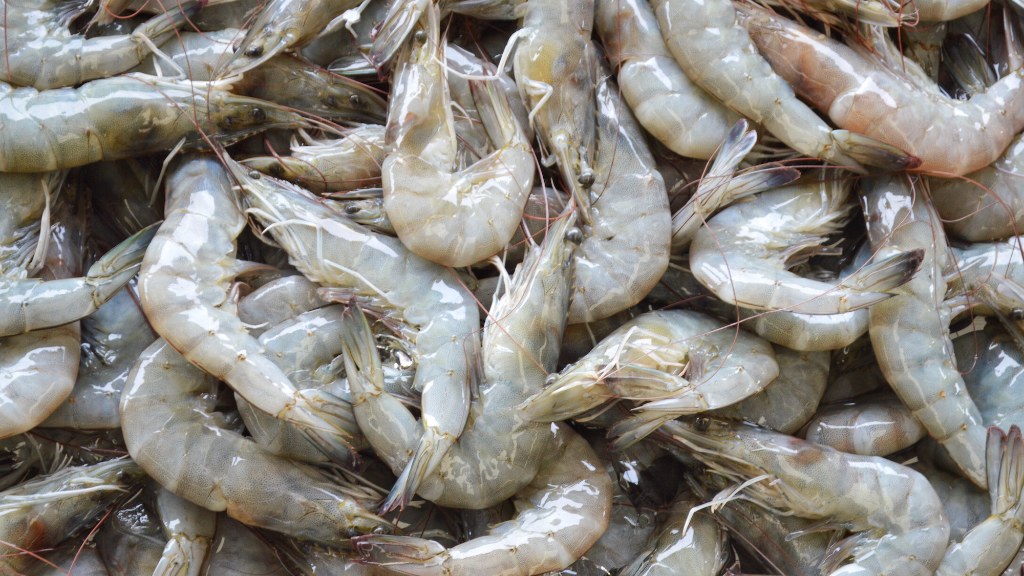
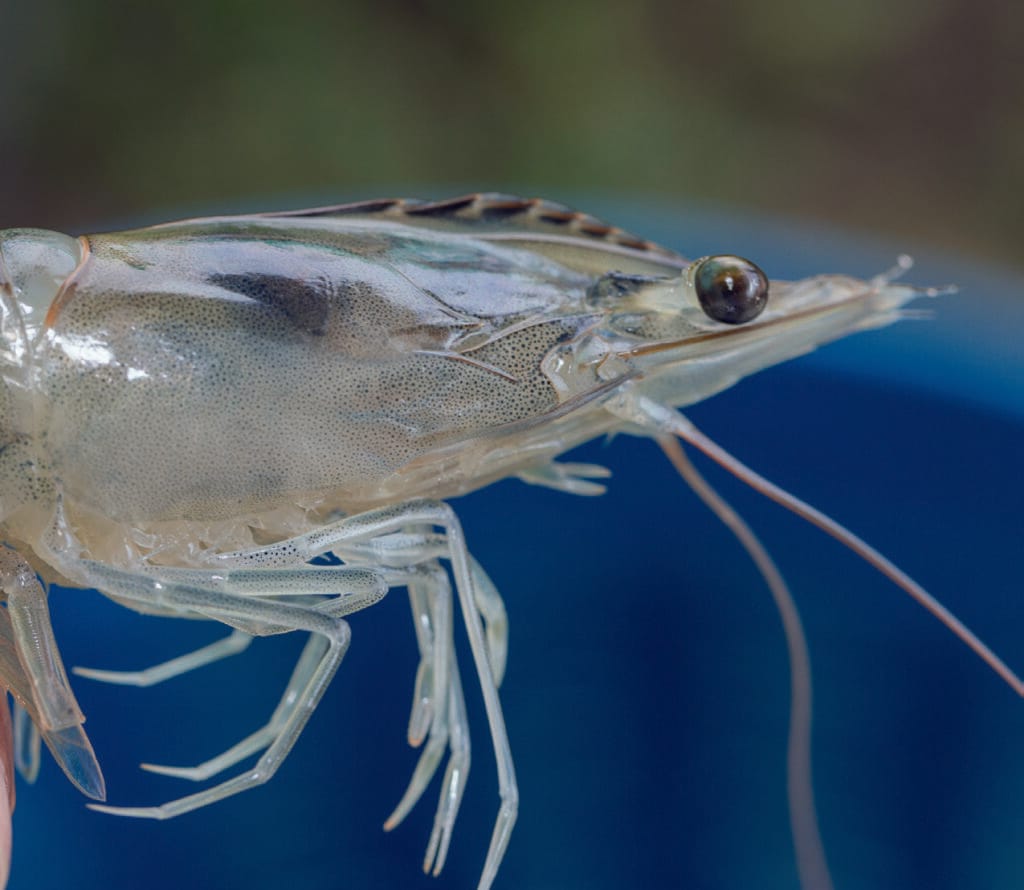
Pacific white shrimp (Litopenaeus vannamei) is a major aquaculture species, producing over 5.6 million tons worldwide in 2022. However, it faces major disease threats like acute hepatopancreatic necrosis disease (AHPND), hepatopancreas necrosis syndrome (HPNS), and white feces syndrome (WFS), all linked to IM dysbiosis. Notably, WFS outbreaks increase significantly at high temperature (33 – 34°C) and have expanded to higher latitudes due to climate change.
This study tested two hypotheses:
(1) shrimp IM can be stratified into health-related enterotypes; and (2) ambient warming influences microbial structure and disease susceptibility. Analyzing 1,369 IM samples from nine countries, researches identified three enterotypes closely linked to health. Temperature emerged as the main driver of IM variation, confirmed through multi-omics and antimicrobial peptide gene knockdown experiments, highlighting warming- driven disease risks in aquaculture.
Methods and Results
To investigate the IM of Pacific white shrimp (L. vannamei) and its response to warming, the study analyzed 1,369 IM samples from 15 cohorts across nine major shrimp-producing countries, covering ~79.8% of global production.
Water parameters ─ temperature, salinity, pH, and dissolve oxygen ─ were recorded for 1.150 of these samples. After performing 16S rRNA gene amplicon sequencing and quality control, a total of 61 million clean reads were obtained, resulting in 13,204 amplicon sequence variants (ASVs). Rarefaction curves confirmed that microbial diversity was well captured. The dominant phyla were Proteobacteria, Tenericutes, and Bacteroides, with top genera including Vibrio (30.8%), Candidatus Bacilloplasma (16.5%), Shewanella (8.6%), and Photobacterium (7.0%).
Alpha diversity (Chao 1 and Shannon indices) varied by country, peaking in Thailand and lowest in China. Diversity was highest in low-latitude regions. Nineteen core ASVs were found (present in > 80% of samples, > 0.01% abundance), mainly Proteobacteria, with some linked to WFS and AHPND.
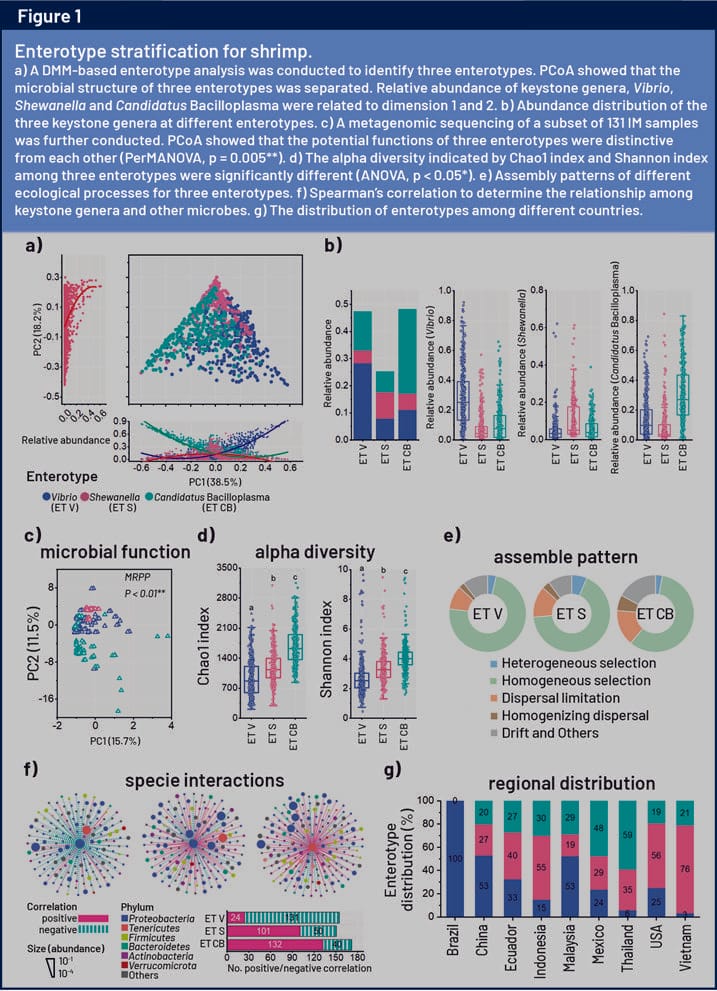
Using Dirichelet multinomial mixtures (DMM), shrimp IM was stratified into three enterotypes (Figure 1):
» ET V: Vibrio-dominated (n = 496).
» ET S: Shewanella-dominated (n = 455).
» ET CB: Candidatus Bacilloplasmadominated (n = 418) (Figure 1a-b).
These enterotypes were functionally distinct, based on metagenomic analysis of 131 samples (MRPP, p = 0.001, Figure 1c):
» ET V was enriched in lipid and carbohydrate metabolism.
» ET S in mineral absorption and hydrocarbon degradation.
» ET CB in fatty acid and galactose metabolism.
Alpha diversity significantly differed among enterotypes (Chao1 p = 0.005, Shannon p = 0.001; Figure 1d). Vibriocorrelated negatively with diversity, while Shewanella and Candidatus Bacilloplasma were positively associated. Network analysis showed ET CB had lower microbial connectivity and complexity (Figure 1e-f), and country- wise distribution revealed regional biases (Figure 1g).
To link enterotypes with shrimp health, 165 diseased (98 WFS, 67 HPNS) and 167 healthy shrimp were examined. Diseased shrimp showed distinct enterotype distribution:
» WFS: 64% I ET CB.
» HPNS: 60% in ET V.
» Healthy: Evenly distributed.
A random forest model generated Probability of Disease (POD) scores, showing WFS risk highest in ET CB and HPNS in ET V. Network analysis revealed ET CB´s community was less interactive, and POD was significantly linked to the Vibrio/Candidatus Bacilloplasma radio and Shewanella abundance.
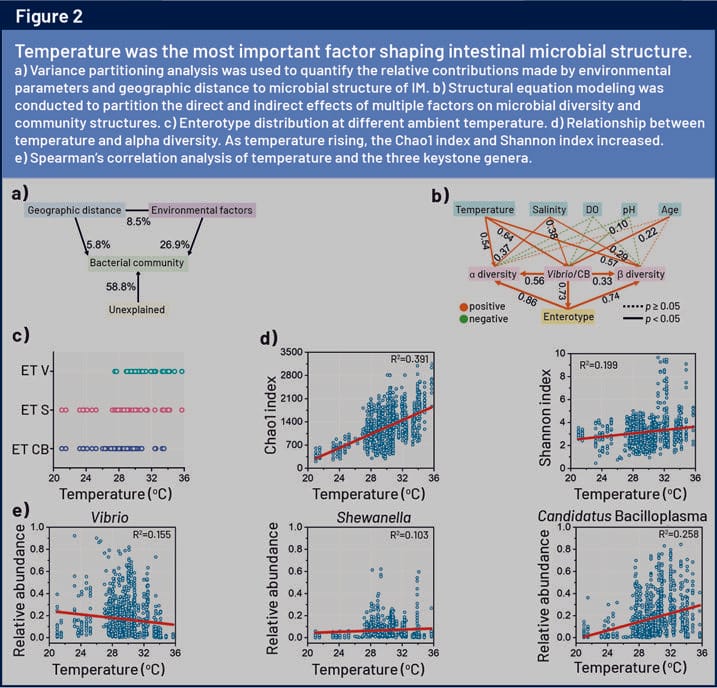
To evaluate the relationship between IM and environmental factors, a variance partitioning analysis (VPA) was performed to quantify the relative contributions made by environmental parameters and geographic distance to the microbial structure of IM. Temperature was the dominant environmental factor shaping IM (VPA: 26.9% EXPLAINED; Mantel r2 = 0.486 (Figure 2a). Temperature strongly influenced microbial structure and enterotype distribution (Figure 2c-d), with Vibrio decreasing and Shewanella and Candidatus Bacilloplasma increasing as temperature rose (Figure 2e).
In controlled warming experiments (20 – 36°C), higher temperatures reduced survival (AT 36°C) and shifted IM toward Enterotype Candidatus Bacilloplasma (ET CB). Alpha diversity rose with temperature, while microbial networks became less connected. Transcriptome analysis showed 2,276 differentially expressed genes (DEGs) across temperature groups, including antimicrobial peptides (PENs, ALFs) linked to microbial shifts. RNAi knockdowns confirmed Pen4 and Alf4 modulated Vibrio, and Pen3 and Alf2 affected Candidatus Bacilloplasma.
Discussion
This study investigates how global warming affects IM and disease vulnerability in Pacific white shrimp. As ectothermic animals, shrimp are particularly sensitive to temperature changes, which can alter microbial communities in their intestines, increasing the likelihood of disease outbreaks such as WFS and early mortality syndrome (EMS).
A key finding is that rising temperatures influence the composition of the shrimp gut microbiota by reshaping its enterotypes ─ three distinct microbial community types identified in this study. Each enterotype showed different patterns in species interaction, diversity, and disease association. Enterotype V (ETV), dominated by Vibrio, a known opportunistic pathogen, was closely linked to intestinal dysbiosis and shrimp disease. Vibrio´s high abundance negatively correlated with microbial diversity, suggesting it suppresses other microbes, lowering the ecosystem´s resilience.
In contrast, Enterotype CB (ETCB), dominated by Candidatus Bacilloplasma, showed more positive microbial interactions, though these links may reduce network stability under environmental stress. ETCB also presented lower species interaction complexity, aligning with previously established indicators of dysbiosis in WFS-affected shrimp. The ratio of Vibrio to Candidatus Bacilloplasma emerged as a key ecological indicator strongly associated with enterotype composition, microbial diversity, and disease presence.
Environmental factors, particularly temperature and salinity, were significant drivers of microbial shifts. Warmer regions like Thailand and China showed greater diversity in enterotype distribution, while Brazil, with fewer samples and narrower temperature and salinity ranges, only exhibited one enterotype (ETV). Salinity was identified as the second most influential factor shaping microbiota after temperature.
Warming increased alpha diversity but decreased the structural complexity of microbial interactions, suggesting that diversity alone is not a reliable indicator of microbial health. Importantly, higher temperatures were associated with increased expression of immune-related genes (e.g., TLR, IMD, Casp3), influencing the microbial community and host resistance to pathogens like Vibrio. As shrimp gut microbiota are more dynamic and less host-controlled than those of terrestrial animals, they are more susceptible to environmental influences.
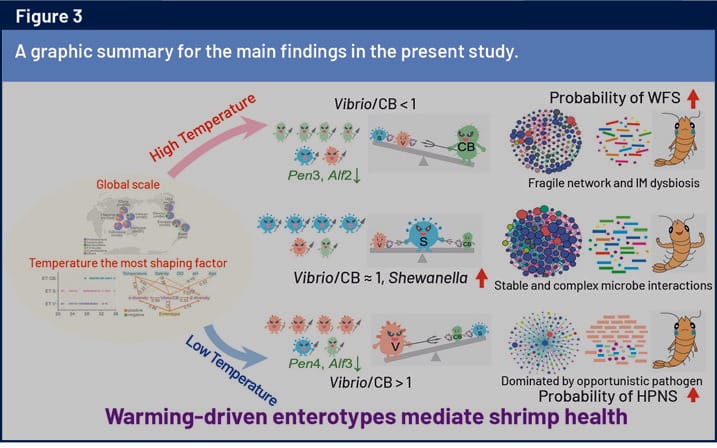
The study proposes a conceptual model linking global warming (Figure 3), IM restructuring, and shrimp health outcomes. It underscores that temperature rise not only shifts enterotype prevalence but also reduces the microbiota´s resilience, potentially facilitating disease outbreaks. Given the observed spread of WFS to higher latitudes in recent years, the study calls for immediate preventive strategies in aquaculture to mitigate risks posed by climate change. Overall, shrimp enterotypes may serve as valuable ecological indicators of warming impacts in ectothermic animals.
This is a summarized version developed by the editorial team of Aquaculture Magazine based on the review article titled “WARMING-DRIVEN MIGRATION OF ENTEROTYPES MEDIATES HOST HEALTHANDDISEASE STATUSES IN ECTOTHERM LITOPENAEUS VANNAMEI” developed by: ZENG, S. and HUANG, Z. – Sun Yat-sen University and China-ASEAN Belt and Road Joint Laboratory on Mariculture Technology; KRIENGKRAI, S. – Kaset- sart University; ZHOU, R. – Sun Yat-sen University and YUAN, D. – Network of Aquaculture Centers in Asia-Pacific. La versión original fue publicada en JANUARY, 2025 through COMMUNICATIONS BIOLOGY. The full version can be accessed online through this link: https://doi.org/10.1038/s42003-025-07558-2