

The initiative will support research, development and the application of new knowledge to aquaculture production systems
INVE Aquaculture and Tianjin University of Science and Technology (TUST) have announced the establishment of a joint laboratory for innovative artemia applications, marking an important step in their long-standing collaboration in aquaculture research and innovation. The signing and inauguration ceremony took recently place at the university’s Binhai campus in Tianjin, China.
The event brought together representatives from both organizations, including Patrick Waty, CEO of INVE Aquaculture, and Wang Min, Vice President of Tianjin University of Science and Technology. The ceremony was also attended by Patrick Sorgeloos, a pioneer in Artemia research, together with representatives from the Asian Regional Artemia Reference Center (ARARC).
The joint laboratory aims to strengthen collaboration between academia and industry by combining TUST’s expertise in aquatic science and brine biotechnology with INVE Aquaculture’s long-standing experience in Artemia biology, live food technologies and early-stage nutrition for hatcheries. The initiative will support research, technology development and the application of new knowledge to aquaculture production systems, with particular focus on Artemia and early-stage nutrition, key factors in hatchery performance.
Long Story of Cooperation
Over the years, Tianjin University of Science and Technology and INVE Aquaculture have maintained close cooperation in areas such as product development, technical expertise and talent development. The new laboratory will further expand this collaboration, creating a platform for applied research, innovation and knowledge exchange.
The initiative also reflects INVE Aquaculture’s broader R&D approach, which promotes science-based innovation through strategic partnerships with leading research institutions worldwide. In China, this collaboration contributes to a local-for-local R&D strategy, supporting solutions tailored to the needs of the local aquaculture industry while strengthening international scientific cooperation.
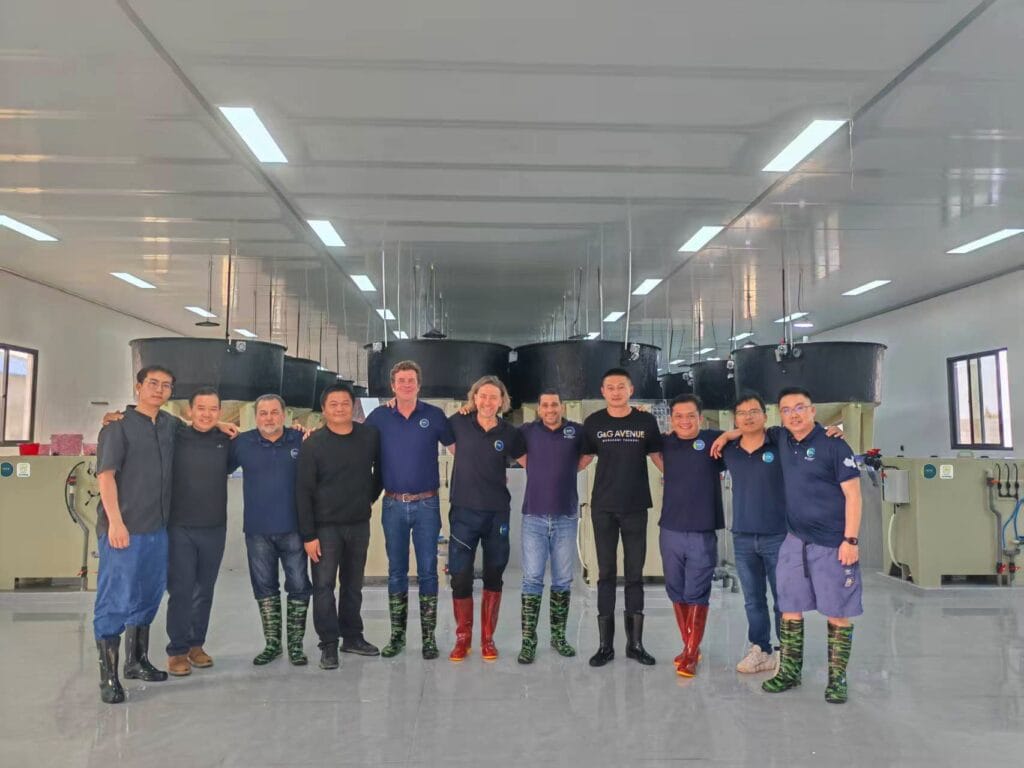
Largest Nauplii Center at Long Cheng Hatchery
For INVE Aquaculture, Artemia production plays a critical role in the performance and consistency of early shrimp larval stages. In hatcheries, live food remains one of the main sources of biological, operational and economic variability during larval and early post-larval phases.
According to Amir Khalil, Regional Sales Director at INVE Aquaculture, “China’s shrimp hatchery sector has evolved rapidly in recent years, with leading producers investing in larger and more structured production systems. As hatcheries scale up, improving the consistency and efficiency of live food production becomes increasingly important for the improvement of stability in larval performance and maximize cost efficiency.”
To address this challenge, the INVE Aquaculture team, led by Francesco Lenzi, Global Technical Expert for Live Food, and supported by Product Manager Geert Rombaut, has developed a comprehensive program to support hatcheries in establishing, modernizing or optimizing their Artemia production systems. Built on proven standards and validated operational protocols, the program is designed to improve hatching efficiency, reinforce biosecurity and standardize the artemia production workflow. The objective is to help hatcheries produce high-quality nauplii in a more consistent and efficient way while reducing live-food-related costs.
Following successful implementations in several regions, this concept has now been deployed at a significantly larger scale in China with the development of the country’s largest Artemia nauplii center at Long Cheng, powered by INVE technology and technical support.
The facility at Long Cheng represents a major step forward in scaling artemia production within commercial shrimp hatcheries. It includes two dedicated artemia production modules. Each module consists of 40 hatching tanks of 3 MT capacity, operating at approximately 2.5 MT working volume, arranged in four rows of ten tanks to ensure efficient workflows and standardized operations.
Automation and precision are central to the system. Each tank line is connected to an INVE SEP-Art Automag tool, which automates key Artemia processing steps, reducing manual handling and improving overall operational consistency. Under these conditions, each module can process approximately 240 kg of artemia cysts per day.
A dedicated quality control room equipped with SnappArt 360 L-SENSE, INVE’s advanced AI-powered solution for automated live food counting, processing and data management, enables technicians to monitor Artemia hatching performance on a daily basis.
“Scaling artemia production is not only about increasing tank capacity,” explains Francesco Lenzi, Global Technical Expert on Live Food at INVE Aquaculture. “The key is to standardize every step of the process. The successful implementation of this project was made possible through the close collaboration between INVE’s global, regional and local technical teams and the hatchery staff, who worked together throughout the design, installation and operational start-up of the facility.”
This INVE artemia production approach goes beyond product supply. It combines optimized infrastructure, biotechnology solutions, validated operational protocols and technical knowledge transfer into a single operational framework designed to strengthen hatchery capabilities. Implementation is supported by INVE technical teams, who transfer protocols, methodologies and operational know-how directly to hatchery staff, ensuring the facility can independently manage and control every stage of artemia production.
“What we see at Long Cheng is part of a broader shift in the shrimp hatchery industry,” says Fernando Garcia, Commercial Director at INVE Aquaculture. “Across major shrimp-producing regions such as China, India, Indonesia and Ecuador, hatcheries are increasingly looking for ways to transform artemia production from a variable live-food operation into a more standardized and controlled process capable of delivering large volumes of high-quality nauplii.”