Editorial Staff | Aquaculture Magazine, with information from Hatch Blue and Hadl
Source: Hatch Blue and Hadl announcement. Loss estimates, deployment figures and performance data are reported by the companies.
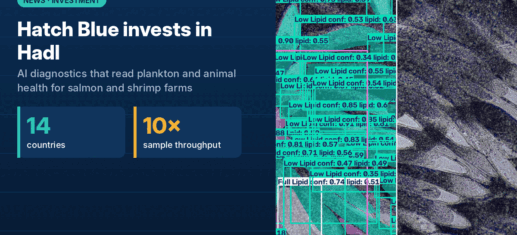
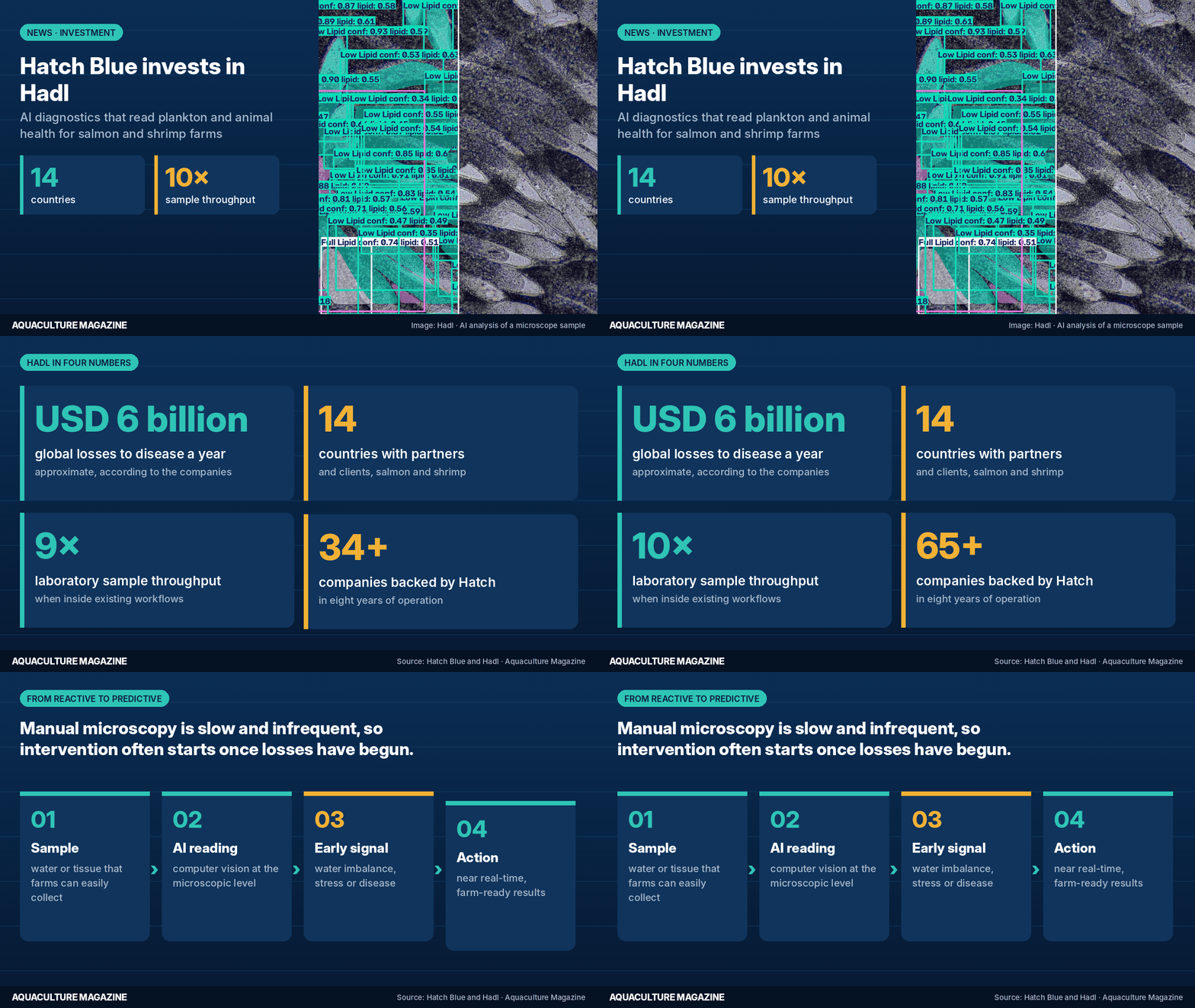
Hadl’s computer-vision models read plankton and animal health in salmon and shrimp samples, with partnerships and clients in 14 countries and, according to the company, a tenfold increase in laboratory sample throughput.
Global aquaculture investment firm Hatch Blue announced an investment in Hadl, a deep tech company building AI-powered diagnostics for aquaculture and beyond, from its Hatch Accelerator Fund II. Hadl’s technology reads animal health and plankton, using computer vision models to analyze complex biological data at the microscopic level, and returns farm-ready results in near real time.
Hadl has developed models spanning salmon and shrimp, with partnerships and clients in 14 countries. The technology is deployed directly on farming sites, offered as a technical service for input suppliers, or integrated into the existing workflows of laboratories, where, according to the company, it improves sample throughput tenfold.
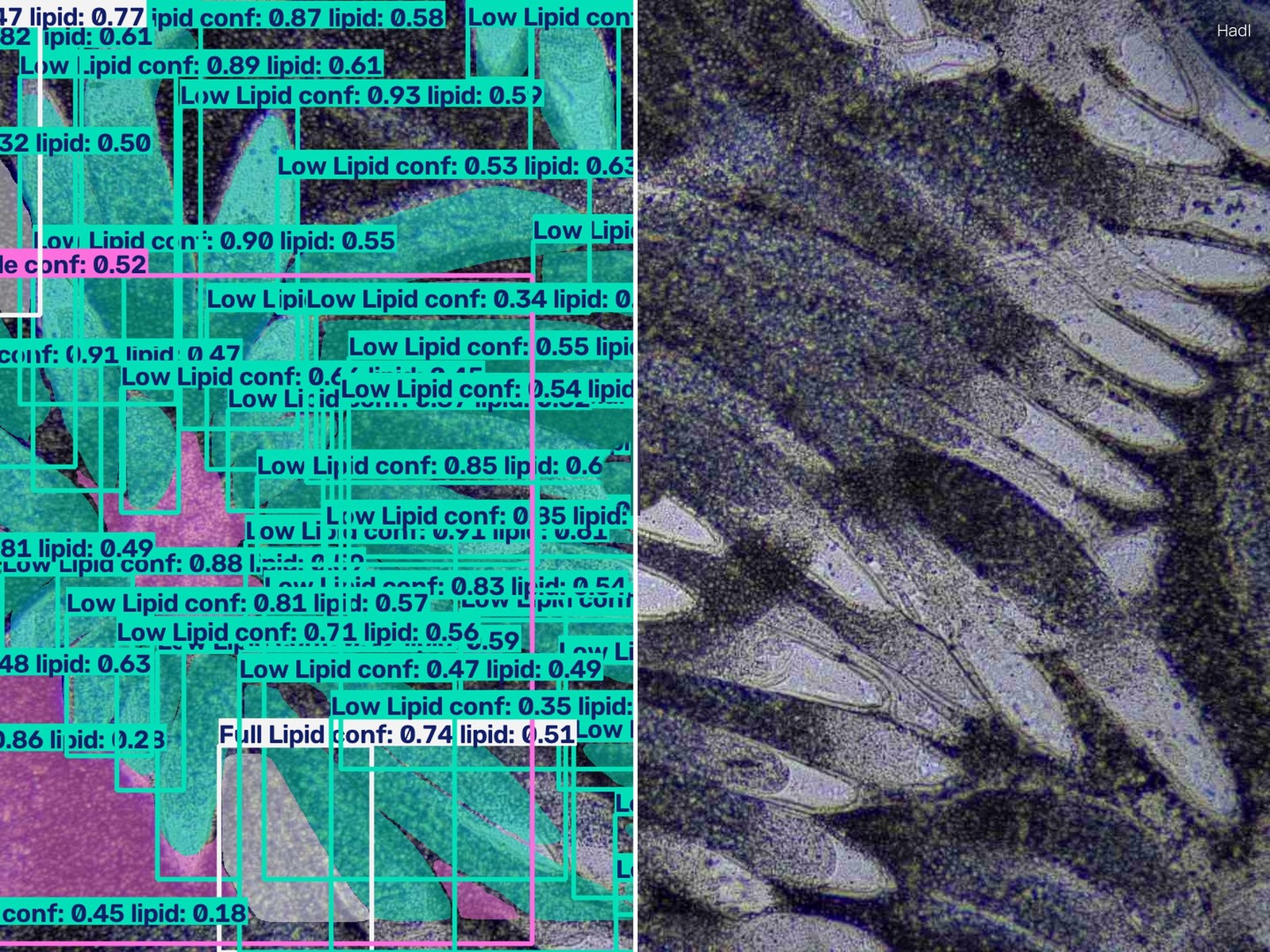
Figure 1. Computer-vision analysis of a microscope sample (left) next to the original image (right). Source: Hadl.
Manual microscopy confirms changes too late
According to the companies, the global aquaculture industry loses some USD 6 billion to disease and millions of salmon to plankton every year. Salmon and shrimp laboratories read water samples and animal tissue under a microscope to detect toxic plankton imbalances and signs of animal stress or disease. The process is manual, error-prone and infrequent, so changes are confirmed late and intervention often starts once losses have begun.
Hadl aims to turn this process from reactive to predictive. Its models run on samples that farms can easily collect, replacing manual assessment with fast, consistent and auditable AI analysis, so that early signals of water imbalance, stress or disease can be detected before they turn into significant losses. The technology is deployed on site for farmers or in the workflow of industry and government laboratories.
Hadl’s models run on samples that farms can easily collect and aim to detect early signals of water imbalance, stress or disease before they turn into significant losses.
“Farming is a relentless dance with our environment, we often never know what caused a problem, and when we do, it’s nearly always too late to act. Our models and partnerships are uncovering the hidden patterns in our food systems and giving farmers, researchers and laboratories a trusted data set to work with,” said Alexander Farthing, CEO of Hadl.
Distribution through feed and additive companies
Hadl was founded by Alexander Farthing, a farmer and repeat technology founder whose previous company was also backed by Hatch Blue through to an exit and acquisition. The wider team combines PhD researchers, farm operators and engineers with a decade of experience deploying technology in laboratories and farms. With capabilities in the United States, Latin America, Europe and Indonesia, Hadl builds models and solutions that large feed and additive companies distribute through their own infrastructure and channels, through partnerships and trials that are active today.
Hadl joined Hatch Blue through the Hatch CREST Accelerator in November 2025, and Hatch Blue then invested in the company from Hatch Accelerator Fund II. The investment has supported the expansion of Hadl’s technology to Norway and Latin America. Hadl has no plans to raise funds in the near future, but is looking for partners and hardware providers to roll out its plankton and salmon health models and make sampling easier.
“The problem with digital innovation in aquaculture is often its complexity, which limits farmer adoption. Adoption is critical to generate the vast data sets that ultimately fuel AI models and generate the enterprise values that we as investors are after. Alex, being a shrimp farmer, understands the issue and has built an easy-to-use digital solution to a large problem,” said Carsten Krome, Co-Founder and Managing Partner at Hatch Blue.
Hatch Blue has invested in more than 65 companies
Hatch Blue is a global investment firm specializing in aquaculture that combines investing, consulting and innovation programs. Conceived in late 2017 by co-founders Carsten Krome, Georg Baunach and Wayne Murphy, the firm reports that, after eight years in operation, it has invested in more than 65 companies, run multiple accelerator programs and raised a first USD 8 million fund and the USD 93 million Blue Revolution Fund. It is headquartered in Ireland, with additional presence in Norway, Germany and Singapore.
Aquaculture Magazine recently reported on Hatch Blue’s agreement with UMITO Partners to launch an aquaculture innovation studio in Japan, as well as other applications of digital tools in aquaculture, such as satellite intelligence for farm management.
Frequently asked questions
What does Hadl do?
Hadl builds AI-powered diagnostics for aquaculture. Its computer vision models analyze water samples and animal tissue at the microscopic level to read plankton and animal health in salmon and shrimp, and return farm-ready results in near real time.
Where is Hadl’s technology used?
According to the company, Hadl has partnerships and clients in 14 countries. The technology is deployed on farming sites, as a technical service for input suppliers, or inside laboratory workflows, where it improves sample throughput tenfold.
How did Hatch Blue invest in Hadl?
Hadl joined Hatch Blue through the Hatch CREST Accelerator in November 2025, and Hatch Blue then invested from its Hatch Accelerator Fund II. The amount was not disclosed. The investment has supported Hadl’s expansion to Norway and Latin America.
Sources and Methodology
Content type: news based on a corporate announcement from Hatch Blue and Hadl, prepared by a contributor to Aquaculture Magazine. Note on the data: the estimate of USD 6 billion in annual disease losses, the 14 countries, the tenfold throughput improvement and Hatch Blue’s portfolio figures are reported by the companies and were not independently verified by Aquaculture Magazine. The announcement does not disclose the amount of the investment, nor published validation data on the accuracy of Hadl’s models. Images: courtesy of Hadl; featured image is an animated graphic by Aquaculture Magazine built only with data from this article.
Aquaculture Magazine covers technology, production and business news for the global aquaculture industry.