By Roy D. Palmer | FishProf column for Aquaculture Magazine
From Norway to New Zealand, salmon farming is confronting difficult questions about sustainability, regulation and technology. FishProf believes Tasmania’s independent review must ask one more: what does all this mean for the people who buy and eat the fish?
Australia’s salmon farming industry is at a crossroads. In Tasmania, the Independent Study of the Tasmanian Salmon Industry, led by Dr Wendy Craik AM and Dr Russell Reichelt AO, is examining environmental performance, regulatory effectiveness, community impacts and future production systems.
FishProf welcomes the review. Aquaculture is too important to Australia’s food future for its development to be determined by slogans, entrenched positions or selective science.
But FishProf has identified a conspicuous omission in the study’s stakeholder framework: the seafood consumer.
An industry can satisfy production targets, meet regulatory requirements and support regional employment yet still fail to deliver the best possible outcomes for consumers.
The Seafood Consumers Association (SCA), an independent Australian charity, has raised this concern with the study leads. Its argument is straightforward. Tasmania produces salmon, but Australians across the mainland help sustain the market. Their interests in authenticity, nutrition, affordability and trust deserve explicit consideration.
An industry can satisfy production targets, meet regulatory requirements and support regional employment yet still fail to deliver the best possible outcomes for consumers.
Surely that deserves investigation.
A Tasmanian debate with international consequences
The study’s Terms of Reference expressly require international comparisons, including Norway, Chile, Scotland, Canada and New Zealand.
That is sensible. Salmon farming is a global industry confronting common challenges: warming waters, disease, parasites, fish welfare, environmental impacts, feed issues, community acceptance and escalating production costs.
Norway has developed an environmental traffic-light approach to regulating production growth, with sea-lice impacts on wild salmon central to its assessment. Its ongoing regulatory reforms illustrate the difficulty of balancing expansion with ecological limits.
Scotland continues to confront questions about sea-lice management, escapes, fish health and the environmental performance of marine farms.
Canada’s British Columbia debate demonstrates how aquaculture policy can become inseparable from wild-salmon protection, Indigenous interests and decisions about future production technologies.
Chile’s experience highlights the importance of biosecurity, environmental management and effective oversight in a major salmon-producing country.
New Zealand offers a particularly relevant comparison through its Chinook salmon industry, which operates under different biological and production conditions from Tasmania’s Atlantic salmon sector.
Table 1. International comparisons named in the study’s Terms of Reference, as discussed in this column
| Jurisdiction | Issues the column highlights |
|---|---|
| Norway | Environmental traffic-light approach to regulating production growth; sea-lice impacts on wild salmon central to the assessment; ongoing regulatory reforms |
| Scotland | Sea-lice management, escapes, fish health and the environmental performance of marine farms |
| Canada (British Columbia) | Aquaculture policy linked to wild-salmon protection, Indigenous interests and decisions about future production technologies |
| Chile | Biosecurity, environmental management and effective oversight in a major salmon-producing country |
| New Zealand | Chinook salmon industry operating under different biological and production conditions from Tasmania’s Atlantic salmon sector |
Prepared by Aquaculture Magazine with information from the author’s column.
FishProf understands that none of these countries possesses a perfect model. Tasmania should borrow proven approaches, examine failures and avoid importing solutions without considering local conditions.
International benchmarking must extend beyond environmental rules to include the quality, affordability and authenticity of the final product.
The name on the packet matters
Consider a curious inconsistency in Australia’s seafood market.
The Australian Fish Names Standard, AS 5300, identifies Oncorhynchus tshawytscha as Chinook Salmon. The Victorian Fisheries Authority breeds the species and regularly stocks Victorian waters for recreational purposes under this name. Yet imported New Zealand products are frequently marketed as ‘King Salmon’.
King salmon is a recognised common and commercial description internationally, and its use does not automatically establish deception. Nevertheless, FishProf believes Australian consumers deserve consistent, understandable naming that identifies the species without ambiguity. FishProf has experienced the confusion of consumers believing ‘NZ King Salmon’ to be wild caught.
The issue is particularly important because AS 5300 is mandatory in specified export contexts but generally voluntary in Australia’s domestic market. Nonetheless it is an internationally recognised standard.
The question is not whether New Zealand producers should be prevented from marketing a premium product. It is whether Australian consumers receive sufficiently clear and consistent information to make informed comparisons.
The SCA has already highlighted this inconsistency, including the contrast with locally farmed Chinook Salmon.
FishProf believes accurate naming should be a foundation of fair competition, not an optional marketing consideration.
Certification: more paperwork or more assurance?
Tasmanian salmon producers also operate within a complicated combination of statutory regulation, buyer requirements and private international certification programs.
Schemes such as the Aquaculture Stewardship Council and Best Aquaculture Practices can provide assurances to supermarket chains and large catering organisations. They are not, however, substitutes for government enforcement, nor do they necessarily verify identical matters.
FishProf questions whether overlapping audits sometimes require businesses to demonstrate equivalent compliance repeatedly.
The objective should not be to have weaker standards. It should be stronger assurance with less unnecessary duplication.
If so, what does that cost? Which assessments could be mutually recognised? And does the additional expenditure deliver measurable benefits for consumers or the environment?
These are research questions, not conclusions already established by Australian evidence.
The SCA has proposed exploring an internationally harmonised seafood assurance framework built around common principles, credible independent verification and recognition of equivalent audit evidence.
The objective should not be to have weaker standards. It should be stronger assurance with less unnecessary duplication.
The study should also examine the interaction between private certification, Tasmanian regulation and Commonwealth environmental law, including the Environment Protection and Biodiversity Conservation Act 1999.
Wild-capture export fisheries and aquaculture operate under different statutory assessment arrangements. Whether those differences produce material gaps or inconsistencies requires careful legal and regulatory analysis.
FishProf believes good regulation should be judged by outcomes, not the volume of paperwork generated.
Are we measuring the nutritional value of salmon?
Salmon is widely valued for its long-chain omega-3 fatty acids, particularly EPA and DHA.
Yet the nutritional composition of farmed fish can change with feed formulation, production conditions and processing.
The consumer’s question is simple: does the salmon being purchased continue to deliver the nutritional benefits for which it is promoted?
As aquaculture seeks to reduce dependence on marine-derived feed ingredients, terrestrial plant oils, novel proteins, algae and other alternatives are becoming increasingly important.
These innovations may improve resource efficiency and supply security. But FishProf believes nutritional performance must remain part of the equation.
Replacing marine oils with alternative ingredients can alter EPA and DHA concentrations unless formulations compensate appropriately.
The consumer’s question is simple: does the salmon being purchased continue to deliver the nutritional benefits for which it is promoted?
The 2014 report of the UN High Level Panel of Experts on Food Security and Nutrition argued for placing nutrition and food security more centrally in fisheries and aquaculture policy.
FishProf believes Tasmania’s review provides an opportunity to apply that principle through measurable product-quality and nutritional outcomes.
The price of tomorrow’s salmon
The study will examine land-based recirculating aquaculture systems, hybrid production and offshore farming.
Each offers potential benefits, but none is a cost-free solution.
Land-based systems can provide greater control over water treatment and containment, while requiring substantial capital, energy, technical expertise and reliable operational management.
Offshore systems may offer different environmental conditions but introduce engineering, servicing, exposure and logistics challenges.
Hybrid systems may help manage production stages while retaining some marine farming advantages.
Table 2. Future production systems under examination by the study
| System | Potential benefits noted | Challenges noted |
|---|---|---|
| Land-based recirculating aquaculture systems (RAS) | Greater control over water treatment and containment | Substantial capital, energy, technical expertise and reliable operational management |
| Offshore farming | Different environmental conditions | Engineering, servicing, exposure and logistics |
| Hybrid production | May help manage production stages while retaining some marine farming advantages | None is a cost-free solution |
Prepared by Aquaculture Magazine with information from the author’s column.
FishProf understands that the critical question is not simply which technology appears most environmentally attractive.
It is which combination can deliver credible environmental performance, fish welfare, economic viability and a nutritious product that households can afford.
If future salmon production becomes increasingly expensive, will it remain an accessible food or become predominantly a premium product?
An effective review should examine that possibility rather than assume production efficiency automatically translates into consumer affordability.
Could invasive carp become tomorrow’s salmon feed?
FishProf believes one particularly interesting Australian opportunity deserves investigation: converting commercially harvested invasive European carp into suitable aquafeed ingredients.
Carp populations cause serious ecological problems in parts of the Murray–Darling Basin. Rather than treating biological control as the only possible response, Australia could investigate whether targeted harvesting and processing might contribute to both ecosystem management and domestic feed production.
Properly processed carp could potentially provide fishmeal, fish oil or protein hydrolysates.
However, the concept requires rigorous assessment of contaminant loads, nutritional composition, pathogen controls, processing economics, transport costs and sustainable harvesting arrangements.
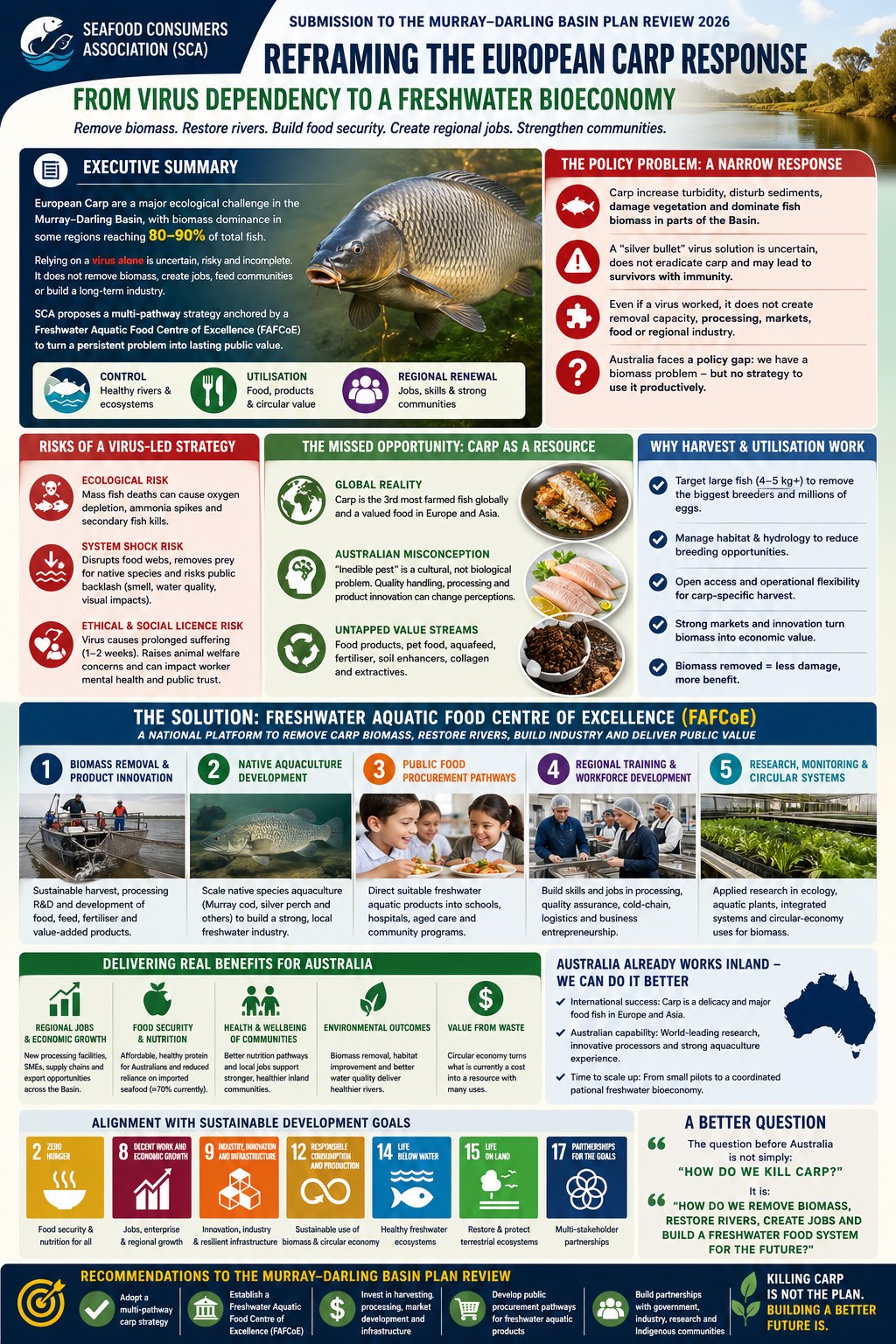
Figure 1. “Reframing the European Carp Response: From Virus Dependency to a Freshwater Bioeconomy,” the Seafood Consumers Association’s submission to the Murray–Darling Basin Plan Review 2026. Click to enlarge. Source: Seafood Consumers Association (SCA).
A commercial feed market must not create incentives to maintain or spread an invasive species.
FishProf is not proposing that carp harvesting alone can solve the Basin’s ecological problems or replace all existing salmon feed ingredients.
Rather, it is an opportunity to test whether two Australian challenges could be addressed through one carefully designed circular-economy initiative.
From salmon production to food-system performance
The United Nations Committee on World Food Security is updating its policy work on sustainable fisheries and aquaculture for food security and nutrition.
This international process reinforces a fundamental point: aquatic food policy must consider the entire journey from production to human nourishment.
FishProf believes Tasmania should use the same lens.
Environmental performance, employment, scientific research and regulatory compliance remain essential. But so are truthful labelling, nutritional integrity, consumer confidence and access to affordable seafood.
The review should therefore include independent consumer representation and explicitly assess the effects of its recommendations on the people who ultimately purchase the product.
A credible future for Tasmanian salmon farming cannot be built by ignoring environmental concerns. Equally, it cannot be secured by treating consumers as passive recipients of whatever the supply chain produces.
FishProf wants Australian aquaculture to succeed — through better science, smarter technology, credible regulation, genuine transparency and products that consumers can trust.
The challenge is not simply to produce more salmon. It is to produce salmon that earns its place on the Australian dinner table.
That is the standard by which a genuinely consumer-centred aquaculture industry should be judged.
NOTE: The author is also the founder and CEO of SCA, whose position informed the commentary.
References and Sources
- Tasmanian Government (2025–2026). Independent Study of the Tasmanian Salmon Industry: Terms of Reference. Primary authority for the review’s scope, international benchmarking and stakeholder arrangements. Official study and Terms of Reference.
- Craik, W., and Reichelt, R. (2026). Independent Study of the Tasmanian Salmon Industry — Study Plan, Version 2.0, October 2026. Relevant to the study methodology, consultation and proposed research questions. Study Plan (PDF).
- Jensen, F., Tveterås, R., and Nielsen, R. (2024). “The traffic light system. Is it a solution to a nonpoint pollution problem?” Aquaculture Economics & Management, 28(2), 177–207. Supports the Norwegian regulatory comparison and sea-lice assessment. Research article.
- Food Standards Scotland and Scottish Government (2025). Statement on public health risks associated with sea lice in Scottish salmon, 3 July 2025. Documents Scottish sea-lice controls and distinguishes fish-health issues from food-safety risks. Official statement.
- Fisheries Research and Development Corporation (FRDC) (2026). Australian Fish Names Standard (AS 5300) and Fish Names Database. Supports the distinction between mandatory export use and general voluntary domestic adoption. Australian Fish Names Standard.
- Aquaculture Stewardship Council (ASC). ASC Farm Standards and Certification Programme. Source for the nature and scope of private aquaculture certification. ASC official website.
- Global Seafood Alliance. Best Aquaculture Practices (BAP): Certification Standards and Guidelines. Source for the different components of third-party aquaculture assurance. BAP standards.
- Australian Government (1999, as amended). Environment Protection and Biodiversity Conservation Act 1999 (Cth). Legislative basis for the article’s proposed examination of Commonwealth environmental assessment arrangements. EPBC Act.
- High Level Panel of Experts on Food Security and Nutrition (HLPE) (2014). Sustainable Fisheries and Aquaculture for Food Security and Nutrition. HLPE Report No. 7, Committee on World Food Security, Rome. Supports the central argument that aquaculture governance should account for nutrition and equitable food access. HLPE Report 7.
- “Full replacement of fish oil with algae oil in farmed Atlantic salmon (Salmo salar) — Debottlenecking omega 3” (2023). Aquaculture, 574, article 739653. Demonstrates that feed-oil substitution can change salmon fatty-acid composition and that alternative oils may preserve or improve nutritional outcomes. Aquafeed research article.
- Brown, A. R., Wilson, R. W., and Tyler, C. R. (2025). “Assessing the Benefits and Challenges of Recirculating Aquaculture Systems (RAS) for Atlantic Salmon Production.” Reviews in Fisheries Science & Aquaculture, 33(3), 380–401. Supports the discussion of production technology, environmental trade-offs and costs. RAS review article.
- Klatt, L., Pinho, S. M., Mekala, G., Losordo, T. M., and Turchini, G. M. (2026). “In search of electricity use patterns for resource-efficient fish farming in recirculating aquaculture systems — A systematic review.” Aquaculture, 619, article 743887. Supports the discussion of RAS energy requirements and the need for comparable cost and performance evidence. 2026 systematic review.
- Australian Government Department of Agriculture, Fisheries and Forestry (2022–2026). National Carp Control Plan and Carp Biological Control Program. Establishes the ecological problem and the continuing evaluation of carp management. It does not establish the commercial feasibility of producing salmon feed from harvested carp. National Carp Control Plan.
- High Level Panel of Experts on Food Security and Nutrition (2026). New HLPE-FSN drafting team for the report on sustainable fisheries and aquaculture, 8 July 2026. Confirms the forthcoming international report and its planned consideration at CFS 55 in October 2027. FAO announcement.

FishProf is the Aquaculture Magazine column by Roy D. Palmer, CEO of the Seafood Consumers Association (SCA).
Opinions expressed in this column are those of the author and do not necessarily reflect the views of Aquaculture Magazine.