
By Aquaculture Magazine Editorial Team
Modern aquaculture, particularly tilapia farming, is experiencing a period of high technical demands. Rather than merely seeking to increase production volumes, producers now seek stability, predictability, and consistent results that allow them to plan their operations with less risk. In this context, the maturation and reproduction phase has become one of the most critical aspects of the production system. Small physiological variations can result in significant economic differences.
Given this scenario, choosing nutritional and functional products is no longer a secondary decision. Not all products perform equally, nor are they all manufactured to the same quality standards. Experience gained from field trials demonstrates that product quality — including formulation, process control, certifications, and consistency — is a determining factor in reducing reproductive variability and improving farming results.
This article focuses on tilapia maturation and analyzes how incorporating a certified, high-quality product like MegaTure-F directly impacts reproductive indicators. Results from a renowned Ecuadorian aquaculture company confirm that when quality is the cornerstone of product development, the benefits are clearly and measurably reflected on the farm.
Tilapia Maturation: A Highly Sensitive Process
Reproduction in tilapia is a biologically demanding process. During maturation, broodstock must allocate significant energy toward gamete formation while coping with confinement, handling, environmental fluctuations, and metabolic stress. Imbalances in this process negatively impact fertility, egg quality, and fry viability.
One of the least visible yet most critical factors at this stage is oxida- tive stress. Free radicals cause cellular damage in reproductive tissues and glands, forcing the animal to divert energy toward defense mechanisms instead of reproduction. This “hiddencost” reduces the system’s biological efficiency and increases variability between production cycles.
Reducing this defensive energy expenditure requires attention to both nutrition and the quality of the products used. Only stable formulations with high-purity ingredients and controlled processes can effectively influence these physiological mechanisms without causing side effects.
In tilapia breeding, using feed manufactured under strict quality standards is essential for achieving reproductive stability, biological efficiency, and consistent results in each production cycle.
When it comes to the maturation of tilapia, critical decision are key. The difference lies not only in nutrition, but also in the quality of the product that underpins each production outcome.To achieve reproductive stability, reduce variability, and maximize biological performance, it is essential to choose inputs manufactured to strict standards with verifiable certifications and consistent field performance. Experience in Ecuador shows that quality is not an abstract concept; it is measured by viable fry, reproductive efficiency, and sustainable results.
Product Quality: The Attribute That Makes All the Difference
In aquaculture, quality is an operational necessity, not just a marketing slogan. Aquaculturists value products that perform consistently from batch to batch, remain stable over time, and produce measurable results in real-world farming conditions. This is indeed one of the most highly recognized value attributes by Megasupply’s customers, according to user and potential client surveys.
MegaTure-F was developed with this in mind — quality as the foundation of performance. The product holds four SGS certification seals attesting to its manufacture under strict quality standards, ingredient traceability, and process control. These certifications validate the formulation and guarantee the product’s stability, consistency, and safety for continuous use.
In a market where many products promise results but few deliver them over time, certified quality is a real differentiator. Consistent products are key to reducing production variability, one of the main challenges in tilapia farming.
In tilapia breeding, using feed manufactured under strict quality standards is essential for achieving reproductive stability, biological efficiency, and consistent results in each production cycle.
Selecting products with verifiable certifications is not just a formality; it guarantees performance. Controlling the formulation, ingredients, and processes translates into lower physiological stress, improved fertility, and reduced reproductive variability.
MegaTure-F: Quality Applied to Reproductive Physiology
MegaTure-F is a high-quality nutritional emulsion formulated specifically for breeding animals. It works by combining vitamins, minerals, and antioxidants in precise amounts. Selenium and the enzyme glutathione peroxidase play key roles in neutralizing hydrogen peroxide (Figure 1).
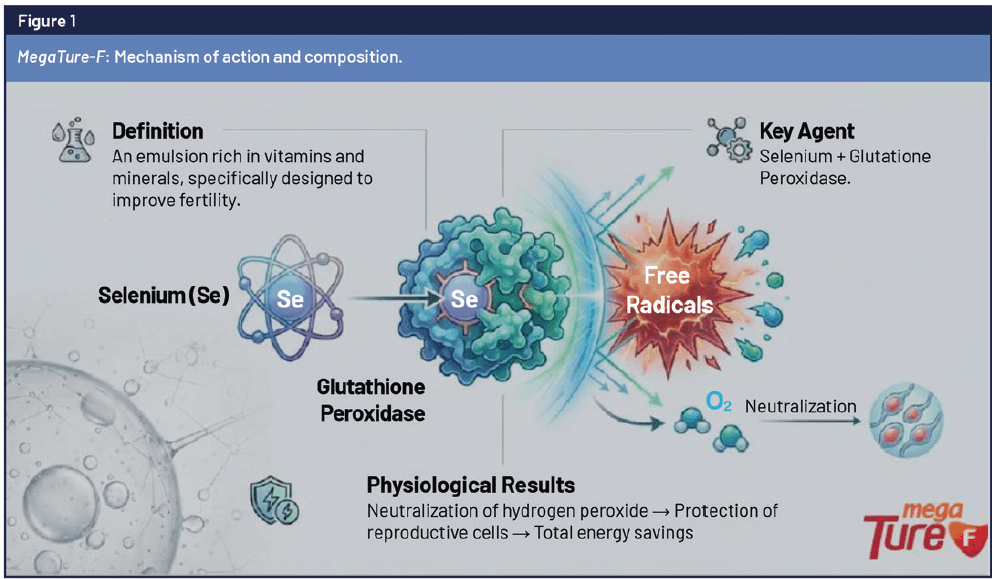
From a physiological perspective, this action results in:
✓ Protection of reproductive cells.
✓ Reduction of oxidative damage.
✓ Metabolic energy savings
✓ Increased energy availability for gamete production.
This approach does not force reproduction; rather, it optimizes the animal’s natural biological efficiency. The quality of the product ensures these processes occur stably, without peaks or abrupt drops in reproductive performance.
Design of Field Trials in Ecuador
The findings presented in this article are based on a field trial conducted from 2023 to 2024 at a leading Ecuadorian aquaculture company. The study evaluated the impact of MegaTure-F on tilapia broodstock diets under real-world farming conditions.
Key features of the study
✓ Start date: September 25, 2023.
✓ Base diet: GISIS TILAPIA balanced feed for broodstock (36% protein).
✓ Treatment: Addition of MegaTure- F at controlled doses (15 ml/kg).
The sample includes six batches of broodstock with variable biomass (weights ranging from 267 g to 5,929 g). The experimental design enabled comparison of previous cycles with treated cycles and evaluation of key indicators of fertility, hatching, and total fry production. The methodological consistency of the trial reinforces the validity of the obtained results.
Results from field trials demonstrate that quality is more than just marketing talk. It is a technical factor that directly impacts hatchery efficiency, the production of viable fry, and the stability of the reproductive system, even when using the same infrastructure.
Results: When Quality Translates into Numbers
The results of the field trial clearly demonstrate sustained improvements in all evaluated reproductive indicators, confirming the direct impact of product quality on crop performance.
Improved fertility in females
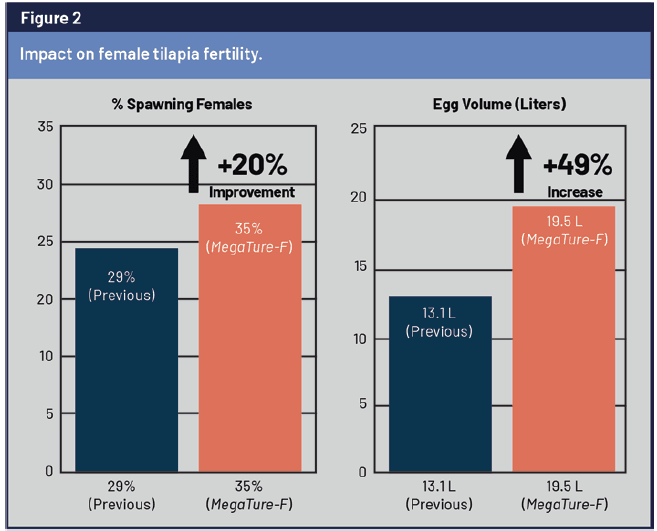
✓ A 20% increase in the percentage of females that spawned (Figure 2).
✓ A 49% increase in the volume of eggs collected (Figure 2).
These results reflect improved re- productive efficiency. They are associated with better physiological condition in the breeding stock.
Results from field trials demonstrate that quality is more than just marketing talk. It is a technical factor that directly impacts hatchery efficiency, the production of viable fry, and the stability of the reproductive system, even when using the same infrastructure.
Hatching efficiency and viability
✓ A 54% increase in the viable hatch rate.
✓ A notable case was when one batch’s hatch rate rose from 30% to 85%.
One of the most significant findings was the reduction in variability between batches, which demonstrates the stability provided by a high-quality product.
Total fry production
✓ An 89.9% increase in the total number of hatched fry.
✓ Production nearly doubled using the same infrastructure.
From a commercial standpoint, this is a key point: the quality of the product made it possible to maximize yield without the need for additional investments in facilities.
Normalized productivity
The number of fries per kilogram of females increased by 33%, confirming that the improvement was genuine and not merely volumetric.
Quality, stability, and reduced variability
One of the biggest challenges in tilapia breeding is variability between production cycles. Fluctuations in fertility, hatching, and survival create operational uncertainty and affect planning.
The results obtained with MegaTure-F demonstrate that product quality directly contributes to greater reproductive stability.
✓ Greater reproductive stability.
✓ Less variation in results between batches.
✓ Greater predictability in fry production.
Megasupply’s customers particularly value this, recognizing quality as a key attribute for reducing risks and improving production decision- making.
Megasupply: A Company Built on Quality
Field results are not an isolated occurrence, but rather a reflection of a business philosophy. Megasupply has established its presence in the aquaculture market by offering high-quality products, as evidenced by stable formulations, international certifications, and technical support. When market perception aligns with field results, the message becomes credible and effective.
Megasupply‘s value proposition is based on the clear principle that product quality is the foundation of farm performance. This quality is recognized by our customers and is reflected in our stable formulations, international certifications, and consistent results under real production conditions.

Conclusions
Experience with tilapia breeding in Ecuador confirms that product qual- ity is not an abstract concept, but rather a decisive factor in production outcomes. Using MegaTure-F improved fertility, hatching efficiency, and total fry production. This reduced variability and increased the stability of the breeding system. These results, obtained under real-world farming conditions, demonstrate the effectiveness of a product manufactured under strict quality standards and supported by international certifications. In aquaculture, choosing quality is an investment that yields real, sustainable results, not an additional cost.
This article is sponsored by: MEGASUPPLY

This is a summarized version developed by the editorial team of Aquaculture Magazine based on the review article titled “ESTUDIO DE CASO: OPTIMIZACIÓN DE ÍNDICES REPRODUCTIVOS EN TILAPIA” y “MEGATURE-F: EMULSIÓN NUTRICIONAL PARA CAMARONES Y PECES EN MADURACIÓN SEXUAL” developed by: MEGASUPPLY.
Página web: www.megasupply.net
Email: orders@megasupply.net