

Editorial Staff | Aquaculture Magazine, with information from SATS
Timed with National Seafood Month, the coalition argues that eight years to permit a single net pen in federal waters shows why the U.S. needs a predictable pathway, as Congress considers the bipartisan MARA Act.
Stronger America Through Seafood (SATS), a coalition that advocates for federal policies to increase U.S. seafood production, launched on October 1 a campaign titled “8 Years, 8 Ways America is Missing Out.” Running through October, National Seafood Month, the campaign calls for a clear and predictable federal permitting pathway for open ocean aquaculture while Congress considers the bipartisan Marine Aquaculture Research for America (MARA) Act (S. 2586/H.R. 9802).
Eight years and 12 agencies for one net pen
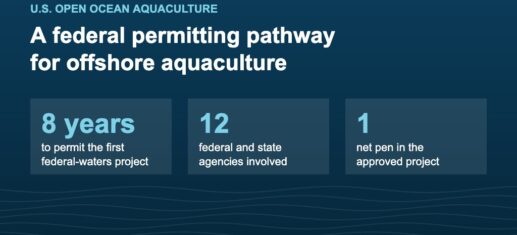
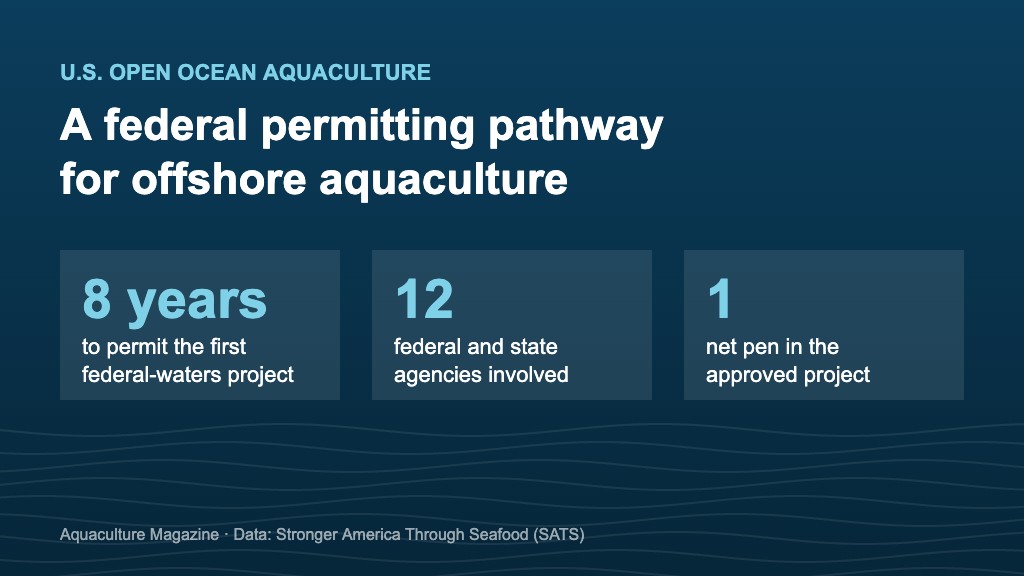
The campaign takes its name from the first open ocean aquaculture demonstration project in U.S. federal waters to be approved this year. According to SATS, the project, planned for the Gulf, spent eight years in the permitting process and went through 12 federal and state agencies to secure approval for a single net pen.
Drue Banta Winters, Campaign Manager of SATS, said there is growing bipartisan recognition in Congress that expanding American aquaculture is an opportunity the country cannot afford to miss. In her view, the U.S. has the science, technology and resources to grow more seafood in its own waters and complement wild-capture fisheries, but the time needed to move one demonstration project through permitting shows why a clear federal pathway is needed.
The first demonstration project approved in U.S. federal waters spent eight years in permitting for a single net pen.
The figures behind the campaign
SATS notes that the U.S. ranks 20th globally in aquaculture production, imports up to 85% of its seafood and has no commercial aquaculture projects operating in federal waters. The coalition also cites a May 2026 report by Virginia Cooperative Extension, a partnership of Virginia Tech, Virginia State University, the U.S. Department of Agriculture (USDA) and local governments, which estimated that regulatory barriers cost the U.S. aquaculture industry about USD 807 million in lost economic value in 2023.
Throughout the month, SATS is using its social media channels and a fact sheet to highlight eight areas where it says the country is missing out: seafood production, food security, economic opportunity, coastal communities, American agriculture, innovation and U.S. investment, sustainability and climate resilience, and U.S. competitiveness.
What the MARA Act would do
The MARA Act would establish a science-based framework to advance commercial-scale open ocean aquaculture demonstration projects in U.S. federal waters. Winters said the coalition sees the bill as an opportunity for Congress to give U.S. aquaculture a clear pathway to grow, with implications for jobs, food security, innovation and global competitiveness.
Frequently asked questions
What is the “8 Years, 8 Ways America is Missing Out” campaign?
It is a National Seafood Month campaign by Stronger America Through Seafood (SATS) that calls for a clear federal permitting pathway for open ocean aquaculture and highlights eight areas where, according to SATS, the U.S. is missing out.
Why “8 years”?
According to SATS, the first open ocean aquaculture demonstration project approved in U.S. federal waters, planned for the Gulf, spent eight years in permitting and went through 12 federal and state agencies for a single net pen.
What is the MARA Act?
The Marine Aquaculture Research for America (MARA) Act (S. 2586/H.R. 9802) is bipartisan legislation that would establish a science-based framework for commercial-scale open ocean aquaculture demonstration projects in U.S. federal waters.
Sources and Methodology
This news item was prepared by the Aquaculture Magazine editorial staff from the Stronger America Through Seafood (SATS) press release of October 1, 2026. SATS is an advocacy coalition; the figures on U.S. production, imports and regulatory costs are as reported by SATS. Featured graphic: Aquaculture Magazine, with data from SATS.