
* By FishProf
As Associate Professor Tomer Ventura’s research reveals, the definition of success in aquaculture is changing. Moving beyond traditional lagging indicators, advanced genomics allows us to decode the shrimp nervous system and map stress-response genes. This groundbreaking work establishes practical molecular welfare indicators to turn invisible stress into measurable parameters. Ultimately, prioritizing animal welfare becomes a vital business tool that directly drives farm profitability and market trust.
I had one of those “stop and think” moments at the Evoke conference in Melbourne last week.
You know the kind. You’re in yet an other session, coffee in hand, half your brain on the next panel – and then someone quietly upends one of the fundamentals you thought you understood about aquaculture.
This time it was Associate Professor Tomer Ventura from the University of the Sunshine Coast, talking about shrimp welfare and genomics. Not a new topic on paper, but the depth of what his team is uncovering made me realize how far and how fast our industry is moving.
The definition of success in shrimp farming is changing from simple harvest volume to responsible production. Consumers, retailers, and regulators now demand verifiable assurance regarding animal welfare, which is increasingly baked into international certifications, procurement policies, and market price.
For decades we’ve said, often with a shrug, “Well, prawns don’t scream.” They don’t vocalize, they don’t pull a sad face, and in a pond of millions you don’t see individuals limping around. So, we’ve used the blunt tools we had: survival, growth, feed conversion, maybe a bit of behavior. If they’re growing and not dying, they must be fine… right?
Ventura’s work suggests that this is no longer good enough – for the science, for the market, or for our social license.
The Silent Animals That Are Not So Silent
Shrimp farming has exploded over the past 30 years. It’s gone from niche coastal ponds to a global protein engine, feeding local communities and international markets alike. As volumes grew, systems became more sophisticated and technology took hold: aeration, feeding systems, genetics, biosecurity, you name it.
But the definition of “success” is changing.
It’s no longer just tons harvested and cost per kilo. Consumers, retailers and regulators want assurance that those tons are produced responsibly, with genuine attention to welfare. That’s not some fluffy NGO slogan; it is increasingly baked into certifications, procurement policies and – crucially – price.
Unlike cattle or salmon, shrimp cannot be individually monitored and do not exhibit obvious, vertebrate-type pain behaviors in dense, murky systems. This has left the aquaculture sector relying on lagging indicators like mortality spikes, poor growth, and disease outbreaks to detect chronic stress.
For shrimp, this creates a practical problem. Unlike cattle or salmon, they can’t be individually monitored. They don’t exhibit obvious, vertebrate-type “pain behaviors”. They live in dense, murky systems where subtle signs are easily missed.
As Ventura points out, this has left the sector relying on lagging indicators – mortality spikes, poor growth, disease outbreaks – to tell us something is wrong. By the time those signals show up, the animal has been under stress long enough to damage performance and profitability.
The question his group asked is simple: can we listen to shrimp in a different way?
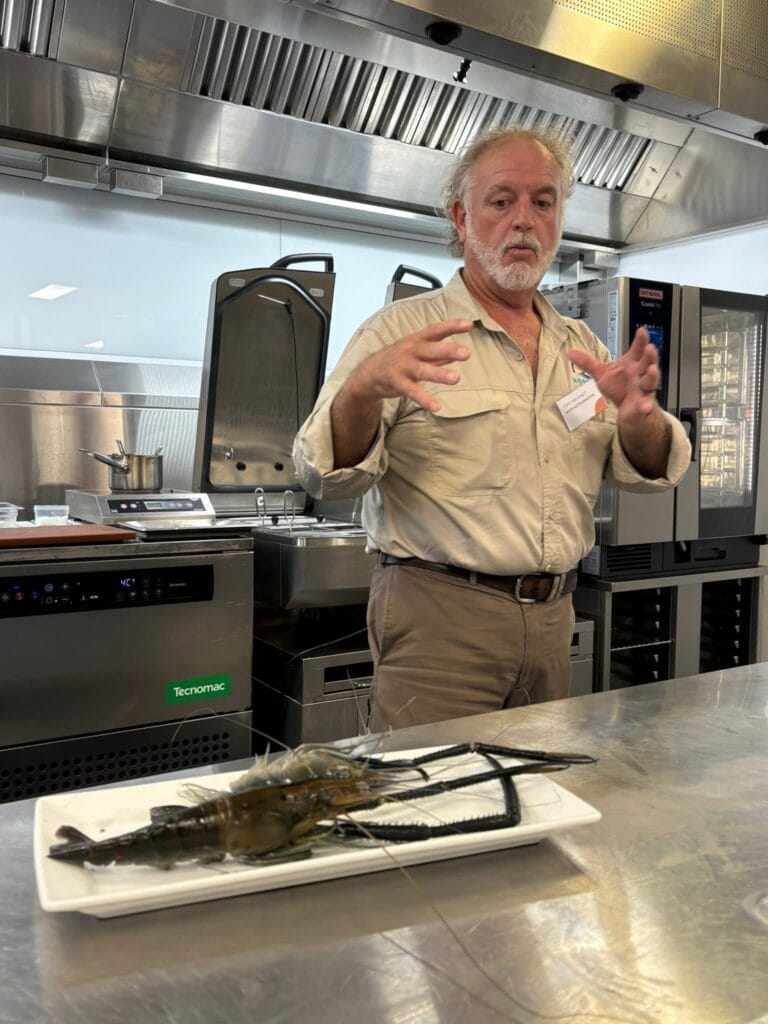
Decoding the Shrimp Nervous System
The answer, it turns out, is sitting in the genome.
For years, scientists argued about whether crustaceans even have the molecular machinery to detect and respond to harmful conditions in a way that is comparable – biologically, not emotionally – to vertebrates.
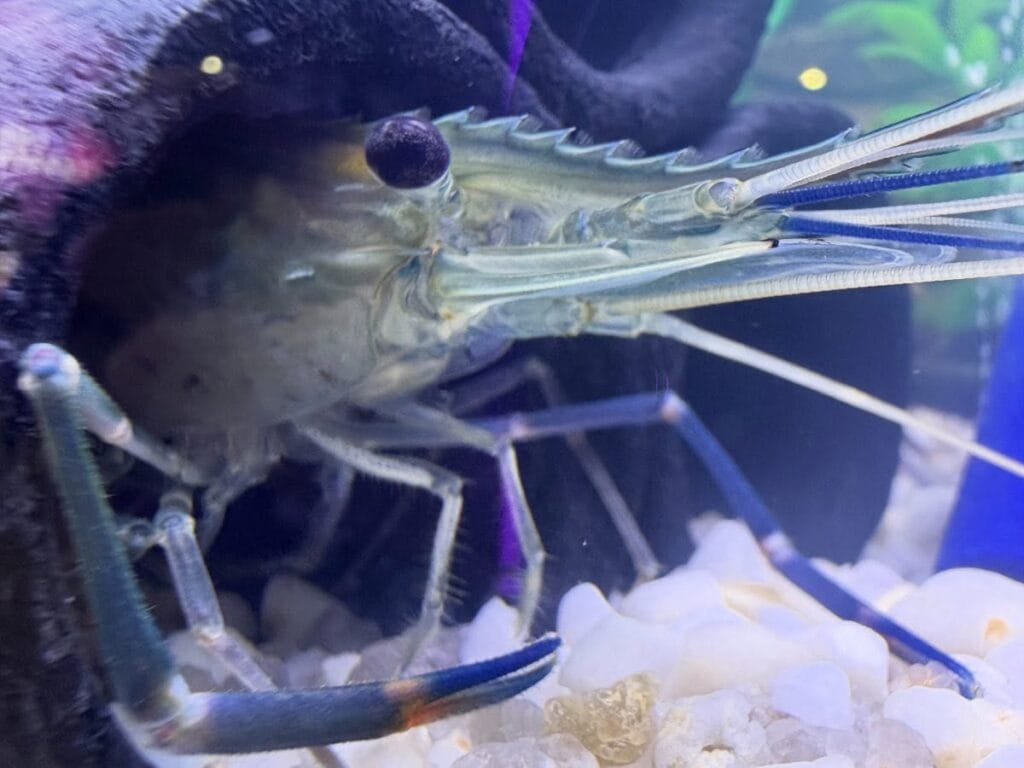
Thanks to advances in sequencing and bioinformatics, we now know that shrimp possess a remarkably sophisticated suite of sensory and stress-response genes.
Ventura’s team and others have identified:
» TRP channels – receptors that respond to heat and chemical cues.
» Piezo channels – specialist sensors for mechanical pressure.
» Acid-sensing receptors – responsive to changes in pH and acidity.
» Volta-gegated sodium channels – core components of neural signaling.
» Purinergic receptors – involved in signaling tissue damage and inflammation.
In plain language, shrimp have the “hardware” to detect when something in their environment is physically or chemically wrong. They don’t yelp, but their cells light up.
The work doesn’t stop at sequence hunting. The group is mapping where these genes are active in the body – measuring gene expression across tissues like the antennal nerves, central ganglia and gills. High activity in those areas paints a picture of where shrimp “feel” the world, and how that sensory information moves through their nervous system.
Advanced sequencing and bioinformatics reveal that shrimp possess a sophisticated suite of sensory and stress-response genes. These include TRP channels for chemical cues, Piezo channels for mechanical pressure, acid-sensing receptors for pH changes, and purinergic receptors for tissue damage signaling.
This is not armchair science. It’s the foundation for something extremely practical: molecular welfare indicators.
But the definition of “success” is changing.
It’s no longer just tons harvested and cost per kilo. Consumers, retailers and regulators want assurance that those tons are produced responsibly, with genuine attention to welfare. That’s not some fluffy NGO slogan; it is increasingly baked into certifications, procurement policies and – crucially – price.
For shrimp, this creates a practical problem. Unlike cattle or salmon, they can’t be individually monitored. They don’t exhibit obvious, vertebrate-type “pain behaviors”. They live in dense, murky systems where subtle signs are easily missed.
By characterizing stress-response genes, researchers can identify genomic biomarkers that spike under adverse farm conditions. These markers can be built into practical diagnostic tools like qPCR assays, allowing farmers to objectively measure the stress of grading, transport, or harvest protocols.
As Ventura points out, this has left the sector relying on lagging indicators – mortality spikes, poor growth, disease outbreaks – to tell us something is wrong. By the time those signals show up, the animal has been under stress long enough to damage performance and profitability.
The question his group asked is simple: can we listen to shrimp in a different way?

Decoding the Shrimp Nervous System
The answer, it turns out, is sitting in the genome.
For years, scientists argued about whether crustaceans even have the molecular machinery to detect and respond to harmful conditions in a way that is comparable – biologically, not emotionally – to vertebrates.
Thanks to advances in sequencing and bioinformatics, we now know that shrimp possess a remarkably sophisticated suite of sensory and stress-response genes.
Ventura’s team and others have identified:
» TRP channels – receptors that respond to heat and chemical cues.
» Piezo channels – specialist sensors for mechanical pressure.
» Acid-sensing receptors – responsive to changes in pH and acidity.
» Voltage-gated sodium channels – core components of neural signaling.
» Purinergic receptors – involved in signaling tissue damage and inflammation.
From Gene Lists to Farm Tools
One of the points Ventura made – and we discussed afterwards – is that full-blown welfare experiments can be ethically sensitive and expensive. Nobody wants to design a trial that deliberately hurts animals just to see how bad it gets. And smaller research groups simply don’t have the budget for elaborate, repeated challenge studies.
Genomics Offers a Different Path
By characterizing the genes, and then watching how they switch on and off under different conditions, you can start to identify “biomarkers” – genes that reliably spike when the animal is under stress.
Once those markers are validated, they can be built into practical diagnostic assays such as qPCR tests. Take a small tissue sample, run the assay, and you don’t have to guess whether the grading protocol, transport system or harvest method is stressing the stock – you see it in the expression profile.
By characterizing stress-response genes, researchers can identify genomic biomarkers that spike under adverse farm conditions. These markers can be built into practical diagnostic tools like qPCR assays, allowing farmers to objectively measure the stress of grading, transport, or harvest protocols.
That opens up a long list of possibilities:
» Comparing different handling or transport methods to see which is genuinely least stressful.
» Testing new technologies (aeration, lighting, feed regimes) for welfare benefits rather than marketing claims.
» Providing hard data for certification schemes that want “welfare proof”, not just a policy statement.
» Integrating those welfare indicators into digital traceability and QR-based labelling, allowing stories about “better shrimp” to be backed by real numbers.
If you are a farmer, this is not an abstract ethics seminar. Chronic stress knocks down immunity, opens the door to disease, worsens feed conversion and drags down growth. Turning invisible welfare problems into measurable parameters is another lever to improve performance.
No pain, big gain, indeed.
Welfare as a Business Tool, Not a Burden
One of the enduring myths in aquaculture is that welfare is always a cost
In reality, as Ventura’s work reinforces, welfare and profitability are tightly linked. Stressed shrimp are expensive shrimp: they get sick more, convert feed less efficiently and die more often. Every percentage point of stress you can remove from the system – by better design, handling, or technology – shows up somewhere on the bottom line.
The genomics angle simply gives us a finer lens
Instead of waiting for a crash, we can monitor early stress signatures and adjust before damage accrues. It is no different in principle to watching dissolved oxygen or pH, but with a direct line into the animal’s physiology rather than the water column.
The other side of the coin is social license. As public scrutiny of aquaculture grows, “trust me, we care” is not enough. Objective, third-party-verifiable indicators of welfare give farms a stronger story to tell retailers and consumers – particularly in premium markets that are already paying more for certifications tied to ethics and environment.
At Evoke, I was struck by how much the conversation has shifted. Ten years ago, a talk like Ventura’s might have been parked in an academic breakout. Now, welfare genomics is front-and-center in discussions about sustainability, market access and digital traceability.
Welfare is an operational business tool rather than a cost burden because chronic stress directly knocks down shrimp immunity. Monitoring early molecular stress signatures allows producers to optimize feed conversion, prevent disease outbreaks, and secure a premium competitive advantage.
Where does this leave the wider seafood world?
So, what does this mean beyond shrimp? First, it reminds us that science is moving inside the animal, not just around it. We have spent decades optimizing systems – feeds, cages, ponds, logistics. The next frontier is understanding, and optimizing, the biology of welfare itself.
Second, it shows how data can bridge the gap between ethical expectations and practical farming. Consumers increasingly want to know not just that their seafood is safe and legal, but that it was produced in a way they can live with. Genomics, if translated sensibly, can provide part of that reassurance.
Third, it challenges all of us – farmers, processors, retailers, and yes, consumer advocates like the Seafood Consumers Association – to think about how these tools get into the hands of operators, not just sit in journal articles.
Ventura’s “no pain – big gain” proposition is not about wrapping shrimp in cotton wool. It is about using the finest tools of modern biology to run better farms, make better products and build better trust. When you can read stress in a shrimp’s genes, you are a long way from the days of “if it’s alive at harvest, it must be okay”.
At Evoke, that realization was both humbling and exciting. The next time someone tells you welfare is a cost center, point them towards the emerging genomics of shrimp. The data says otherwise.
And as FishProf, I’ll be watching closely to see which producers turn that science into a genuine competitive advantage – because in the seafood world, those who listen earliest are often the ones still standing when the music changes.

References and sources consulted by the author on the elaboration of this article are available under previous request to our editorial staff.