

By: INCAR2
The model proposes a risk-based regulatory system for salmon farming in Chile, integrating environmental and production variables to move toward more preventive and sustainable management.
A team of Chilean researchers, led by Dr. Doris Soto, Principal Investigator at the Applied Research Center CIA‑INCAR², is proposing an innovative model to regulate salmon production in Chile by integrating environmental, sanitary, and production variables to advance toward more sustainable aquaculture.
This development is the result of a research effort that began more than five years ago, primarily funded during the FONDAP INCAR Center phase, and which continues to be further developed in its current phase as CIA‑INCAR², consolidating a line of research focused on the sustainable management of aquaculture based on scientific evidence.
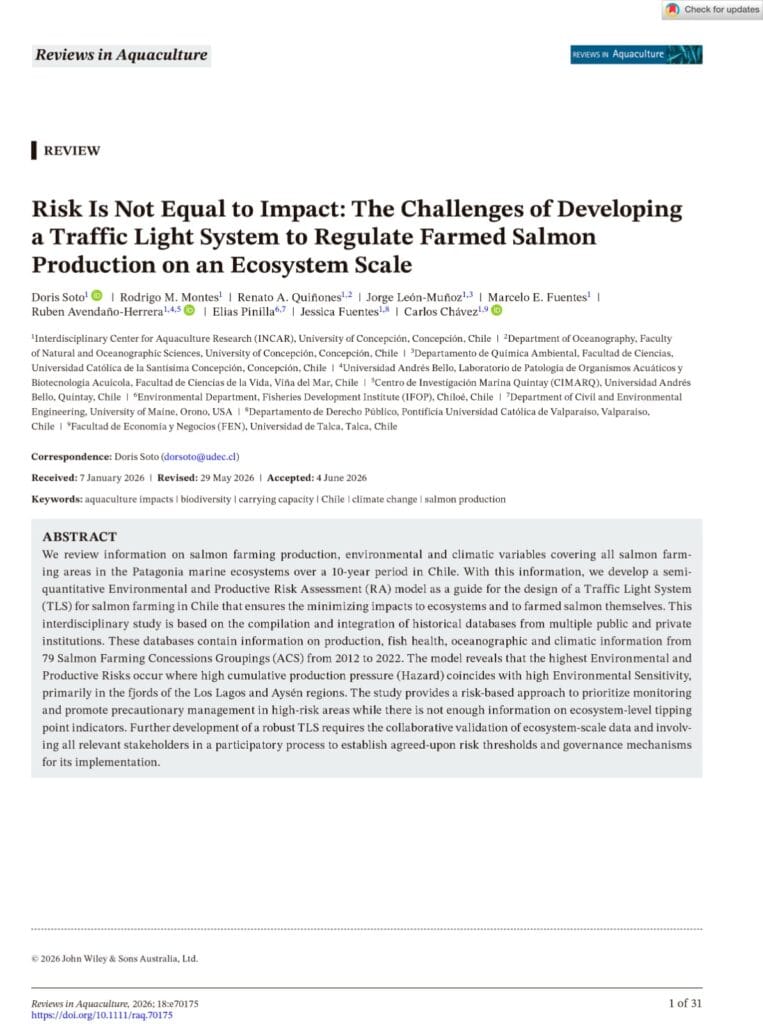
The scientific article, which proposes moving toward the implementation of a “traffic light” system for salmon farming in Chile based on integrated risk assessment at the ecosystem scale and published in the journal Reviews in Aquaculture, provides a conceptual and methodological framework aimed at strengthening sector regulation under a preventive, evidence-based approach.
The research, titled “Risk Is Not Equal to Impact: The Challenges of Developing a Traffic Light System to Regulate Farmed Salmon Production on an Ecosystem Scale,” was led by Dr. Doris Soto and included contributions from specialists from various institutions: Dr. Rodrigo Montes (UdeC‑INCARr²), Dr. Renato Quiñones (UdeC‑INCAR²), Dr. Jorge León‑Muñoz (USCS‑INCAR²), Dr. Marcelo Fuentes (UdeC), Dr. Ruben Avendaño‑Herrera (UNAB‑INCAR²), Elias Pinilla (IFOP), Dr. Jessica Fuentes (PUCV‑INCAR²), and Dr. Carlos Chávez (UTALCA‑INCAR²).
The study integrates information from a decade (2012-2022), considering production, health, oceanographic, and climatic data from all salmon farming areas in the Chilean Patagonian Sea. Based on this data, researchers developed a semi-quantitative model for assessing environmental and production risks, intended to guide the design of a traffic light system to regulate salmon farming. The analysis does not include more recent information because production data from 2023 onward was unavailable; however, as the researchers emphasize, production patterns have remained consistent, making the analysis fully relevant.
Among the main findings, the model identifies that the highest levels of risk are concentrated in areas where high production pressure coincides with high environmental sensitivity, particularly in fjords in the Los Lagos and Aysén regions. This approach makes it possible to prioritize critical areas and move toward more preventive management focused on reducing impacts before they occur.
However, the team notes that significant information gaps still exist for accurately determining impacts at the ecosystem level, particularly regarding so‑called “tipping points.” Therefore, they emphasize the need to apply the precautionary principle and strengthen monitoring systems and data generation at appropriate spatial scales.
The proposal also highlights the importance of advancing collaborative public‑private processes, involving the scientific community and civil society, to validate data, define environmental risk thresholds for southern Chile’s marine ecosystems and the industry itself, and establish governance mechanisms to implement such regulatory tools. Possible measures include regulating maximum production per farming area, as well as reducing the use of antimicrobials and pesticides, where the total amount used—and its potential impact on ecosystems—is key.
Likewise, the researchers emphasize the need to review the current spatial distribution of salmon farming, considering the aforementioned risks and emerging factors such as climate change, thereby moving toward a development model that balances productivity with environmental protection and social acceptance.
Finally, the team acknowledges that implementing these measures entails social and economic challenges, and therefore calls for strengthening dialogue and collaboration among all stakeholders in the sector and in the areas where operations are located, with a view to building a more sustainable, resilient salmon farming industry with a long-term vision.
To review the full publication, you can visit it here.