* By Brian Vinci, George Chamberlain, Robins McIntosh, Riley Krohn, Sujit Kaewchum, Antonio Santa Marta and Robert Jones
Super-intensive shrimp farming demands robust infrastructure to handle solids like uneaten feed and molts. This article explores the use of computational fluid dynamics (CFD) to narrow down design options for 16- and 36-meter circular tanks. The results demonstrate that while self-cleaning hydraulics are technically feasible, their success depends on combining specific inlet jets with strong system management and reliable power.
Introduction
Shrimp farming has been shifting from extensive and semi‑intensive ponds to intensive and super‑intensive systems, driven by demand and the need to reduce per‑unit environmental impacts. The intensification increases waste production and the risk of solids accumulation, which can degrade water quality and lead to disease outbreaks. This project set out to define and test hydraulic designs for circular tanks with central drains that could keep tank bottoms clean through rotational and radial flow, using shrimp‑specific biological tolerances and water quality criteria as design constraints.
Background
Most shrimp production occurs in extensive and semi‑intensive ponds, but intensive and super‑intensive systems that use smaller, deeper, often lined ponds or large circular tanks (e.g., 16–36 m diameter, 1–2 m deep) are becoming more common. Circular tanks with central drains and powered circulation (e.g., paddlewheels) have already been used in some shrimp operations, with reported adherence to strict “clean” operating principles to address solid waste accumulation and disease outbreaks.
Solid wastes in shrimp farming mainly consist of uneaten feed, feces, molts, and decaying biofloc. Studies indicate that solids tend to deposit in areas with bottom velocities below 7–8 cm/s and that deposition is spatially uneven, contributing to localized anaerobic conditions. Current methods for managing solids, such as suction pumps, center drains, “shrimp toilets,” and mechanical scrapers, can be effective to varying degrees but are often labor‑intensive, improperly sized, or prone to resuspending waste solids.
Experimental data on L. vannamei indicate critical swimming speeds generally range from 28 to 47 cm/s, depending on temperature, salinity, body size, and fasting duration; higher temperatures and moderate salinities tend to increase critical swimming speeds. Endurance studies showed that shrimp could maintain position at lower velocities (5–11 cm/s) for extended periods, but endurance declined as velocity increased. These findings support keeping most tank water velocities well below critical speeds, aiming for roughly 10 to 30 cm/s to allow shrimp to hold position without exhaustion while still moving waste solids to a location for removal.
Safe total and unionized ammonia concentrations vary with salinity in Litopenaeus vannamei juveniles, showing some increased tolerance at higher salinities. Dissolved oxygen (DO) is a key limiting factor, with recommendations to keep DO above 4–5 mg/L for intensive systems and avoid prolonged periods below 3.5–4 mg/L. For solids, guidance recommends maintaining settleable solids below 20 mL/L and keeping suspended solids in biofloc systems within a range that maintains adequate primary production while minimizing gill irritation and stress.
Typical culture unit depths of 1–2 m are reported across ponds and tanks, and shrimp are characterized as benthic animals that use the bottom rather than the full water column. Limited data suggest that artificial substrates are beneficial, but this study focused on tank bottom hydraulics rather than habitat structures.
These literature findings established quantitative design targets for this project: circular tanks approximately 16–36 m in diameter and 2 m deep, with bottom velocities generally between 10–30 cm/s, solids removal sufficient to prevent buildup in zones with velocities below about 7–8 cm/s, and water quality maintained within known thresholds for ammonia, DO, and suspended solids.
Design targets for super-intensive tanks must align with the biological tolerances of L. vannamei. Research suggests critical swimming speeds range from 28 to 47 cm/s, making water velocities of 10–30 cm/s ideal for moving solids to central drains without causing shrimp exhaustion. Maintaining dissolved oxygen above 4–5 mg/L is equally vital for preventing stress in high-density environments
Self-Cleaning Tank Design and Computational Fluid Dynamics Modeling
Using the identified criteria, self-cleaning tank designs were proposed and tested using computational fluid dynamics (CFD). All modeled tanks had a 2% bottom slope toward a central drain whose diameter was 10% of the tank diameter. Two tank diameters(16 and 36 m) were considered,representing typical sizes for superintensive tanks.
Seventeen scenarios were established by systematically varying:
» Water circulation method: sidewallairlifts, pumped reuse/reinjection.
» Inlet type: vertical jets, standard inverted‑L inlets, modified inverted‑L inlets with bottom jets directed at the tank center, and circular bottom rings with perimeter jets directed toward the tank center.
» Center‑drain hydraulic loading: 12–24 L/min/m².
» Equivalent hydraulic retention time (HRT): 15–90 minutes, representing the strength of circulation (shorter HRT = higher impulse momentum).
» Inlet jet velocities: 1.3, 2, and 4 m/s.
Computational Fluid Dynamics (CFD) modeling of circular tanks shows that pumped reuse/reinjection with inverted-L inlets outperforms airlifts for generating rotational currents. Higher hydraulic loading at the center drain (18–24 L/min/m²) is crucial for reducing low-velocity zones where solids typically accumulate, ensuring the tank bottom remains clean.
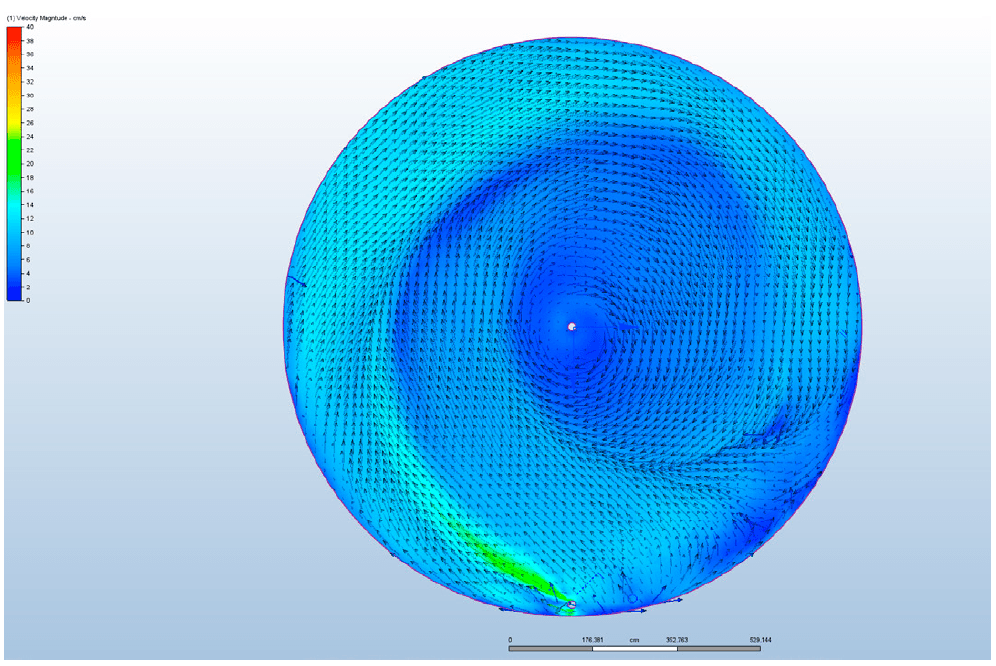
Autodesk CFD 2024 was used to simulate three-dimensional velocity fields in operating tanks. Performance was assessed using bottom-velocity contour maps and histograms showing the percentage of the bottom area within specific velocity ranges (0–5, 5–10, 10–15, …, 35–40 cm/s). Successful scenarios featured a coherent rotational current around the tank, a radial flow component that directed solids toward the center drain, and a substantial portion of the bottom area with velocities between 10 and 30 cm/s.
Commercial Tank Retrofit and Field Testing
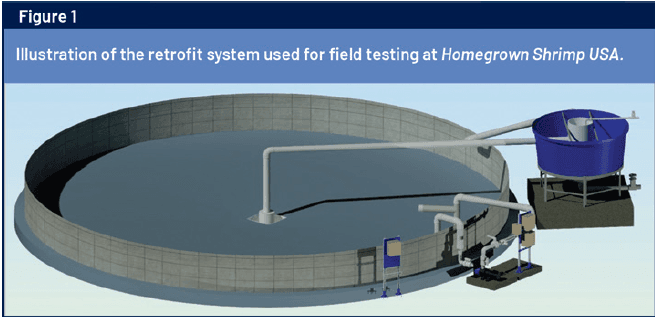
The same criteria and modeling tools were applied to a commercial shrimp production tank at Homegrown Shrimp USA (Indiantown, FL). A retrofit system based on pumped reuse and reinjection, featuring a standard inverted-L inlet and a center-drain solids treatment loop, was modeled to ensure the predicted velocities would meet shrimp swimming and solids transport criteria before installation.
The retrofit system included a side-stream pump skid with inline nanobubble oxygenation and a standard inverted-L inlet for water reinjection to generate rotational flows, a screened center-drain intake with an axial flow pump moving water to a radial-flow solids settler, a gravity return line to the tank near the perimeter from the solids settler, and a pump in the bottom of the settler to remove settled solids to a centralized denitrification loop (Figure 1)
To support super-intensive biomass densities, advanced aeration is necessary to maintain stable dissolved oxygen levels. Field testing of a commercial retrofit utilized a side-stream pump skid with inline nanobubble oxygenation, successfully keeping water quality within recommended ranges during production trials even as shrimp grew to an average of 32 g.
This project’s field work included two production trials, each starting with 32,000 post-larval shrimp (PL); regular water quality monitoring for DO, temperature, alkalinity, and nitrogen compounds; shrimp growth and harvest data collection; measurements of water velocity along tank cross-sections; and analysis of solids levels in the tank water, settler outlet water, and settled solids at the bottom of the settler.
Results Modeling
CFD modeling results showed that sidewall airlift units either produced large areas with water velocities below 10 cm/s or required very high airflow rates to reach the target velocities, limiting their effectiveness as primary water-circulation devices. Pumped reuse/reinjection setups with inverted-L inlets generated stronger rotational currents and covered more of the tank area with water velocities in the 10–25 cm/s range, especially when center-drain loading was between 18–24 L/min/m² and the effective HRT was reduced to approximately 30 minutes.
Despite improvements with inverted-L inlets and increased center-drain loading rates, most 16 m diameter tank scenarios still had a low-velocity zone with velocities below 10 cm/s near the tank center, and sometimes below 5 cm/s. These areas may allow solids to settle, challenging the goal of creating fully self-cleaning tanks. For 36 m diameter tanks, high-velocity vertical jet inlets created localized zones with velocities well above 30 cm/s, which shrimp could potentially avoid, while inlets with lower jet velocities produced large areas with velocities below target levels, highlighting trade-offs related to scale.
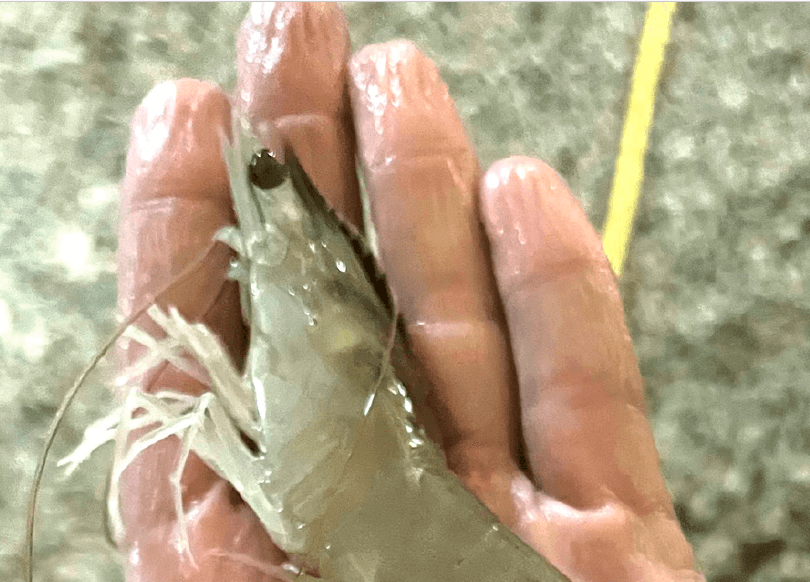
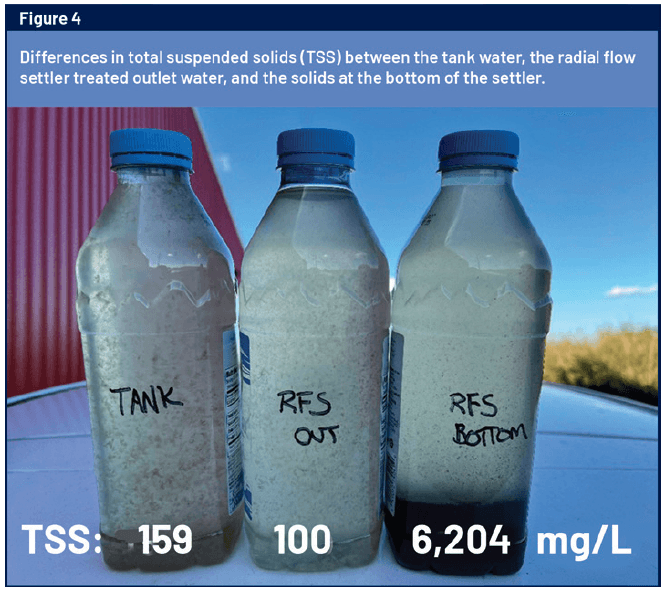
Effective solids removal prevents localized anaerobic conditions caused by decaying biofloc and feces. Testing demonstrated that a radial-flow settler can successfully treat center-drain effluent, concentrating suspended solids from 159 mg/L in the culture tank to over 6,000 mg/L at the bottom of the settler for removal to denitrification loops.
Introducing modified inverted-L inlets with bottom jets aimed at the tank center and circular bottom rings at the tank perimeter, with jets also directed at the tank center, improved radial flow. Configurations using perimeter bottom rings reduced the size of low-velocity zones at the tank center and increased the percentage of water velocities within the target range (15–25 cm/s), leaving only small zones below 10 cm/s in the 16 m-diameter tanks under low HRT conditions. However, when the equivalent HRT was extended to 90 minutes to decrease energy use, low-velocity zones at the tank center reappeared despite the presence of perimeter bottom rings with jets directed toward the tank center.
Overall, the modeling showed that higher impulse momentum (shorter equivalent HRT, higher pumped flows) improved self-cleaning metrics but increased energy requirements. Additionally, higher center-drain hydraulic loading enhanced water velocities near the tank’s center and reduced the size of low-velocity zones. Multiple or modified inlets provided more uniform radial flow and better solids-transport conditions than single standard inlets, especially in larger tanks.
Field testing
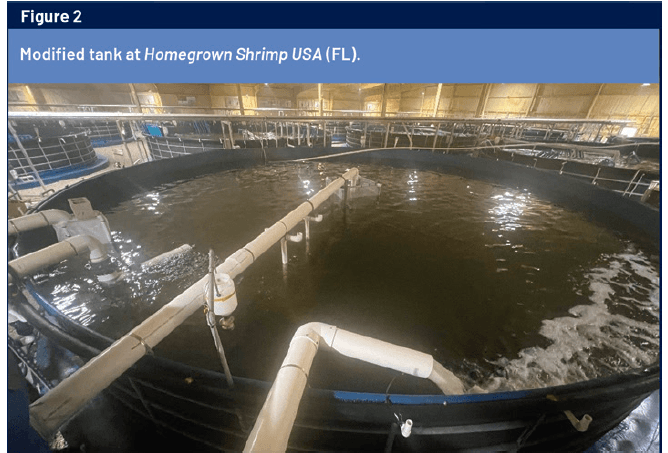
In the commercial tank setup, the retrofit used a simplified design featuring a single side-stream pump and a standard inverted-L inlet, along with a center-drain pump connected to a radial-flow settler with gravity return of treated water to the production tank. The installed layout reversed the location of inflows from the settler return and side-stream inverted-L inlet compared to the original design, reflecting practical constraints (Figure 2).
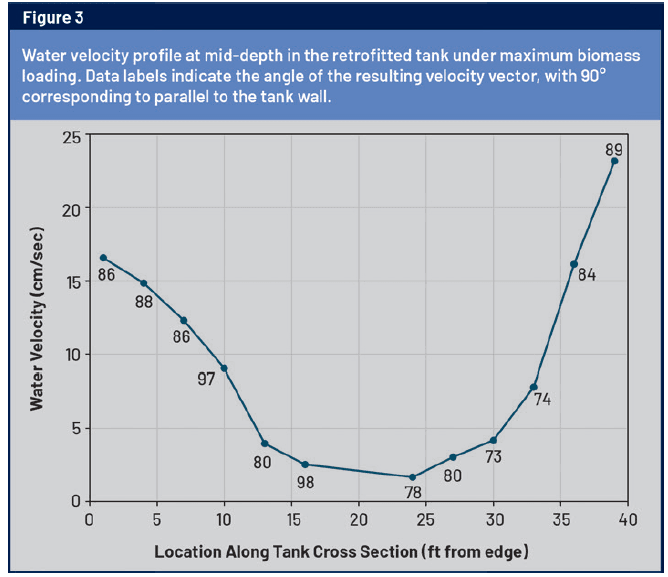
Water velocities measured at mid-depth along the tank perimeter showed a clear rotational current, with velocities mostly in the low to mid-teens cm/s and directions parallel to the wall. This aligns with the lower end of the modeled target water velocity range and suggests effective mixing of the culture water. Measurements also confirmed the presence of low-velocity zones below 10 cm/s near the tank center, even after flow adjustments. This behavior matches the modeling expectation that single-inlet layouts without perimeter bottom rings would have some low-velocity zones near the tank center (Figure 3).
Suspended solids analysis at peak biomass showed that the radial-flow settler effectively treated the flow from the tank center: total suspended solids (TSS) measured 159 mg/L in the tank, 100 mg/L at the settler outlet, and 6,204 mg/L at the bottom of the settler cone, with visible differences in clarity among the samples. This demonstrates that once solids reached the settler, the settler removed and concentrated solids as intended (Figure 4).
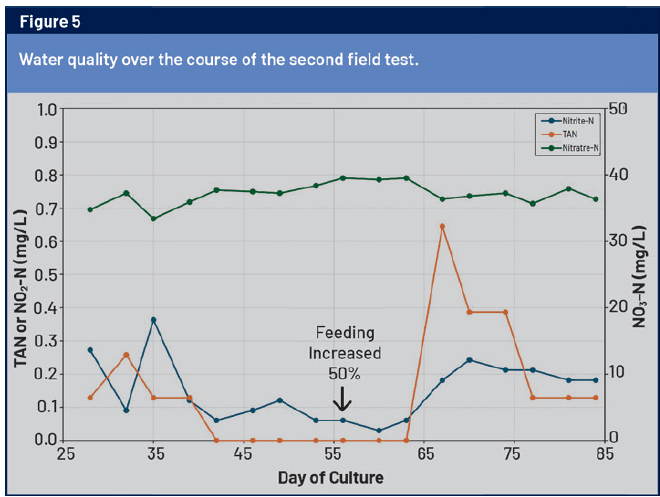
Water quality remained within the recommended ranges for intensive L. vannamei production. Dissolved oxygen was maintained at or above the minimum target levels through the use of the nanobubble oxygenation unit, while hardness and alkalinity stayed within typical industry ranges. Additionally, TAN, nitrite-N, nitrate- N, and solids levels did not indicate any water quality degradation (Figure 5).
Shrimp grew to an average weight of 32 g in 91 days, with an average daily gain of 0.35 g/day and a final biomass density of 1.97 kg/m³. However, survival was low at 19%, and the feed conversion ratio (FCR) was high at 3.09. Low survival and, consequently, low FCR are attributed to high PL mortality during the nursery period before the tank retrofits were implemented.
Discussion and Conclusions
The project demonstrated that self-cleaning tank hydrodynamics could be adapted from finfish RAS to intensive shrimp tanks while remaining within shrimp swimming and water quality limits. CFD modeling proved useful for assessing how design factors such as tank diameter, inlet type, center-drain hydraulic loading, jet velocity, and equivalent HRT interact to influence velocity distributions, and for narrowing down design options before starting a retrofit.
Simultaneously, modeling and field data showed that conservative, low‑complexity setups, such as a single inverted‑L inlet without a perimeter bottom ring with jets aimed at the tank center, were unlikely to achieve target velocities throughout the entire tank volume. Low-velocity zones near the tank center appeared in these designs, and although they did not compromise acceptable bulk water quality or shrimp growth, they could lead to localized solids buildup and increase the system’s vulnerability to operational disruptions. The results, therefore, indicate that future designs should incorporate:
» Higher impulse momentum (shorter equivalent HRT) within acceptable energy budgets.
» Increased center‑drain hydraulic loading to enhance radial flow velocities near the tank center.
Both higher impulse momentum and increased center-drain loading can be readily achieved by pumping water from the center-drain area for side-stream reuse/reinjection rather than from the tank perimeter.
While hydraulic design is a cornerstone of self-cleaning tanks, biological performance depends on overall system robustness. Factors such as reliable power, hardened pumps, and nursery practices for post-larval shrimp are decisive for survival and feed conversion ratios (FCR). Future designs should prioritize higher impulse momentum and increased center-drain loading to ensure consistent self-cleaning behavior.
The field trials also highlighted that hydraulic design alone did not determine biological performance. System robustness (reliable power, hardened pumps, and alarms) and early-life management (nursery practices, PL quality, timing of circulation startup) had major effects on survival and FCR. Undetected PL mortality could have been prevented by stocking nursed juveniles, but logistical issues prevented that in this study. For decision- makers, the key takeaway was that self-cleaning tank hydraulics were technically feasible and beneficial, but they needed to be combined with strong infrastructure and management.
* Brian Vinci¹, George Chamberlain², Robins McIntosh³, Riley Krohn³, Sujit Kaewchum³, Antonio Santa Marta⁴, Robert Jones⁵
¹ The Conservation Fund Freshwater Institute, Shepherdstown, WV USA.
² The Center for Responsible Seafood, Portsmouth, NH USA.
³ Homegrown Shrimp USA, Indiantown, FL USA.
⁴ The Nature Conservancy, Berlin, Germany.
⁵ The Nature Conservancy, Princeton, NJ USA.