

By Aquaculture Magazine Editorial Team
Poultry by-product meal is high in protein and has a similar amino acid profile to fish meal. It also lacks any known anti-nutritional factors, making it a promising ingredient for carnivorous fish diets. This article summarizes the results of a study that evaluated the impact of including it in seawater growth diets on the quality of the pellets, the growth and welfare of the Atlantic salmon, and the quality of the fillets.
Global aquaculture production has tripled over the last two decades and continues to rise, with fed aquaculture now outpacing non-fed species (Food and Agriculture Organization [FAO], 2022). Atlantic salmon (Salmo salar), the most farmed marine fish species (FAO, 2024), requires high-quality protein in its diet (National Research Council, 2011). Fishmeal has been increasingly replaced by plant-based proteins such as soy protein concentrate, but this shift poses challenges. Antinutritional factors in plants can negatively impact fish growth and health and heavy reliance on highquality plant proteins contributes to feed-food competition.
Therefore, alternative protein sources that are nutritionally sound, environmentally friendly, and support a circular bioeconomy are needed. A circular bioeconomy approach promotes nutrient recovery by using existing resources like by-products, which improves sustainability in aquaculture. In the European Union (EU), self-sufficiency in highprotein materials such as soybean meal remains low at around 28%. Animal by-products represent an underutilized yet promising circular protein source.
Up to 48% of slaughtered animal weight is not used for human consumption, yielding over 20 million tons annually in the EU (European Commission, 2024). Category 3 animal by-products ─ low risk materials ─ can legally be used in aquaculture feeds since the 2013 lifting of the EU ban (Resolution 56/2013), which had been imposed in 2001 due to bovine spongiform encephalopathy.
Poultry by-product meal (PBM) is a category 3 product widely available in Europe. PBM is rich in protein, has an amino acid profile similar to fishmeal, and lacks known antinutritional factors, making it a promising ingredient for carnivorous fish diets. While small-scale studies show PBM supports salmonid growth, largescale trials reflecting commercial farming conditions are limited.
Additionally, physical pellet quality is crucial, as poor-quality leads to feed waste and higher costs. Fillet quality — key to market value ─ is another vital factor. Thus, this study evaluates the impact of 0%, 5% and 10% PMB inclusion in seawater grow-out diets on pellet quality, growth, welfare, and fillet quality in Atlantic salmon.
Poultry by-product meal (PBM) is high in protein and has a similar amino acid profile to fishmeal. It also lacks any known anti-nutritional factors, making it a promising ingredient for carnivorous fish diets like Atlantic salmon.
Materials and Methods
PBM was produced by BHJ A/S (Gråsten Denmark) from category 3 poultry by-products (bones, skins, viscera) sourced from Norway, Sweden, and Denmark. Following EU Regulation 1069/2009, raw material was minced (<30 mm), heated to ≥70°C for 20 min, then sterilized at 100°C for 60 min.
Aller Aqua A/S produced three isoenergetic, isolipidic, isonitrogenous diets with 0% (control), 5%, and 10% PBM in 6 mm and 9 mm pellet sizes. Diets met nutritional requirements for Atlantic salmon (National Research Council, 2011), with PBM replacing other protein sources.

Results
Pellet quality
The pellet quality analysis revealed high physical pellet quality for all diets with small numerical differences between the diets. Pellet length was significantly shorter for the 5% diet compared to the other two (p = 0.001). There was a significant reduction in expansion between each of the three diets (p = 0.0001), and the reduction was larger for the 5% PBM diet than the 10% diet.
Fish health and growth performance
Fish health was regularly evaluated by external fish health biologists throughout the experimental period. A larger proportion than normally expected had jaw and spine deformities. The deformities were found equally in all dietary groups and were not related to the experimental diets. Otherwise, the fish were of good condition and fish health was evaluated as good.
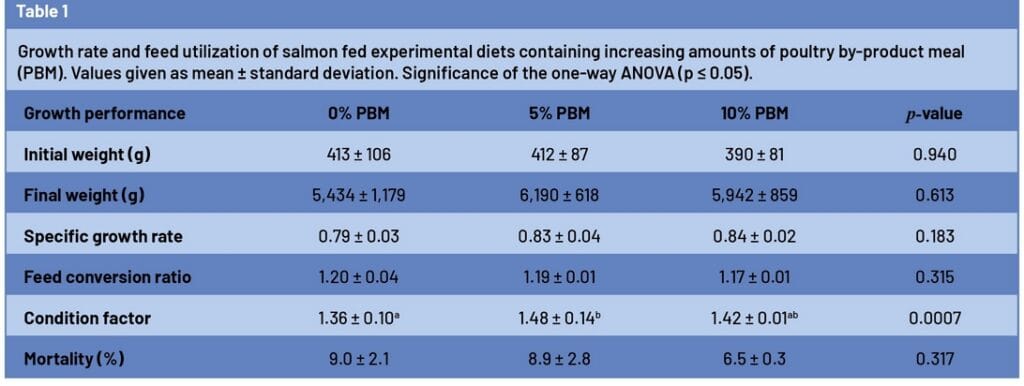
Fish in all cages had three thermic delousing treatments (31 – 32◦C), and two of the cages fed 0% PBM needed a fourth treatment at the end of the experiment due to higher lice numbers. Growth performance results showed no differences between the dietary groups for initial and final weight, mortality, feed conversion ratio or specific growth rate (Table 1).
Welfare parameters
External and internal welfare parameters demonstrate good welfare for all dietary groups. Fish fed 5% PBM had a significantly higher condition factor (p = 0.0007) compared to the control group. Fish fed 10% PBM had a lower ulcer score (p = 0.03) and darker liver color (p = 0.02) compared to the control group fed 0% PBM, yet the differences between the dietary groups were numerically small. No fish in the 10% group had ulcers, 6/30 fish had ulcers in the control group and 2/30 in the 5% group. Scores for scale loss, skin bleeding, cataract, opercula deformities, viscerosomatic index, visceral fat and heart surface fat were comparable between the groups.
Product quality
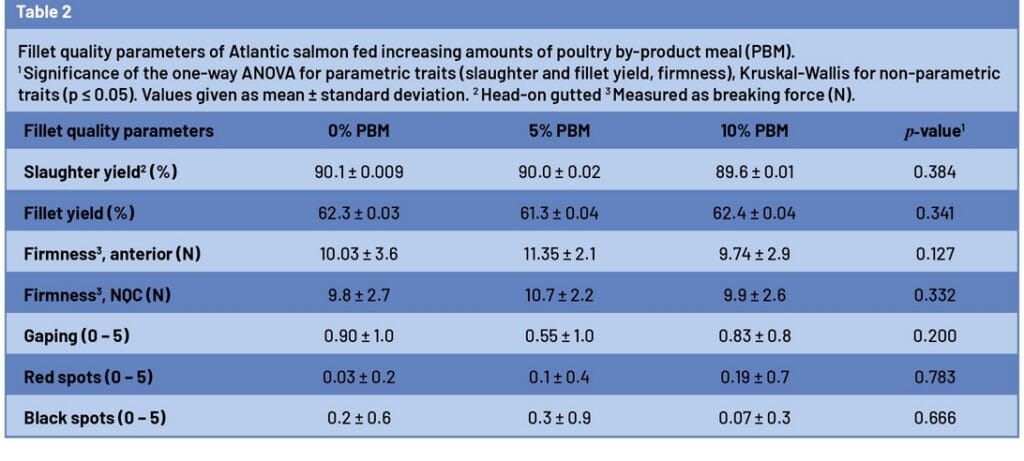
Product quality results are summarized in Table 2, and similar results were found for the three dietary groups. No differences were detected in fillet color or pigment concentration, except for a modest but significant difference in the anterior Salmo- Fan™ measurement between the control and 5% PBM (control: 25.0 vs. 5% 24.4, p = 0.03). The chemical analysis of the fillets revealed a significant increase in dry matter content between the control group and the two PBM groups, and a significant difference in total fat between the control group and the 5% PBM group.
Histology
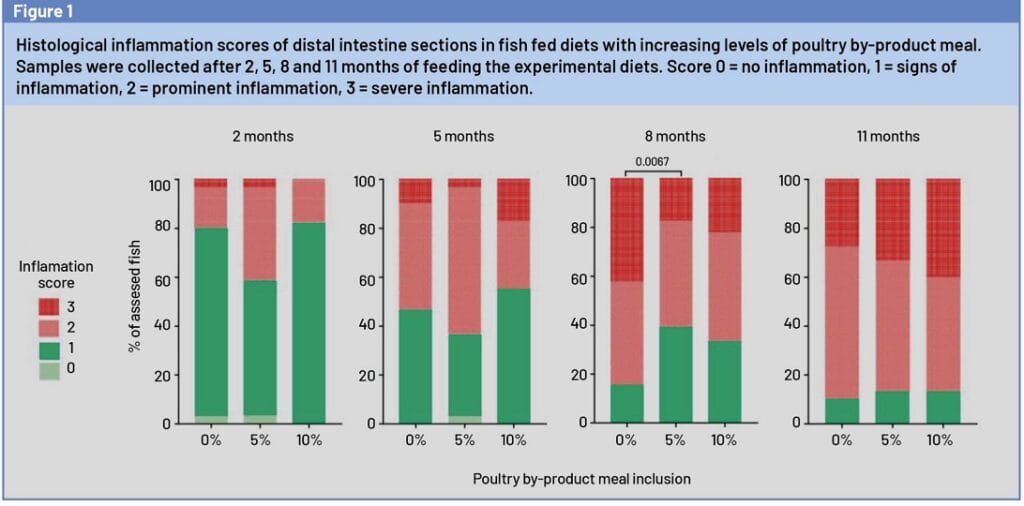
Samples collected before exposure to experimental diets, showed no differences between dietary groups. Inflammation scores increased throughout the experimental period with comparable scores between dietary groups (Figure 1). At the 8-month sampling, fish fed 0% PBM had a significantly higher inflammation score compared to fish fed 5% PBM (p = 0006), but compared to fish fed 10% PBM, there were no significant differences.
Replacing conventional protein with PBM supports a circular economy by transforming low-value by-products into high-quality food. Moderate inclusion of up to 10% is a suitable protein source for Atlantic salmon farmed under commercial-like conditions.
Discussion
This study aimed to evaluate the impact of poultry by-product meal (PBM) inclusion in diets for Atlantic salmon (S. salar) under commercial- like field conditions. PBM, a high-protein alternative derived from poultry processing showed comparable results across all groups (0%, 5%, 10% inclusion) for growth performance, welfare scores, gut histology, and product quality.
Previous studies found no negative effects of PBM on growth up to 28% inclusion (Hatlen et al., 2015). In this trial, deformities observed in all groups were likely due to early-life phosphorus deficiency, not diet. The 5% PBM group showed higher condition factor and fillet fat content, likely from higher final weights, though this did not translate to higher yield. Ulcer presence, a welfare concern in Norwegian salmon farming, was lowest in the 10% PMB group but differences may be confounded by delousing treatments, known to increase and handling.
A circular bioeconomy approach promotes nutrient recovery by using existing resources likeby-products, which improves sustainability in aquaculture
Overall, 83% of fish were graded as “superior,” with no significant differences among groups. Relative filled fat was higher in the 5% group, but fatty acid composition remained unchanged, likely due to PBM’s low lipid content (7.9%) and consistent use of fish oil and rapeseed oil across diets. Fishmeal inclusion decreased slightly with increased PBM, but did not affect fatty acid profile.
Pigmentation, critical for market value, was unaffected despite slightly lower astaxanthin levels in the 0% PBM group. Filled color depends not only on pigment concentration but also on stress and postmortem changes (Heia et al., 2009).
PBM inclusion had no negative effects on fillet texture or gaping. Histological analysis showed no significant impact of PBM on inflammation, vacuolization, or ectopic goblet cells in the distal intestine. While PBM could reduce reliance on plant proteins and associated antinutritional factors, inflammation severity increased with inclusion, suggesting other causes.
Despite limited use in the EU, PBM is widely accepted elsewhere. Barriers in the EU include low consumer acceptance, supply variability, and competition from the pet food sector. Further research is needed to define optimal inclusion levels and assess long-term sustainability and economic impacts.
Product quality results were comparable across all dietary groups, with no diflerences detected in fillet color or texture. Overall, 83% of fish were graded as ‘superior,’ regardless of the level of poultry by-product meal inclusion.
Conclusion
The present study demonstrated that PBM can replace 10% of conventional protein ingredients in diets for Atlantic salmon, without adverse effects on physical pellet quality, growth performance, welfare, distal intestine histology or product quality. Thus, we conclude that moderate inclusions of PBM of up to 10% is a suitable protein source in diets for Atlantic salmon farmed under commercial-like conditions during the grow-out phase in seawater. Additionally, the inclusion of PBM in salmon feed contributes to circular economy by transforming lowvalue by-products into high-quality food and may enhance sustainability of the aquaculture sector.
This is a summarized version developed by the editorial team of Aquaculture Magazine based on the review article titled “POULTRY BY-PRODUCT MEAL IN DIETS FOR FARMED ATLANTIC SALMON SUPPORTS HIGH GROWTH PERFORMANCE, FISH WELFARE AND FILLET QUALITY UNDER COMMERCIAL-LIKE FIELD CONDITIONS” developed by: HAUG EIDE, L – Eide Family AS, Eikelandsosen and Norwegian University of Life Sciences; FORMANOWICZ, J., RØSVIK, M., DJORDJEVIC, B., and ØVERLAND, M. – Norwegian University of Life Sciences; KUIPER, R. and BENDIK DALE, O. – Norwegian Veterinary Institute. The original article was published, including tables and figures, on MAY, 2025, through AQUACULTURE REPORTS. The full version can be accessed online through this link: https://doi.org/10.1016/j.aqrep.2025.102843