

By dsm-firmenich
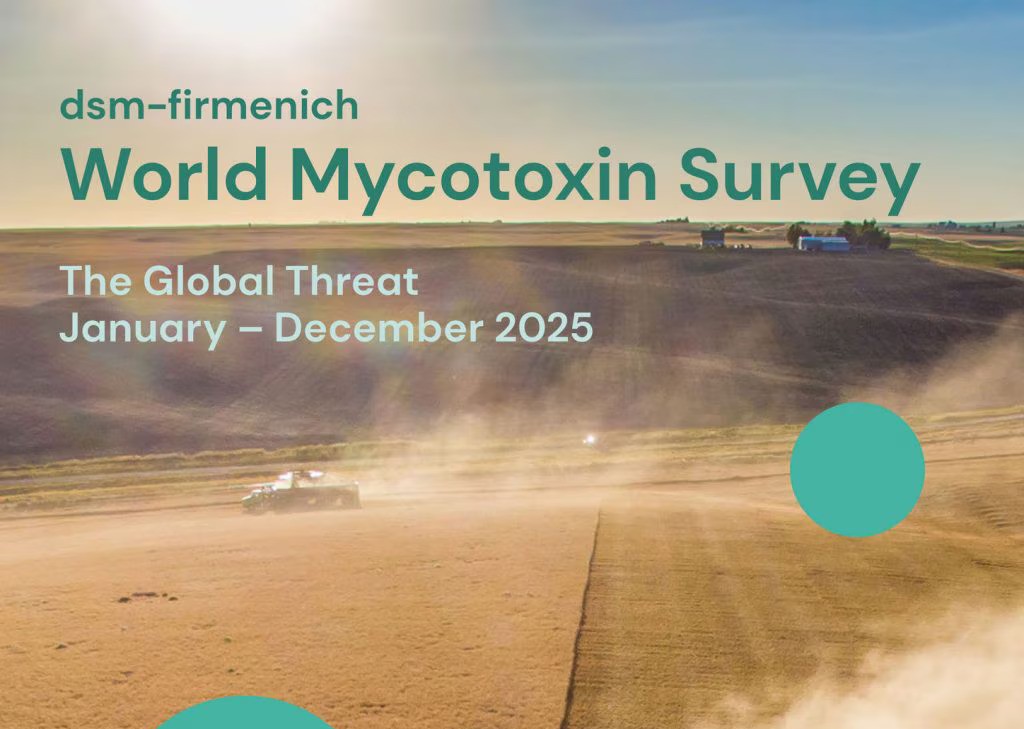
dsm-firmenich Animal Nutrition & Health has released the results of the World Mycotoxin Survey from January to December 2025.
Mycotoxins are naturally produced by the fungi that can contaminate feed raw materials in the field and during storage. When ingested by animals, mycotoxins have a wide range of negative effects such as impaired reproduction, digestive disorders, carcinogenicity, and reduced performance.
About the Survey
Since 2004, dsm-firmenich Animal Nutrition & Health has analyzed thousands of global feed samples annually to understand and monitor contamination levels of the different mycotoxins in a variety of feed ingredients. This information is shared in the quarterly dsm-firmenich World Mycotoxin Survey, which accurately identifies mycotoxin risks based on animal species and location.
Effective mycotoxin risk management should include frequent testing along with a multi-strategy mitigation approach.
The Results
✓ In December 2025, a total of 25,626 samples were collected and analyzed from 95 countries around the world. Compared to 2024, results concluded that all 6 main mycotoxins increased, including aflatoxin, zearalenone, vomitoxin, fumonisins, T-2 mycotoxin, and ochratoxin A.
✓ In 2025, an increased number of regions were discovered to be at extreme risk including: North & Central America, South Aisia, parts of Europe, Middle East, Sub-Saharan Africa, China & Tiwan.
✓ The mycotoxin risks that threaten feed quality and animal performance globally vary across regions worldwide, with multiple kinds of mycotoxins often occurring together.
The survey also includes further details on:
✓ Trends in mycotoxin occurrence over the years.
✓ Prevalence levels for each mycotoxin in each region.
✓ Global and local risk levels for each mycotoxin.
✓ Risk levels posed to each species: poultry, swine, ruminants, and aquaculture, helping you tailor mitigation strategies.
✓ Comparison of prevalence levels from January-December 2024.
✓ Insights on mycotoxin levels in grains and soy from major producing countries.
More information about Spectrum 380®, the most advanced mycotoxin analysis method developed in partnership with the University of Natural Resources and Life Sciences Vienna (BOKU).
Overview on the occurrence of the most frequent mycotoxins, their masked and modified forms as well as emerging mycotoxins; based on results delivered by the most comprehensive commercially available multi-mycotoxin method, Spectrum Top®50.
Additionally, a range of key by-products and alternative feed components were tested, analyzing metabolites found and their prevalence with numerous mycotoxins discovered. The global contamination of key by-products and alternative feed components is summarized in the dsm-firmenich Mycotoxin Survey.
Ursula Hofstetter, Head of Mycotoxin Risk Management at dsm-firmenich stated “The 2025 results show a continued mycotoxin challenge, with contamination rates rising for both Aflatoxins and Zearalenone, and average levels increasing across all major mycotoxins. We’re also seeing an expansion of extreme-risk regions reinforcing the importance of effective mycotoxin management strategies to support animal welfare, productivity, and the profitability of feed and animal protein production globally.”
About dsm-firmenich Animal Nutrition & Health
In 2024, dsm-firmenich shared its plan to find a new owner for the Animal Nutrition & Health (ANH) business, including vitamins. ANH, a dsm-firmenich company, is a global leader in animal nutrition and health, as well as vitamins, carotenoids, and aroma ingredients. ANH is an innovation leader and increased its sales to USD 3.88 billion with a team of more than 7,800 people, driven by its strong purpose: feeding the planet without costing the earth. Together, we make it possible.
For more information: www.dsm-firmenich.com/ANH