
Editorial Staff | Aquaculture Magazine, with information from MIT
Source: Massachusetts Institute of Technology (MIT), on a paper published in ACS Nano. Results are reported by the research team.
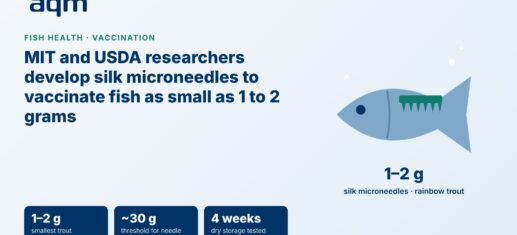
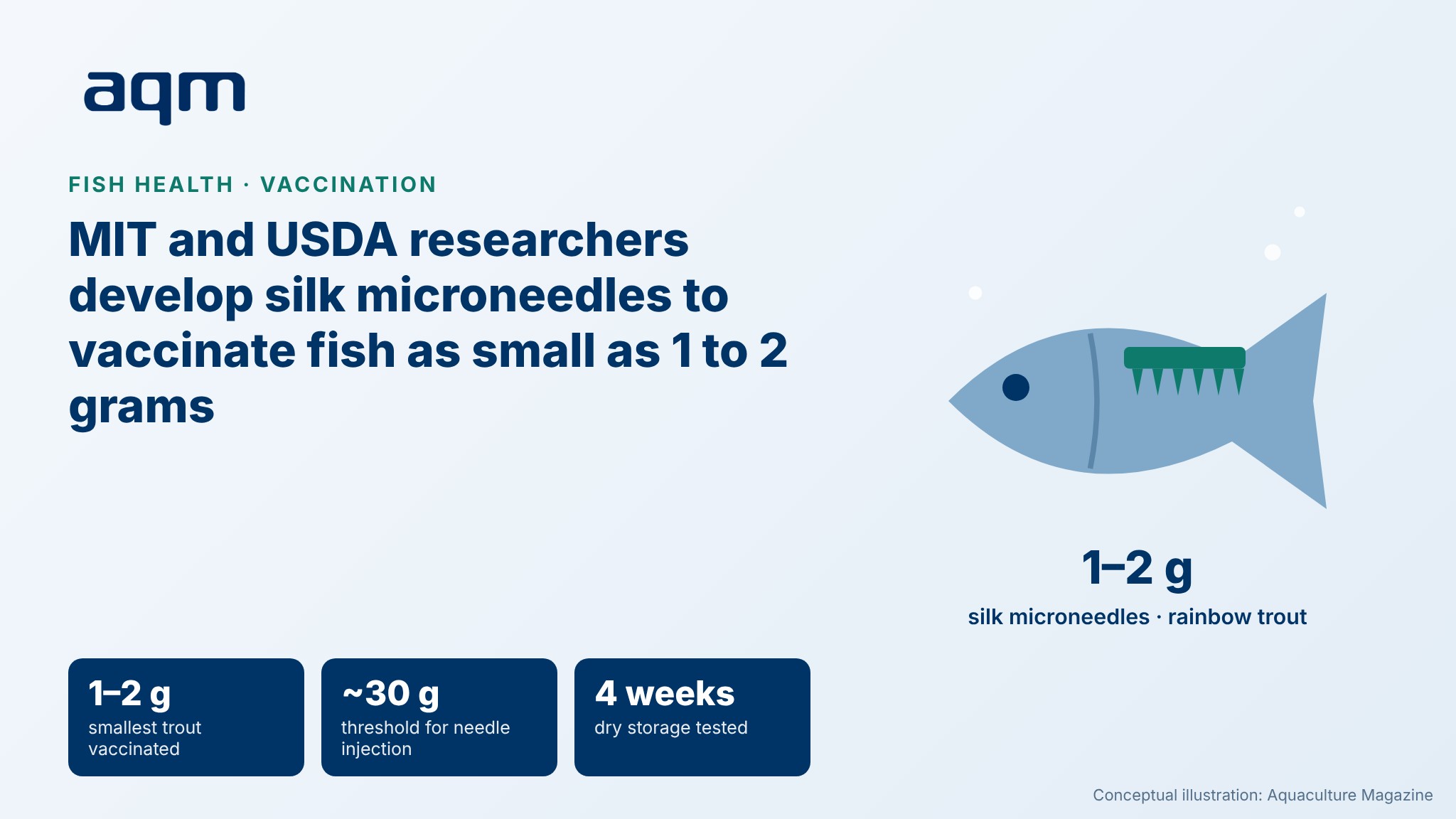
A team from MIT and the U.S. Department of Agriculture developed water-resistant, food-grade silk microneedles that delivered vaccines underwater to fish as small as 1 to 2 grams, below the roughly 30 grams at which needle-based vaccination starts to work well in trout.
Researchers at the Massachusetts Institute of Technology (MIT) and the United States Department of Agriculture (USDA) have developed a new way to administer vaccines to farmed fish. The approach uses water-resistant, food-grade silk microneedles that lightly penetrate and remain attached to fish skin before decomposing. In a paper published in ACS Nano, the team described the system and showed that it can deliver a range of cargos, including bacterial vaccines.
“Our approach could give farmers a more precise tool to maintain fish health,” said Benedetto Marelli, a professor in MIT’s Department of Civil and Environmental Engineering. The researchers note that work remains before the device can be used at scale in fish farms, and describe the paper as a first step.
Small juveniles are left unprotected by needle vaccination
As with terrestrial animal vaccines, fish vaccines are most effective when administered early in life, before exposure to disease. “In trout aquaculture, one of the biggest challenges we face is preventing disease early in a fish’s life, because traditional needle‑based vaccination just doesn’t work well until the fish reach about 30 grams, which leaves the smallest juveniles unprotected during a critical growth period,” said Gregory Wiens, a researcher at the USDA’s National Center for Cool and Cold Water Aquaculture.
According to Wiens, the research shows that food-grade silk fibroin microneedles can deliver vaccines underwater to fish as small as 1 to 2 grams. The single-use microneedles were designed to pierce wet skin, stay attached while the fish swim, and release either bacterin or DNA vaccines in a controlled way. The team tested the approach in rainbow trout.
Silk fibroin microneedles delivered vaccines underwater to fish as small as 1 to 2 grams; in trout, needle injection works well only from about 30 grams.
A shellac layer keeps the silk water-resistant
Marelli’s lab has developed silk microneedles to deliver nutrients to plants for years. The silk is classified as safe for human consumption in food coatings and degrades in the body or the environment over time. Early designs for fish, however, dissolved quickly in water, releasing the vaccine immediately and failing to penetrate the skin.
The system described in the new paper adds a thin layer of shellac, an insect-secreted resin used in food coatings and pills, which acts as a moisture barrier and keeps the microneedles intact before they reach the fish. “Our criteria were safety for fish and humans alike,” said Meng Li, an MIT postdoc and first author of the paper.
Release times from 15 minutes to 24 hours
The researchers showed that the microneedles can store a range of vaccines and demonstrated versions that lasted longer in water or diffused vaccines more quickly. “In some cases, you may want the vaccine released within 15 minutes, but in others, the release can last 10 or even 24 hours,” Li said.
The microneedles also preserved half of the DNA plasmids’ structure when stored for four weeks in dry conditions. According to Marelli, this stability matters for the last mile of delivery in rural areas, where farmers could rely less on cold-chain infrastructure.
The project received support from MIT’s Abdul Latif Jameel Water and Food Systems Lab (J-WAFS), and Li received a USDA fellowship in 2024. The U.S. Geological Survey gave the researchers access to a DNA vaccine for rainbow trout. Non-antibiotic tools for fish health are a recurring topic in Aquaculture Magazine, including alternative strategies to antibiotic-based treatment.
Frequently asked questions
What did MIT and USDA researchers develop for fish vaccination?
Water-resistant, food-grade silk microneedles that lightly penetrate and remain attached to fish skin before decomposing, releasing vaccines such as bacterins or DNA vaccines. The work was published in ACS Nano.
How small can fish be vaccinated with the silk microneedles?
The researchers report that the microneedles delivered vaccines underwater to fish as small as 1 to 2 grams, whereas in trout traditional needle-based vaccination does not work well until fish reach about 30 grams.
How long do the microneedles take to release the vaccine?
Different versions released vaccines within 15 minutes or over 10 to 24 hours, according to the researchers.
Sources and Methodology
Content type: news based on information released by MIT about a peer-reviewed paper in ACS Nano, prepared by a contributor to Aquaculture Magazine. Authors of the paper: Meng Li (first author), Jad Raad, Yunteng Cao, Yue Hu, Colleen Wolfe, Doyoon Kim, Bradley Frank, Gregory Wiens and Benedetto Marelli. Note on the data: the information released does not report survival rates, antibody titers or protection levels after challenge, nor the number of fish tested; results are reported by the research team. Image: conceptual illustration by Aquaculture Magazine, not to scale.
Aquaculture Magazine covers technology, production and business news for the global aquaculture industry.