Sponsored article. This article is sponsored by Reef Industries, Inc. The research summarised here was conducted and published independently by the USDA Agricultural Research Service. The sponsor had no involvement in the study, and the study did not evaluate or compare liner products or brands.
Editorial Staff | Aquaculture Magazine
Source: Green, B.W., Rawles, S.D., McEntire, M.E. & Ray, C.L. (2024). Journal of the World Aquaculture Society 55: e13087. Open access under CC BY-NC-ND. DOI: 10.1111/jwas.13087
Two trials at the USDA Harry K. Dupree Stuttgart National Aquaculture Research Center show yield rising in a straight line with stocking rate, up to 38.3 kg/m³. Individual weight moves the other way, and the trade-off is what determines whether the extra fish pay for themselves.
Green et al., 2024
141–143 and 78–79 days
Outdoor mixotrophic biofloc tanks
The stocker phase is a planning decision, not a technical detail
Intensive production of market-size tilapia generally requires two or more grow-out phases. Fingerlings are grown to stocker size, roughly 10 to 200 g per fish, and then restocked at lower densities for growth to market weight. Choosing the stocking rate for each phase is one of the decisions that determines how efficiently the culture unit is used.
The requirement is not uniform across markets. Producers stock 30 g and 60 g stockers at the start of two grow-out phases in Brazil and Jamaica respectively, while Mexico and Pakistan stock 40 g and 32 g fish for a single grow-out phase. In temperate and subtropical climates, stocker fish produced in the first season are over-wintered in temperature-controlled facilities before being moved to ponds.
Green and colleagues, at the USDA Agricultural Research Service centre in Stuttgart, Arkansas, tested how far stocking rate can be pushed in an outdoor mixotrophic biofloc system, and what it costs in fish size when it is.
Two studies covered stocking rates from 50 to 300 fish per square metre
Hybrid tilapia (Oreochromis aureus × O. niloticus) were raised in outdoor mixotrophic biofloc tanks in two separate studies with different tank sizes, densities and durations.
Table 1. Design of the two studies
| Parameter | Study 1 | Study 2 |
|---|---|---|
| Tank size | 18.6 m² (15.7 m³) | 4.7 m² (3.6 m³) |
| Stocking rate | 50–150 fish/m² | 100–300 fish/m² |
| Equivalent per volume | 59–178 fish/m³ | 132–396 fish/m³ |
| Increment between treatments | 25 fish/m² | 25 fish/m² |
| Duration | 141–143 days | 78–79 days |
| Mean water temperature | 26.5 °C | 27.1 °C |
Source: Green et al. (2024). Swipe horizontally on small screens.
Yield rose linearly with stocking rate in both studies
Gross and net fish yield, average daily feed ration, total feed fed and total sodium bicarbonate added all increased linearly with stocking rate in both studies. Across the full range tested, yield ranged from 20.1 to 38.3 kg/m³.
Linear regression models best described growth to stocker size in both studies. That linearity is the practical finding: within the ranges tested, the system did not reach a point where adding fish stopped adding yield.
Individual weight moved in the opposite direction
Average weight at harvest was inversely related to stocking rate, decreasing quadratically in Study 1 and linearly in Study 2. Fish ranged from 389.8 down to 163.4 g in Study 1, and from 155.2 down to 81.4 g in Study 2. Weight gain decreased quadratically with stocking rate in both.
More fish per cubic metre delivers more kilograms, but smaller individuals. Which of the two matters depends entirely on the size of stocker the next production phase requires.
Survival and feed conversion held steady across every density tested
Survival was independent of stocking rate in both studies, averaging 94.4% in Study 1 and 95.4% in Study 2. Feed conversion ratio likewise did not vary with stocking rate, averaging 1.16 and 1.03 respectively.
The authors read the stable FCR as an indication that fish were fed efficiently across the range. It also means the reduction in individual weight is a consequence of density itself rather than of deteriorating feeding performance, which matters when deciding whether the trade-off is acceptable.
Health indicators pointed the same way. Hepatosomatic index, viscerosomatic index and intraperitoneal fat content were unaffected by stocking rate, as were all haematological parameters measured, including red and white cell counts, haematocrit and glutathione peroxidase activity.
Both studies were run in HDPE-lined tanks, and the containment surface is part of the system
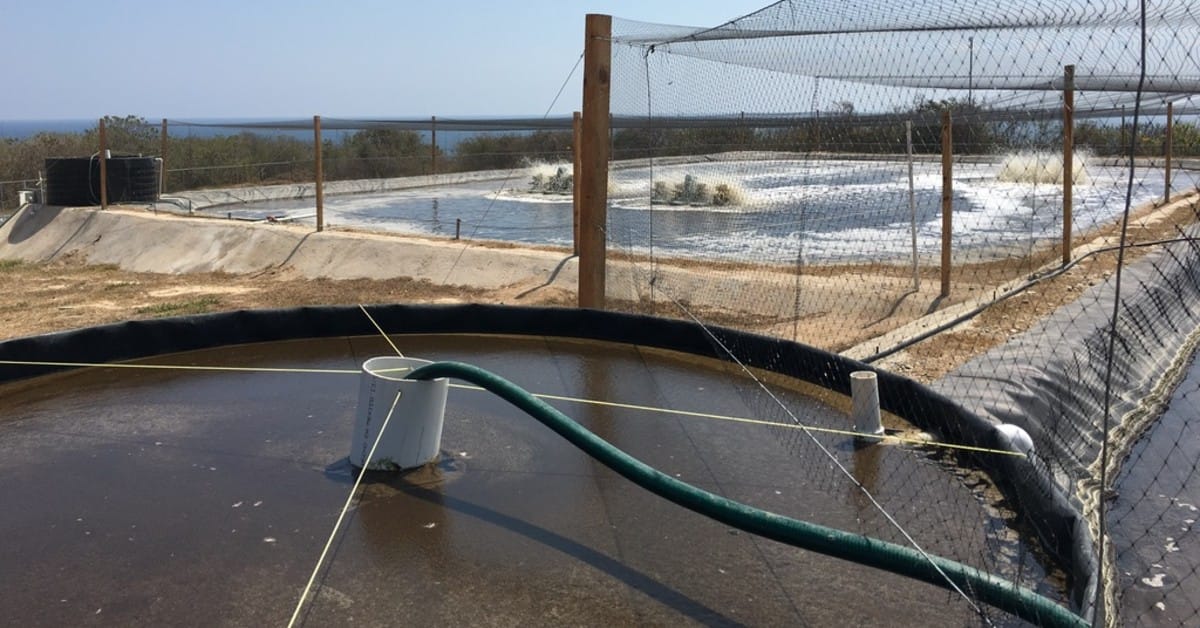
The experimental units in both studies were lined structures rather than earthen ponds. Study 1 used eight rectangular, wood-framed tanks of 18.6 m² lined with high-density polyethylene. Study 2 used nine circular, wire-mesh framed tanks of 2.4 m diameter, also HDPE-lined. Each was fitted with a 130-litre conical-bottom settling chamber on a side stream.
That construction is not incidental to the results. Three of the findings reported depend on it.
Solids management. Settling chambers were drained on average every three days in Study 1, removing between 30.5 and 39.3 kg of solids in dry matter across the trial. Water exchange averaged 0.73% per day in Study 1 and 2.7% per day in Study 2 while the chambers operated. Controlling where solids accumulate and where water leaves the system requires a defined, impermeable boundary.
Water chemistry control. The authors added sodium bicarbonate as needed to hold pH above 7.0, stock salt to maintain a 10:1 chloride to nitrite ratio, and dried molasses as a labile carbon source during biofloc development. Dosing to a known volume, and holding that chemistry, assumes the volume is not exchanging with the surrounding soil.
Geometry independent of the ground. The two studies used different shapes and volumes — rectangular at 15.7 m³ and circular at 3.6 m³ — built on frames rather than excavated. That is what allowed the same research question to be tested across two tank designs in the same facility.
None of this was the subject of the study. Green and colleagues tested stocking rate, not containment materials, and the paper makes no comparison between liner types or between lined and unlined systems. What the paper does establish is the specification of the system in which yields of 20.1 to 38.3 kg/m³ and survival above 94% were obtained: an outdoor, frame-built, HDPE-lined tank with side-stream solids removal.
For a producer reading these numbers as a target, that specification is part of the result.
Water quality tracked feed input, not stocking rate directly
The variables that changed did so in response to total feed input, which in turn increased linearly with stocking rate. In Study 1, mean concentrations of nitrite, nitrate, phosphate and total suspended solids increased linearly with total feed input, and ammonium showed a log-linear relationship. In Study 2, phosphate and TSS increased linearly, pH decreased linearly and nitrate increased curvilinearly.
Total suspended solids reached 591 to 788 mg/L during peak feeding in Study 1 and 510 to 789 mg/L in Study 2. Solids drained from settling chambers rose from 30.5 to 39.3 kg in dry matter as feed input increased.
Dissolved oxygen did not follow the pattern. Mean concentrations ranged from 68.3% to 90.0% saturation and were independent of both stocking rate and feed input, including during peak feeding. In a system where oxygen is normally the first constraint to appear, that finding defines where the operational ceiling was not.
Whole-body composition changed only in ash and energy retention
In Study 2, whole-body dry matter, protein, protein retention and lipid were unaffected by stocking rate. Whole-body ash increased with stocking rate, which the authors attribute to the allometric relationship whereby skeleton and scales account for a larger proportion of body weight as fish size decreases.
Whole-body energy retention decreased significantly with stocking rate, and whole-body energy showed a strong indication of decreasing. These are the only composition variables that responded, and both are consistent with producing smaller fish rather than with a nutritional deficit.
Partial budget analysis favoured higher densities, with one caveat
The authors ran a partial budget analysis on a per-cubic-metre basis for producing a 75 g stocker, considering changes in expenses and income for fish numbers, feed and electricity use.
In Study 1, the net change in profit increased from USD 10.68/m³ to USD 16.70/m³ as stocking rate rose from 50 to 125 fish/m², then fell by 55% at the highest rate tested. Taken end to end, increasing from 50 to 150 fish/m² produced an estimated net change of USD 48.45/m³.
Study 2 was more variable, with no discernible pattern. The largest positive change, USD 18.06/m³, came with the step from 250 to 275 fish/m², while the only negative value, USD 0.29/m³, corresponded to the step from 225 to 250 fish/m². End to end, moving from 100 to 300 fish/m² yielded USD 58.63/m³.
The drop of 55% in Study 1 at the highest density is the most useful number for a producer: the economics improved with density up to a point, and then stopped improving before yield did.
What this means when choosing a stocking rate
The findings support the outdoor mixotrophic biofloc system as a viable route for producing stocker hybrid tilapia at commercial intensity. Three points follow for anyone setting a density.
Start from the stocker size the next phase requires, not from the yield target. Since yield rises and individual weight falls across the same range, the binding constraint is the size specification downstream. A 30 g stocker and a 100 g stocker call for different densities or different durations.
Feed input, not stocking rate, is what drives water quality. The relationships detected were with total feed fed. Monitoring and alkalinity management should be planned against the feed curve rather than against the number of fish stocked.
The economic optimum arrived before the biological one. Yield kept rising linearly while the profit change in Study 1 peaked at 125 fish/m² and then dropped sharply. Maximum yield and maximum return were not the same density.
Questions this article answers
How much does yield increase with stocking rate in a biofloc system for stocker tilapia?
Yield increased linearly with stocking rate in both studies, ranging from 20.1 to 38.3 kg/m³ across stocking rates of 50 to 300 fish/m² in outdoor mixotrophic biofloc tanks. No plateau was reached within the ranges tested.
What does higher density cost in individual fish size?
Individual weight at harvest fell from 389.8 to 163.4 g/fish in Study 1, as stocking rate rose from 50 to 150 fish/m² over 141–143 days, and from 155.2 to 81.4 g/fish in Study 2, from 100 to 300 fish/m² over 78–79 days.
Does higher density reduce survival or worsen feed conversion?
Neither, within the ranges tested. Survival was independent of stocking rate and averaged 94.4% and 95.4% in Studies 1 and 2. Feed conversion ratio was also independent of stocking rate, averaging 1.16 and 1.03.
Which water quality variables respond to increased density?
Those driven by feed input: nitrite, nitrate, phosphate, ammonium and total suspended solids, which reached 591–788 mg/L during peak feeding in Study 1. Dissolved oxygen was the exception, remaining between 68.3% and 90.0% saturation and independent of both stocking rate and feed input.
Is the highest density the most profitable?
Not in Study 1. The net change in profit rose from USD 10.68/m³ to USD 16.70/m³ up to 125 fish/m², then fell by 55% at the highest rate tested. Study 2 showed no discernible pattern. The authors state that further replicated research and economic analysis are needed.
What kind of tanks were used in the trials?
Outdoor HDPE-lined tanks built on frames, not earthen ponds. Study 1 used eight rectangular wood-framed tanks of 18.6 m² (15.7 m³); Study 2 used nine circular wire-mesh framed tanks of 2.4 m diameter (4.7 m², 3.6 m³). Each had a 130-litre conical-bottom settling chamber on a side stream. The study did not compare liner types or brands.
Sources and method
Level 1. Reference with verified DOI. Green, B.W., Rawles, S.D., McEntire, M.E. & Ray, C.L. (2024). Relationship between stocking rate and production of stocker hybrid tilapia and water quality in a mixotrophic biofloc system. Journal of the World Aquaculture Society, 55(5), e13087. doi.org/10.1111/jwas.13087
Licence and status. Open access under Creative Commons Attribution-NonCommercial-NoDerivs. Published 2024; a U.S. Government work in the public domain in the USA. Authors affiliated with the USDA Agricultural Research Service, Harry K. Dupree Stuttgart National Aquaculture Research Center, Stuttgart, Arkansas.
Funding declared by the authors. USDA-ARS, project 6028-31630-006-00D.
Limitations stated in the source. The two studies used different tank volumes, initial fish weights and durations, and are therefore not directly comparable to each other. The partial budget analysis considered only changes in expenses and income for fish numbers, feed and electricity use, for which quantity and price data were available. In Study 1, model parameters deviated substantially from close-to-linear behaviour according to Hougaard’s measure of skewness and Box’s measure of bias. The authors state that additional replicated research and economic analysis are needed to evaluate stocking rate and culture duration for producing specific-sized stocker hybrid tilapia.
Editorial note and sponsorship disclosure. This article is sponsored by Reef Industries, Inc. The study summarised here was designed, conducted, funded and published independently by the USDA Agricultural Research Service, with no involvement from the sponsor, and it did not evaluate, compare or endorse any liner product or brand. Aquaculture Magazine has summarised the published findings and has not conducted independent verification. Figures, conditions and statistical relationships are those reported by the authors. The USDA notes that mention of trade names does not imply endorsement.
This article is sponsored by
Reef Industries, Inc.
Founded in 1957, Reef Industries is a plastic film and laminate manufacturer with more than 60 years of experience, headquartered in Houston, Texas. The company operates five product divisions — Griffolyn®, Permalon®, Armorlon®, Terra Tape® and Banner Guard® — and distributes worldwide. Its Permalon® liners are used for containment applications including ponds, reservoirs and tanks.
Headquarters: 9209 Almeda Genoa Road, Houston, TX 77075, USA
Manufacturing: 10020 Mykawa Road, Houston, TX 77048 · 1951 Amistad Drive, San Benito, TX 78586
Phone: +1 (800) 231-6074
Email: ri@reefindustries.com
Web: reefindustries.com
Aquaculture Magazine is a leading specialised publication for the global aquaculture industry. Published by DP International, Inc., it covers science, technology, markets and trends across the sector. Contact: info@dpinternationalinc.com