
* By Stephen Newman, Ph.D.
This technical analysis by Dr. Stephen Newman evaluates the strategic role of microbial amendments in global aquaculture. By distinguishing between environmental bioremediation and “true” probiotics, the study highlights the superior efficacy of spore-based Bacillus species. It provides a science-based framework for monitoring product performance, emphasizing enzyme profiles over spore counts to ensure operational success and long-term sustainability in production environments.
Introduction
The use of microbial amendments has become a standard operating practice (SOP) in many aquaculture production paradigms, including fish, shrimp, crabs and bivalves, among others, globally including but not limited to ponds, raceways, hatcheries, and broodstock production. Many dozens of companies offer a wide variety of bacteria with claims that range from field proven science based to nonsensical that are all too often geared towards the farmer and not the production environment.
Prior to discussing how one should determine the effectiveness of a given product, reiterating some of the prior observations that I have written about and that are essential for getting the big picture, is relevant for perspective. I want to make one point very clear. I am in no way disparaging the use of a wide range of products that have proven efficacy.
My argument is that, for a number of science-supported reasons, the biochemical nature of spore-based Bacillus products allows them to work as well as, if not better than, many of these. Their ease of use, combined with the nature of the market, makes them the logical choice for most users of bioremediators in aquatic production environments. Our lead tableted product has been in use for 20 years and the concept has been widely copied.
Spore-forming Bacillus species are the logical choice for bioremediation due to their enzymatic versatility and shelf stability. These microbes degrade organic sludge effectively across diverse salinities and temperatures, providing a cleaner environment that maximizes animal growth and lowers Feed Conversion Ratios (FCR).
Discussion
There are a number of approaches to the use of these products. Many vendors offer powdered products for addition to ponds. These are rarely added directly (although some use them this way) but are typically soaked in water before application. This can be a quick approach, as an example, primarily to activate Bacillus spores via a heat shock, or a much longer approach, where-in the suspension is brewed for hours and up to a day. This is done in order to add high levels of actively growing bacteria all at once.
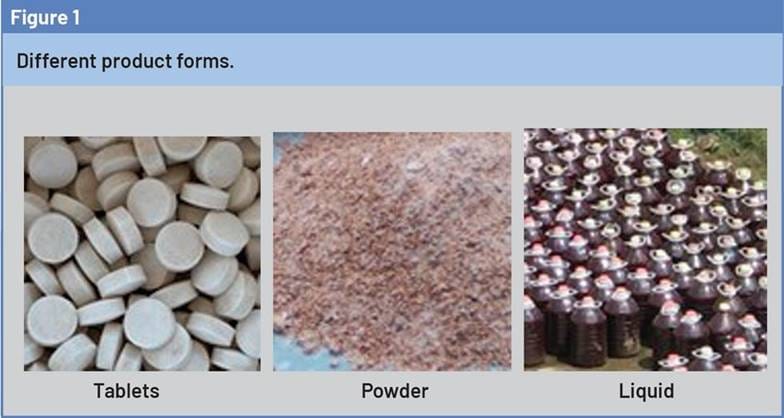
Tablets have been widely adopted as they have been found to be a very, if the not the most efficient way to deliver Bacillus spores to pond bottoms. Some companies offer tablets with other none Bacillus species, typically spray or freeze dried, potentially with limited shelf lives or requiring specific storage conditions (such as refrigeration). Many companies sell liquid products containing photosynthetic bacteria such as Rhodopseudomonas palustris being in wide usage in SE Asia.
Over the last several decades there has been a rapid increase in the numbers of publications in the peer reviewed literature on the use of a wide variety of organisms as “probiotics” for use in aquaculture. While arguments can be made that some of these are better at narrowly based applications, the preponderance of the data strongly suggests that the best for broad ranging bioremediation is spore forming Bacillus species, which can be sold in shelf stable dry forms without loss of viability. Representative examples are depicted in Figure 1 below.
See Table 1 for a written comparison.
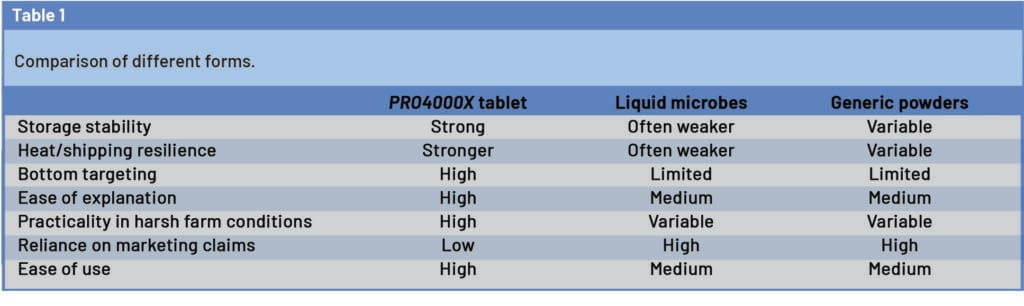
Observations: Bacillus based spores are the best products for bioremediation in aquaculture for a number of reasons. Bacillus species are enzymatically highly versatile and when specific (often proprietary) strains, are used properly, they are the easiest products to use and provide a multitude of impacts in the field. They can be applied to the water column as suspensions of powdered products and directly to pond bottoms as tablets. Photosynthetic bacteria in liquid suspensions are widely used in India and China despite the fact that solid science supports that specific strains of Bacillus species, sold as spores, in a tableted form, work as well or better in general and the consumer is not paying for water.
At the risk of being accused of being pedantic (again), end users often do not understand that when someone sells them a microbial product labeled as a probiotic that this does not necessarily mean that the product functions in the manner that they think that it does. The term is widely used to refer to any microorganisms (bacteria or fungi) that are used in any capacity with any expected outcome in any environment.
Historically, most people when they hear the term probiotic think of blends of bacteria (and/or yeast) that are ingested orally, colonize the gut, alter the microbiome and impact animal health. While the literature suggests that there are examples where impacts are seen on animal health, it is unclear if this is a result of non-specific immune stimulation or a “true” probiotic impact. Most of the products sold and in use today are for the environment, acting typically through bioremediation.
Most aquaculture microbial products act on the production environment through bioremediation rather than stable gut colonization. Ingestion serves primarily as a vehicle for delivering active bacteria into the feces, helping to maintain water quality and reduce niches for potential pathogens.
Observations: The use of microbial products in aquaculture is focused primarily on the production environment. A cleaner stable environment allows animals to maximize their ability to grow, consume feed more efficiently with resulting lower FCRs and ultimately generate higher profits. Ingestion is best considered as a vehicle for delivering spores and metabolically active bacteria in the feces. Stable colonization of the gut by feeding viable bacteria in the field has not been scientifically validated. Repeat applications are required and attempting to modify the microbiome in production environments that by their nature are highly variable is at best. challenging.
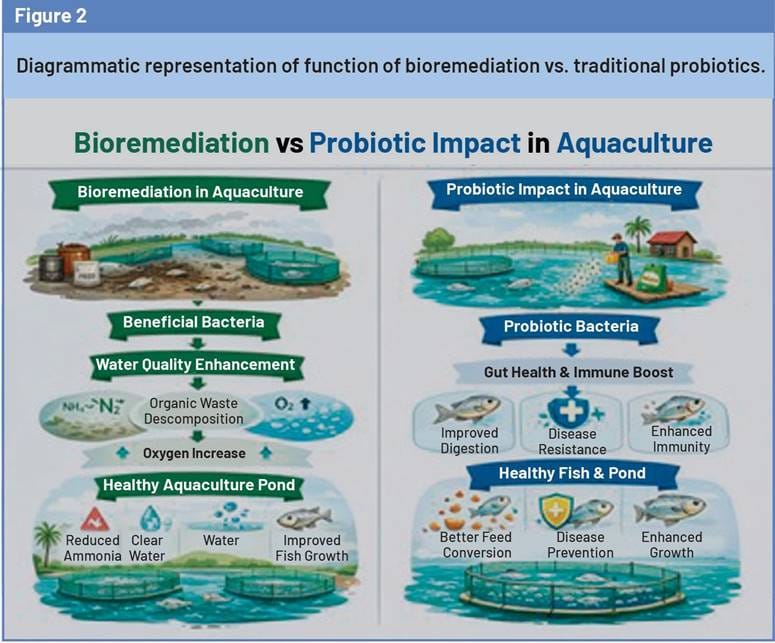
Proper use of Bacillus spores has the potential for a wide range of beneficial impacts many of which have been ascribed to the “probiotic” impact but typically occur in the absence of oral application. Figure 2 below outlines the perceived differences although there is solid evidence that these are not distinct properties and that they overlap. Bacillus species can bioremediate and at the same time have been shown to impact nonspecific immunity with the impacts described below for probiotics. It should be noted that many if not most non toxin producing bacteria strains whether living or dead can stimulate non-specific protective immunity.
Another key feature of bacteria in general is that they are very a diverse, complex and highly evolved group of organisms. The bacterial species that have been designated by the American Association of Feed Officials (AAFCO) in the US as generally recognized as safe (GRAS) are the strains that are present in many of the commercial products.
This does not include just Bacillus but also includes many others. Most of these have strains that would not be appropriate for use. It is clearly stated that for a strain to be GRAS it must not be toxigenic, i.e. it cannot contain genes that are associated with the potential for toxin production or result in disease.
Many if not most of the large numbers of suppliers have little understanding of the complex nature of bacteria. Most laymen think of bacteria as being simple and are aware of the few that can cause problems and those that they consume in their yogurt. There are many vendors that are not concerned, either as a result of ignorance, or apathy, that the risks of using the wrong strains are very real.
Many of the species that are GRAS have strains that would not legally be allowed to be considered GRAS. Buying product from companies that understand this potential for harm and that have professional microbiologists involved in the manufacture, sales and distribution is important for ensuring that GRAS strains are in a given product. It would be naïve to think that the sale of non-GRAS strains does not occur.
Observations: The use of specific bacterial species and strains that are GRAS depends on their not being able to negatively impact animal health either directly because of toxin production or indirectly because of their impact on other components of the microbiome. Bacillus can grow under a wide range of environmental conditions that span the range of production paradigms. Strains that contain toxins and lysogenic phages should never be used. These can pose a serious risk to the production environment. As I have reiterated many times, “Caveat Emptor”, i.e. let the buyer beware.
As discussed elsewhere the impact of a given product depends on a number of factors. Perhaps the single most important is the enzyme profile of the strains. Enzymes are catalytic proteins that speed up chemical reactions. They need cofactors that vary between enzymes, such as metals and vitamins to ensure that they function properly. Without these the enzymes don’t work and the bacteria cannot gain the nutrients that they need to live.
The term “profile” refers to types and quantities of enzymes as expressed by the bacteria. It is essential that the enzyme profiles are able to degrade the many substrates found in accumulated sludge in production systems. The best strains accomplish this via the production of a wide range of enzymes at high levels. Strains that are not well suited have limited production both of the types and quantities of these catalytic proteins.
Of course, as well, the bacteria need to be able to grow under the conditions that they are being used in. Note that some environments, such as those with high water exchange flow rates require the use of innovative approaches such as slow-release substrates or similar approaches that don’t flush the added bacteria out before they have time to act.
Another critical element is how the product is applied. Aquaintech Inc. pioneered, almost 20 years ago, the use of tableted Bacillus spores in aquaculture as this allowed direct application of the spores at high levels to affected areas.
Product efficacy is dictated by the enzyme profile — the type and quantity of catalytic proteins — rather than high spore counts. High-quality strains produce proteases, amylases, and lipases at levels necessary to degrade accumulated organic matter, regardless of the total number of spores per gram.
Observations: Where the product is used, when in the cycle it is used, how much is used and how often it is used all directly impact the end results. While there are some who would have you believe that there is little difference between products and that low-cost products are the same as higher priced products this is usually puffery and a ploy to garner market share. High quality strains cost more. There are many companies in China and India that sell Bacillus strains, some quite inexpensive. The quality of these strains may be suspect especially when pricing of the product is significantly less than that of others in the market place. Buying a USD 5.00 a kg product carries risk when established products run USD 25 or more per kg.
Another important distinction between products is that the number of spores in a given product does not impact efficacy in a manner that one allows one to claim, based on science, that higher spore counts equate with better impacts. Most of the spores don’t germinate and they all do not germinate in the same time frame. A product that claims to have many times the average count of spores per gram of a product that is widely in use does not necessarily mean that it is any better than one with the 4 or 5 billion spores per gram. It could be considered to be puffery to make the claim that it does in the absence of science-based proof.
Yet another import consideration is that there is no relationship between the numbers of species used and efficacy. Efficacy is related to enzyme production and the availability of nutrients and enzyme cofactors. While some strains product enzymes that others do not, there can be considerable overlap between species as to their enzyme profiles.
Observations: Figure 3 demonstrates why spore counts are not what dictate product efficacy. Only a relatively small number of spores germinate determine efficacy. How efficient the vegetative cells are in degrading accumulated organic matter depends on the nutrient loads and enzyme cofactors. Since an unnaturally high level of spores is being added at once this also sets off a cascade of events that include protozoa that feed on germinating bacteria and bacteriophages that destroy vegetative cells. This is how the system in the pond maintains balance. In hatchery tanks the Bacillus can form biofilms since they are being added daily. In production systems such as ponds this is not normally going to happen.
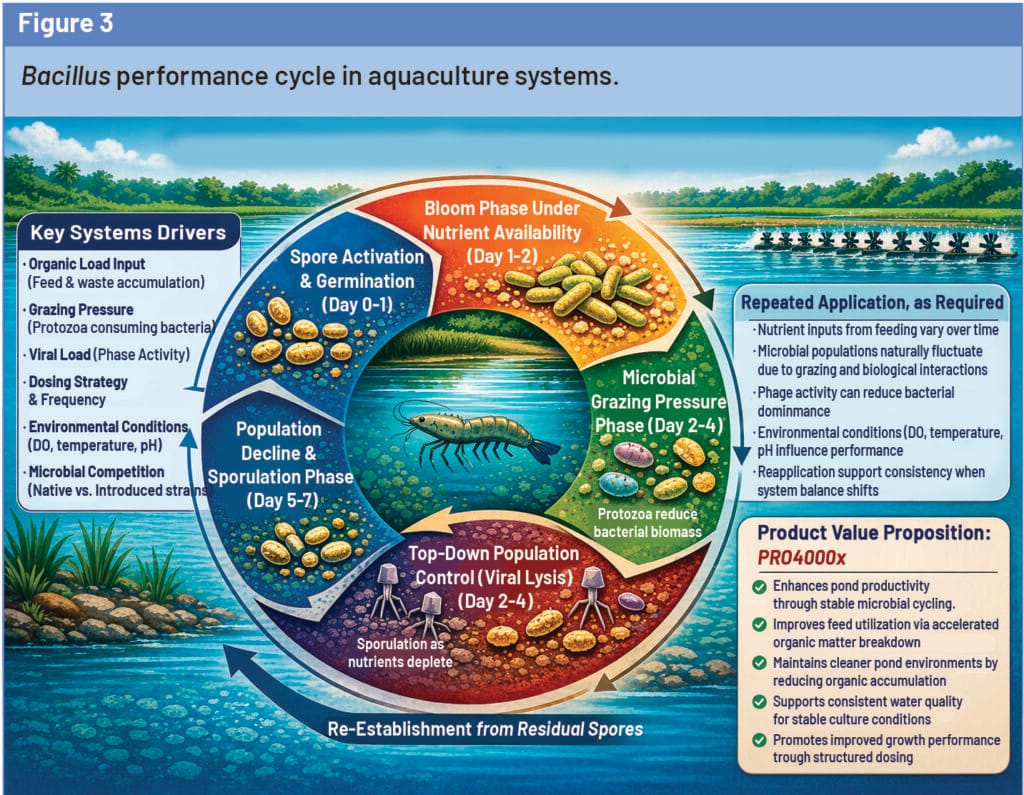
Due to the inherent variability of the environments in which these types of products are employed, higher spore counts are typically employed than likely would be needed to be in some of the environments where they are used. The fact that the products need to be applied repeatedly strongly suggests that there are variables in play that ensure than many of the spores are not ever going to become metabolically active bacteria.
The microbiome in a pond is a very complex assemblage of bacteria, fungi, viruses and protozoa. It includes the water column and the sediment. Even lined ponds will have microbiomes associated with the liners. By their very nature mature microbiomes resist change. The levels and properties of the Bacillus strains that are in PRO4000X are in excess of what would be required under all possible applications.
Observations: Adding bacteria to environments that already have mature microbiomes is the common practice. This limits the potential of the added bacteria (in the instance of Bacillus, their spores) to germinate and compete. Furthermore, it sets off a cascade of events that inherently limit their growth including nutrient limitation and strain specific phages (bacterial viruses) and protozoa that feed off the vegetative cells. Regardless of what one is adding they will not become stable components of the microbiome.
Scientific studies have shown that most of spores do not germinate although they may remain in the environment and could germinate if the conditions allowed it. Because of the complex nature of the microbiome this is not certain and the factors that impact nutrient loads are a major reason why they need to be added repeatedly during the cycle.
Responsible aquaculture requires using only “Generally Recognized as Safe” (GRAS) bacterial strains. Strains must be non-toxigenic and free of lysogenic phages to avoid harming animal health. Professional microbiological oversight is critical to ensure product safety and prevent environmental risks.
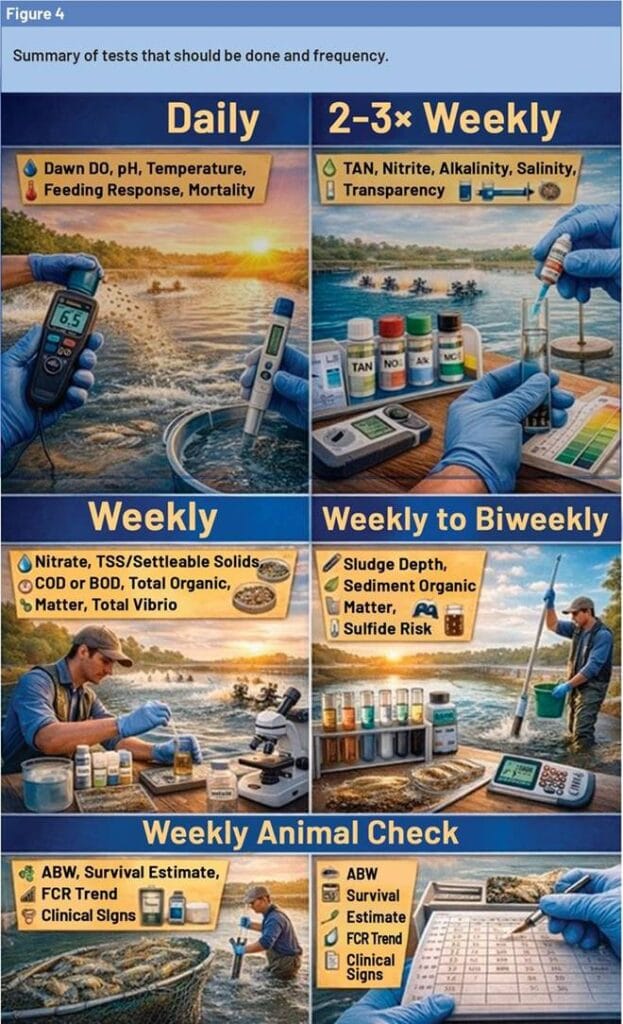
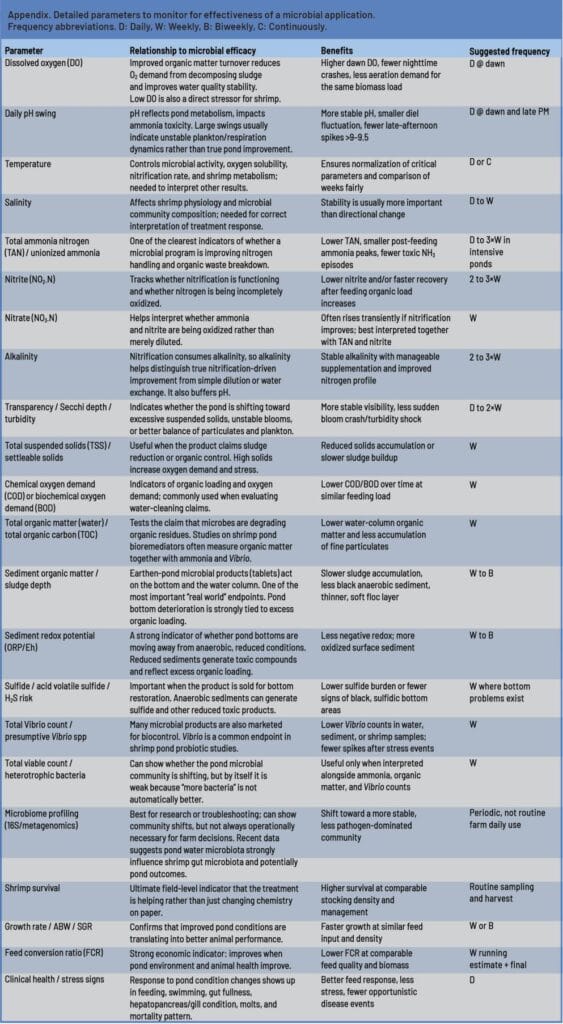
Observations: There are a wide variety of parameters that should be monitored regularly (outlined in Figure 4 and in more detail in the Appendix) as a normal approach to progressive and responsible crop management. For many farmers most of these are far beyond their technical abilities and they have to focus on only a few parameters that can be measured without the need for a lab. Due to the inherent nature of aquaculture production systems, outdoor open to the environment production systems (the most common type of culture) can be highly variable. This variability can be reflected in the impact of adding microbial products and explains some of the variation that can be seen in large scale applications.
Expectations of outcomes of the use of these tools is based on the versatility of the strains and how the product is used. PRO4000X, the first tableted spore-based product has been used in more than a dozen countries with a range of beneficial results.
Observations: While some companies actively claim that the impact of their products is that of true probiotics, as defined above, most of these claims are based on lab studies that do not adequately address what happens in a real-world production environments. There is scant scientific evidence based on what is happening in the field to support these claims. While it may be possible to effectively alter the microbiome in small ponds or tanks where high loads of specific bacteria can be added routinely and cost effectively this is simply not an economic or biologic reality in most production paradigms.
The vast majority of products that are being sold act on the environment. Many bacteria and fungi impact the non-specific afferent of animal immune systems. In fact, this impact is so common that it could be considered to be a generic impact. The large number of publications that demonstrate that a very wide range of organisms have this type of an impact support this.
As the Appendix details the impacts can have wide ranging positive benefits on the overall crop resulting in increased profits. Aquaintech has almost 20 years of accumulated data from many billions of animals at different life stages in a dozen countries. Additionally, there a number of peer reviewed science publications that outline a wide variety of benefits. Our customers have reported a wide variety of impacts. These include but are not limited to:
Benefits from client observations on the use of PRO4000X
✓ Dramatic reductions in accumulated organic matter in nursery and production ponds, shrimp (Penaeus monodon, Litopenaeus (Penaeus) vannamei, P. stylirostrus, Macrobrachium rosenbergii), fish including Tilapia and Barramundi and others, crabs, clams, etc. This has been observed in ponds, dirt, lined, and concrete, as well as plastic and other types of tanks, RAS systems, etc. Cleaner environments in production environments due to less accumulated organic matter increases water quality and reduces niches for potential pathogens.
✓ Increased growth rates (one customer reported almost a 15% increase in weekly growth rates)
✓ Increased survivals, better FCRs, cleaner animals with less fouling issues at partial harvests. These benefits can be attributed to the impact of the Bacillus species on the ability of other bacteria with similar nutritional requirements to utilize these nutrients.
✓ Cleaner broodstock tanks, healthier animals better able to tolerate handling and stress. Prevention of exoskeleton lesions due to handling.
✓ Stabilization of ammonia and nitrite/nitrate levels. Less spikes means healthy animals with less stress.
✓ Restores sediments to health by eliminating dead spots that can generate deadly hydrogen sulfide.
✓ Reduction or elimination of off flavor and odor issues.
✓ In shrimp hatcheries, effective control of vibrio loads, smooth molting of larvae, control of Zoeae syndrome, reduction of ammonia and nitrites.
✓ Nonspecific immune stimulation resulting in enhanced survival against the vibrio that causes AHPNS, Vibrio parahaemolyticus. Alterations of gene expression favoring the observed impact. Ask for references.
Long-term field data confirms that tableted Bacillus spores significantly reduce organic waste in ponds and hatcheries. Observed benefits include stabilized ammonia levels, increased weekly growth rates by up to 15%, and enhanced survival against pathogens like Vibrio parahaemolyticus.
Conclusions
Added microbiological products to aquaculture production systems come in several different forms and there are large numbers of organisms that have a range of impacts. The Bacillus species have several distinct advantages, provided the products are formulated with GRAS strains. They form spores which allows them to be sold in shelf stable forms such as tablets which do not require refrigeration or special storage conditions to extend shelf lives.
The enzyme profiles of select strains allows them to degrade a very wide variety of substrates. Bacillus species are an important source for industrial enzymes that are secreted into the environment. They are able to tolerate a wide range environmental conditions with enzymes that work across a broad spectrum of temperatures and salinities. They are a major source of industrial enzymes, some vitamins and nutraceuticals and are widely consumed in fermented foods such as natto.
Their ability to form spores and the range of degradative enzymes including proteases, amylases, lipases, cellulases and many others make them ideal sources of microbial bioremediation for the wide range of aquaculture production systems. Not all strains are the same and many strains do not produce either the desirable enzymes or adequate levels, and some contain toxins and lysogenic phages. Because of the enzyme production variability, there is no correlation between high spore counts and efficacy nor is a product with more species/strain in it necessarily better for it.

* Stephen G. Newman has a bachelor’s degree from the University of Maryland in Conservation and Resource Management (ecology) and a Ph.D. from the University of Miami, in Marine Microbiology. He has over 40 years of experience working within a range of topics and approaches on aquaculture such as water quality, animal health, biosecurity with special focus on shrimp and salmonids. He founded Aquaintech in 1996 and continues to be CEO of this company to the present day. It is heavily focused on providing consulting services around the world on microbial technologies and biosecurity issues. sgnewm@aqua-in-tech.com www.aqua-in-tech.com www.bioremediationaquaculture.com www.sustainablegreenaquaculture.com.
One thought on “Monitoring the Effectiveness of Probiotic/Bioremediator Usage in Aquaculture”