
By Aquaculture Magazine Editorial Team
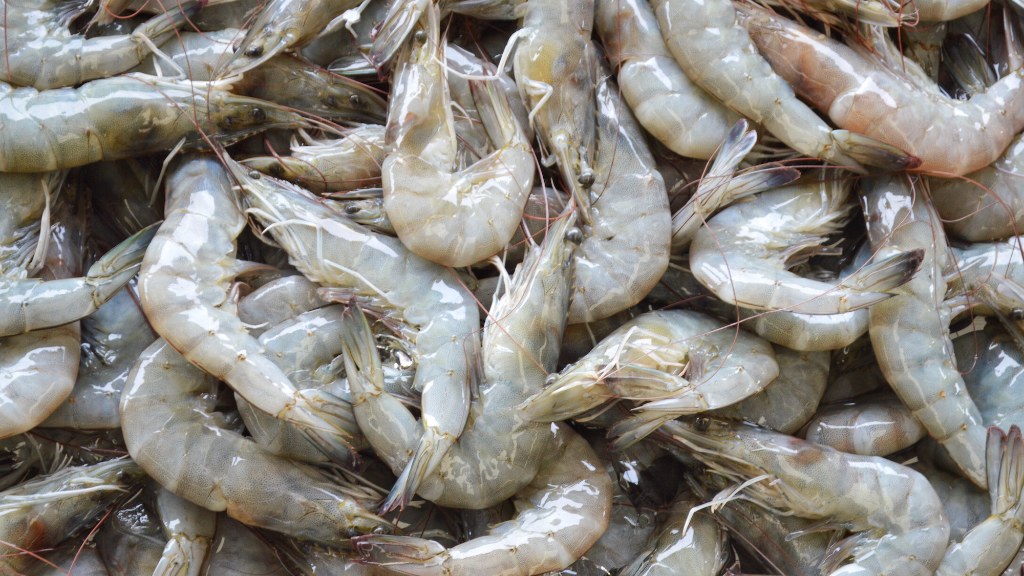
As aquaculture strives for sustainability, replacing fish meal in shrimp diets remains a challenge. This study explores an innovative combination of poultry by-product meal, insect meal, rapeseed meal, peanut meal, single-cell protein, and fish waste. Results show improved growth rates, efficient nutrient utilization, and stable gene expression, proving that alternative protein sources can sustain shrimp health. This breakthrough supports ecofriendly aquaculture without compromising performance.
A diet combining novel, accessible, and sustainable feed ingredients can better meet shrimp nutritional needs ucing reliance on fish meal (FM). This approach ensures a balanced nutritional profile, supporting sustainable aquaculture. Addressing the rising demand for FM, the industry has embraced alternative ingredient combinations, promoting environmentally friendly and effective feed solutions. This strategy not only sustain shrimp growth but also enhances nutrient utilization.
The present study evaluates the impact of various feed ingredient combinations on the growth performance and nutrient efficiency of Penaeus vannamei, aiming to develop sustainable alternatives that support the industry´s long term viability.
Material and Methods
The study was conducted using a 32m3 nursery tank to rear P. vannamei post-larvae (PL12) to juveniles (1 g) under continuous aeration in Koovathur, Tamil Nadu, India. Juveniles were fed a commercial diet (Royal Dragom DT311) four times daily. An 8-week feeding trial at TNJFU used 150-L FRP tanks (one control, four treatments, triplicated). Shrimp (initial weight: ~1.05 ± 0.03 g) were stocked at 35 per tank and fed to satiation. Brackish water (15 ± 1 ppt) was exchanged every three days, and water quality was monitored.
Five distinct protein sources were used to create isonitrogenous (crude protein [CP], 36%) and isolipidic (crude fat [CF], 6%) diets. The various experimental diets were developed in the following ways: Diet 1 (control diet), FM was the primary source of protein; Diet 2, FM was replaced with poultry by-product meal (PBM) and single-cell protein (SCP) (1:1); Diet 3, FM was replaced with insect meal (IM), rapeseed meal (RM) and single-cell protein (SCP) (1:1:1); Diet 4, FM was replaced with fish waste (FW), PM and SCP (1:1:1), and Diet 5, FM was substituted with PBM, SCP, IM, RM, FW and PM (1:1:1:1:1:1). Ingredients were finely ground, homogenized, pelletized (1.6 mm), and dried at 45°C before storage at 4°C. Chromic oxide was added as an inert marker to determine digestibility.
After eight weeks, shrimp were anesthetized and weighed. Growth performance was evaluated. Wholebody proximate composition was analyzed following AOAC (2010) protocols. Amino acid content was determined using UPLC, while fatty acid composition was assessed via gas chromatography. Digestive enzymes (lipase, protease, amylase) were quantified from hepatopancreas and intestine samples. Gene expression of IGF-I and IGF-II was analyzed via real-time PCR, with β-actin as the reference gene.
Fecal samples were collected, dried, and analyzed for digestibility using an inductively coupled plasma spectrometer. Digestibility was calculated based on chromic oxide content. This methodology ensured accurate assessment of dietary impacts on shrimp growth and nutrient utilization.
Results
Growth performance and feed utilization
The 60-day growth trial results (Table 1) showed that shrimp fed diet 1, and 3, and diet 5 exhibited significantly higher final weight and average daily growth (ADG). Specific growth rate (SGR) was highest in diet 1 (4.66 ± 0.14) and diet 5 (4.60 ± 0.06), with no significant difference from diet 3 (4.55 ± 0.07). Feed conversion ratio (FCR) was significantly lower in diet 1 (1.26 ± 0.03) and diet 5 (1.24 ± 0.04). Protein efficiency ratio (PER) was also higher in shrimp fed diet 1 and diet 5. No significant differences (p > 0.05) were observed in shrimp survival across all diets.
Whole body proximate composition
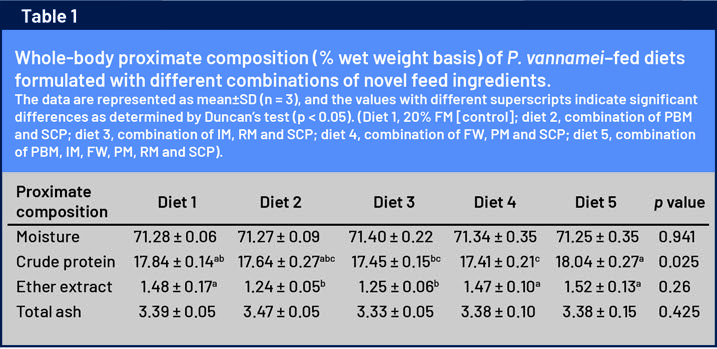
The whole-body composition (Table 1) indicated significantly higher crude protein content in shrimp fed diet 5 (18.04 ± 0.27), similar to diet 1 (17.84 ± 0.14) and diet 2 (17.64 ± 0.27).
Lipid content was significantly lower in shrimp fed diet 2 and diet 3. No significant differences were observed in moisture and ash content across all diets.
Apparent digestibility coefficient
Dry matter digestibility was significantly higher in shrimp fed diet 5 and diet 1. A similar trend was observed in crude protein digestibility. Crude lipid digestibility was highest in shrimp fed diet 1 (76.26 ± 0.53).
Digestive enzyme activity
Hepatopancreas enzyme activity showed significantly higher amylase activity in shrimp fed diet 5, similar to diet 3. Protease activity was significantly higher in diet 1 and diet 5. Lipase activity was highest in the control diet.
Intestinal enzyme activity showed increased amylase activity in shrimp fed diet 1. Diet 3, and diet 5. No significant differences were observed in protease activity. Shrimp fed diet 2 had the lowest lipase activity.
Gene expression activity
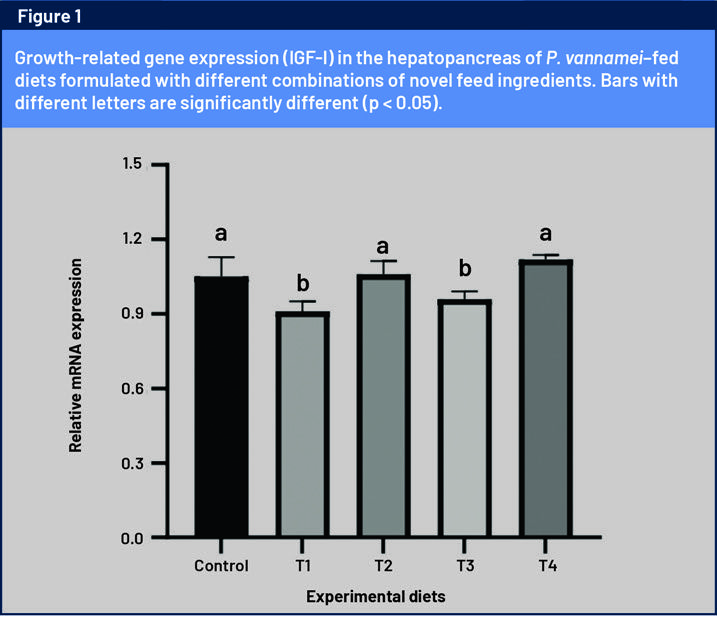
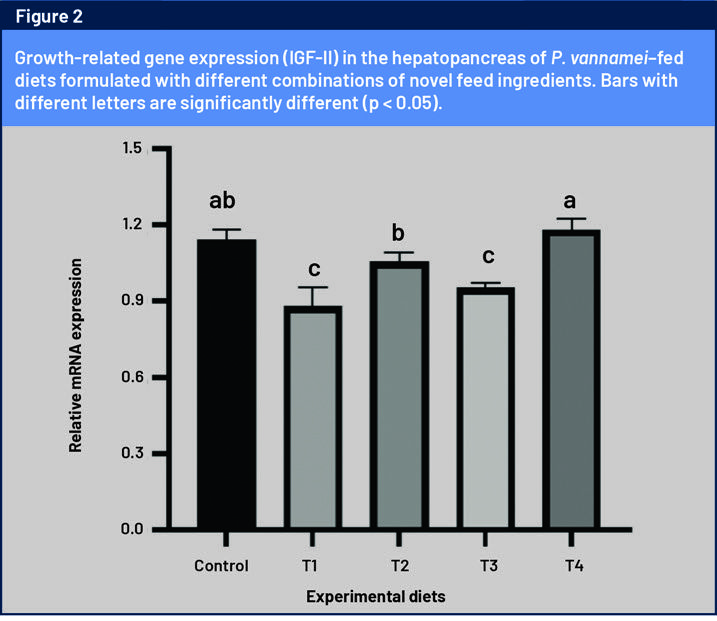
Growth gene expression (IGF-I and IGF-II) data showed significantly increased IGF-I expression (p < 0.05) in shrimp fed specific diets, indicating enhanced growth performance (Figures 1 and 2).
Discussion
Replacing FM with alternative protein sources in shrimp diets, particularly for P. vannamei, has been challenging when attempted at high levels or full replacement. However, some studies suggest that FM can be replaced entirely with terrestrial by-products and plant proteins without affecting shrimp growth or survival. This study evaluated a diet combining various alternative ingredients and found improved SGR and FCR, likely due to a balanced amino acid profile.
Notably, IGF-I and IGF-II gene expression in shrimp fed diet 5 (without FM) vs. similar to that of shrimp on a 20% FM diet, indicating no adverse impact on growth. Therefore, diet 5, composed of PBM, IM, FW, RM, PM, and SCP, can effectively replace FM shrimp diets without compromising growth and nutrient utilization.
Whole-body composition analysis showed no significant differences in total ash content, moisture, or crude protein among diets 1, 2, and 5. Crude lipid content was also similar in diets 1, 4, and 5, supporting the conclusion that alternative proteins provide adequate nutrition. These results align with growth performance and growthrelated gene expression. Digestive enzyme activity plays a crucial role in nutrient absorption.
Amylase and protease activities in the hepatopancreas and amylase and lipase activities in the midgut were comparable across diets, ensuring efficient digestion and absorption of carbohydrates, proteins, and lipids. This efficiency correlates with apparent digestibility coefficients (ADC), higher digestive enzyme activities, and upregulated growth genes, contributing to improved nutrient utilization.
High digestibility is essential for FM replacement. In this study, crude protein and dry matter digestibility were similar in diets 1 and 5, indicating that alternative protein sources were efficiently utilized. Additionally, IGF-I and IGF-II gene expressions were upregulated in diets 1 and 5, demonstrating a strong link between growth performance, digestive enzyme activity, and improved shrimp health and survival.
Conclusion
The finding of this research has revealed that a combination of ingredients containing poultry by-product meal (PBM) + insect meal (IM ) + rapeseed meal (RM) + peanut meal (PM) + single-cell protein (SCP) + fish waste (FW) in (1:1:1:1:1:1) ratio has given the best results as it meets the nutritional requirements of shrimp without compromising growth and nutrient utilization of shrimp. Further, the expression of IGF-I and IGF-II genes and the activity of digestive enzymes confirm that the above combination of diet is best to support the growth performance and nutrient utilization of P. vannamei.
This is a summarized version developed by the editorial team of Aquaculture Magazine based on the review article titled “EFFECT SOF DIETS FORMULATED WITH DIFFERENT COMBINATIONS OF NOVEL FEED INGREDIENTS ON GROWTH PERFORMANCE, APPARENT DIGESTIBILITY, DIGESTIVE ENZYMES AND GENE EXPRESSION ACTIVITIES OF PACIFIC WHITE SHRIMP, PENAEUS VANNAMEI)” developed by: RAJALAKSHMI, K., FELIX, N., RANJAN, A. and SATHISHKUMAR, G.─ Tamil Nadu Dr. J. Jayalalithaa Fisheries University; ARUMUGAM, U.─ Dr. MGR Fisheries College and Research Institute and ISHFAQNAZIR, M─ Sher-E-Kashmir University of Agricultural Sciences and Technology. The original article was published, including tables and figures, on DECEMBER, 2024 through AQUACULTURE INTERNATIONAL. The full version can be accessed online through this link: https://doi.org/10.1007/s10499-024-01803-x