



* By Dr. Dafna Israel and Dr. Allan Heres
Shrimp farming is a critical component in meeting global seafood demand, yet ensuring animal welfare in intensive farming conditions remains a significant challenge. This article explores the key stressors in shrimp aquaculture through a review of relevant literature and highlights how nutritional feed additives can offer targeted solutions, including PAQ-Gro™, a proven stress modulator that shows strong potential in protecting shrimp from various stressors.
Stress in Shrimp Farming
Shrimp farming plays a critical role in meeting global seafood demand, but maintaining animal health under intensive farming conditions remains a major challenge. Stress, driven by complex environmental and management factors, can significantly reduce growth, survival, and overall productivity (Ciji and Akhtar, 2021). This article explores key stressors in shrimp aquaculture through a review of relevant literature and highlights how nutritional feed additives can offer targeted solutions.
Key Stress Factors in Shrimp Farming
Aquatic environments are subject to various imbalances caused by physical, chemical, biological, and procedural factors (Table 1).
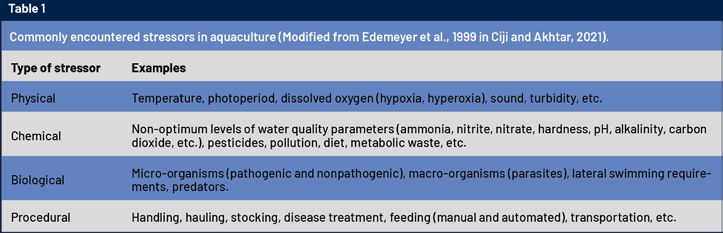
These stressors can lead to poor growth, immunosuppression, reduced disease resistance, and eventually, mortality in farmed shrimp (Ciji and Akhtar, 2021).
Defining a Healthy Crustacean
Coates and Söderhäll (2020) posed the question: What constitutes a ‘healthy’ crustacean? It’s not easy to define. Visible signs such as discoloration, missing limbs, or lesions may indicate stress or disease, but their absence doesn’t guarantee optimal health.
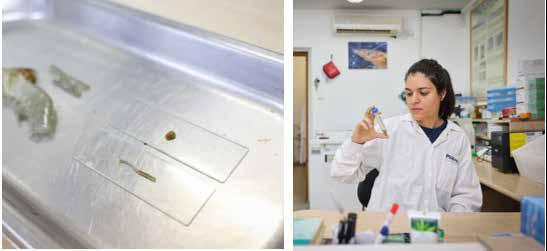
Aquatic invertebrates are continuously exposed to environmental stressors such as temperature extremes, pollutants, and pathogens (Coates and Söderhäll, 2020). Assessing stress in crustaceans involves observing behavioral changes and using biomarkers in hemolymph (blood), including hemocyte counts, enzyme activity, and metabolite levels.
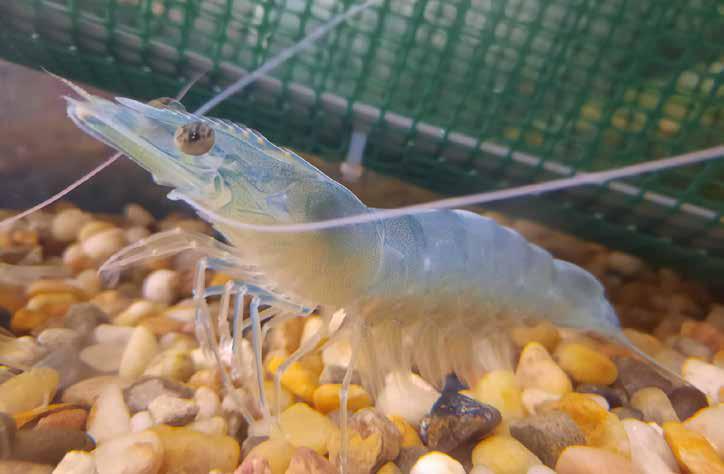
Shrimp health reflects pond conditions. Poor water quality, inconsistent feeding, physical damage, and temperature fluctuations can all affect their well-being. The aquaculture industry increasingly adopts a dual approach: identifying stressors and applying targeted mitigation strategies.
Stress Mitigation Strategies
One widely adopted strategy is the use of feed and water additives. Numerous studies support their effectiveness. For instance, Bunnoy et al. (2024) tested yeast hydrolysate (YH) from sugar by-products in Pacific white shrimp (Litopenaeus vannamei) challenged with Vibrio parahaemolyticus (AHPND).
Shrimp fed YH (10 g/kg feed) exhibited significantly higher survival rates and upregulation of immuneand growth-related genes. Immune markers (Anti-Lipopolysaccharide Factor – ALF –, Lysozyme – LYZ –, Prophenoloxidase – ProPO –, Superoxide Dismutase – SOD) were upregulated in key tissues, while Insulin-like Growth Factor 2 (IGF-2) and RAP-2A were expressed in muscle and hemocytes, respectively. Interestingly, while total Vibrio counts were similar, pathogenic Vibrio colonies were significantly reduced in the intestines of YH-fed shrimp.
Another nutritional feed additive (NFA). that showed promising results under pathogenic challenge was the Zinc Oxide–Nanoscale Silicate Platelet-supported Nanoparticles (ZnONSP). This compound improved zinc accumulation, immune response, stress resilience, and resistance to Vibrio alginolyticus in white shrimp (Penaeus vannamei).
Dietary ZnONSP enhanced hemocyte immune function, including phagocytic rate and respiratory burst. Gene expression analysis showed upregulation of immune genes such as lipopolysaccharide-binding protein, peroxinectin, penaeidin variants, lysozyme, crustin, SOD, glutathione peroxidase, clotting protein, and a-2macroglobulin.
Shrimp fed ZnONSP (800 mg/kg) had a 71.4% survival rate compared to 38.1% in the control group (Liao et al., 2024).
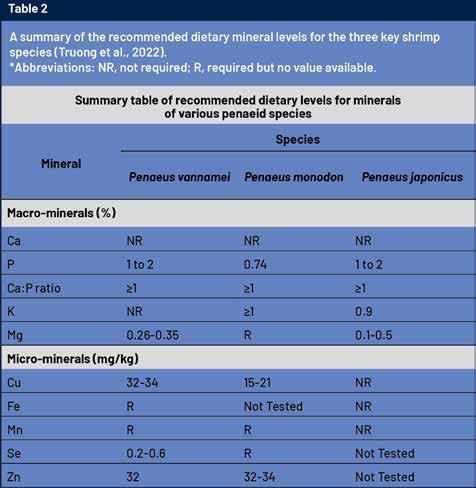
High stocking density (100–300 shrimp/m²) is a common physical stressor that impacts mineral availability and absorption (Truong et al., 2022). A study on Penaeus spp highlighted that intensive systems can increase mineral deficiency risks due to competition and compromised water quality. The mineral content of shrimp tissues was directly affected, emphasizing the importance of monitoring and supplementing key minerals.
Immune Modulation with PAQ-Gro™
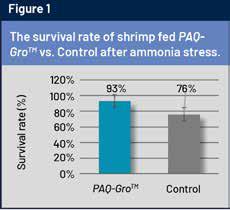
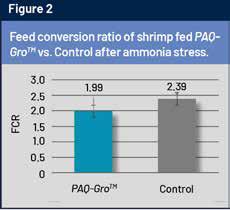
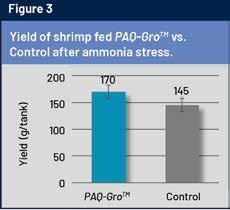
Phibro Animal Health Corporation has developed a proprietary nutritional feed additive (NFA), PAQ-GroTM, specifically designed to modulate the immune system and help shrimp overcome stressful periods, whether physical or pathogenic. This NFA was tested on various species in different settings and challenge models. One of the trials, conducted at the Federal University of Rio Grande do Norte (UFRN) in Brazil, shrimp fed PAQ-GroTM under ammonia stress showed improved survival (93% vs. 76%), better FCR (16% reduction), and a 17% increase in yield.
The objective of this trial was to evaluate the growth performance, survival rate, feed conversion ratio (FCR), and overall health of Pacific white shrimp (L. vannamei) when fed a commercial diet supplemented with PAQ-Gro™, under both normal and chemically induced stress conditions. To simulate stress, two rearing environments were established:
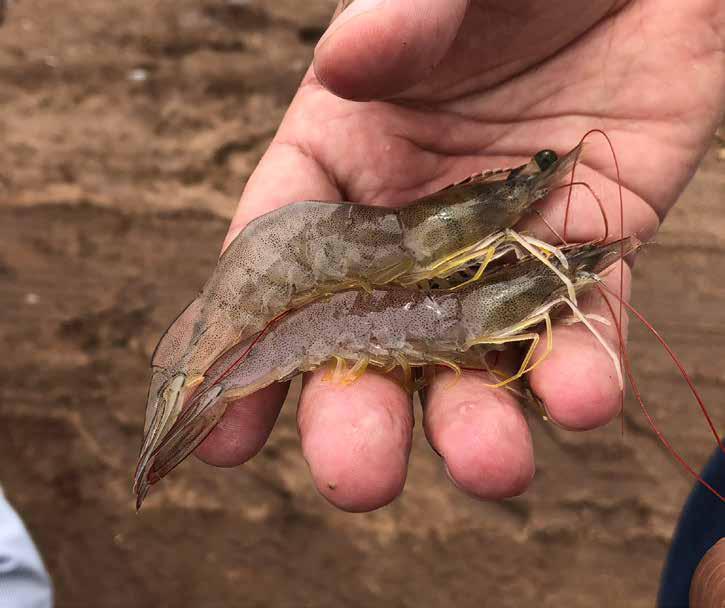
- Optimal water quality (control).
- Chemical stress via ammonia challenge — achieved by adding ammonium chloride and sodium nitrite to maintain ammonia levels up to 6 mg/L and nitrite between 10–16 mg/L.
This experimental design ensured that all groups (both with and without PAQ-GroTM) were exposed to identical water quality conditions, allowing the effect of the additive to be isolated.
Under ammonia stress, shrimp fed PAQ-GroTM exhibited significantly better performance:
» Survival rate increased to 93%, compared to 76% in the control group (Figure 1).
» FCR was reduced by over 16% (Figure 2).
» Overall yield improved by 17% (Figure 3).
These results highlight PAQ-Gro’s effectiveness in mitigating stress and enhancing shrimp performance. By modulating the immune system and improving resilience under challenging conditions, PAQ-GroTM can help farmers achieve better survival, feed efficiency, and profitability.
Another interesting trial demonstrated the benefit of PAQ-GroTM as a stress modulator in pathogenic challenge. The trial was conducted by the Department of Aquaculture, Faculty of Fisheries, Kasetsart University,
Thailand. In this trial two groups of (Litopenaeus vannamei) were tested: one was fed by PAQ-GroTM (6 kg/MT of feed) the other without (Control). After 4 weeks of feeding, the shrimps were challenged with Vibrio parahaemolyticus by immersion treatment, and then a 14-day follow-up was conducted.
Results: Growth and Survival.
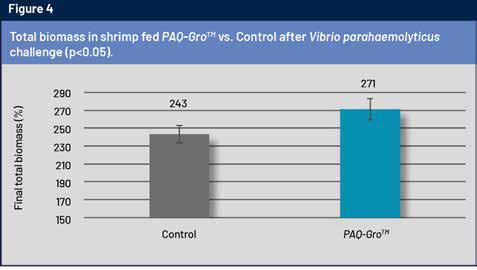
» Shrimp in the PAQ-GroTM group showed significantly higher total biomass (Figure 4).
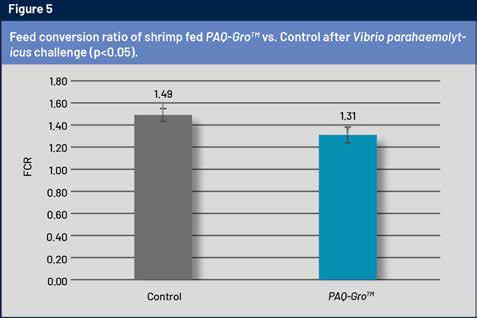
» Feed conversion ratio (FCR) was lower (Figure 5).
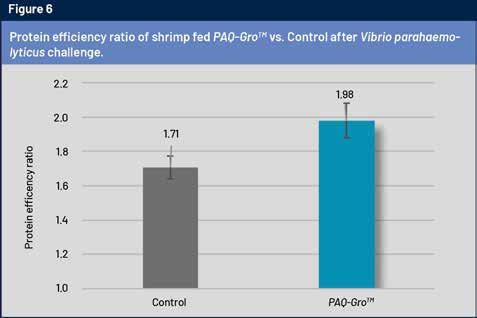
» Protein efficiency was higher (Figure 6).
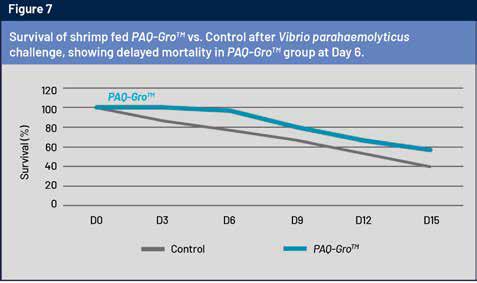
» Mortality was delayed by six days in the PAQ-GroTM group, while the control group experienced mortality immediately following the challenge (Figure 7).
Results: Immune Response.
Shrimp fed PAQ-GroTM also exhibited enhanced immune function under stress conditions:
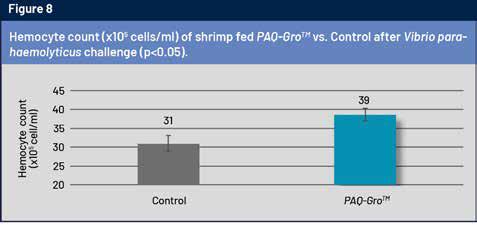
» Hemocyte counts were significantly elevated (Figure 8).
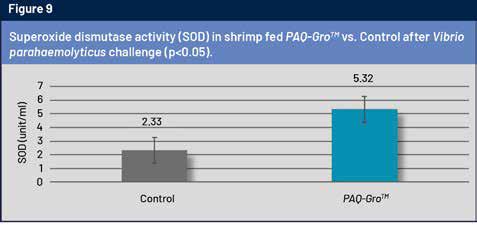
» Superoxide dismutase (SOD) activity was significantly higher, indicating stronger antioxidant defense (Figure 9).
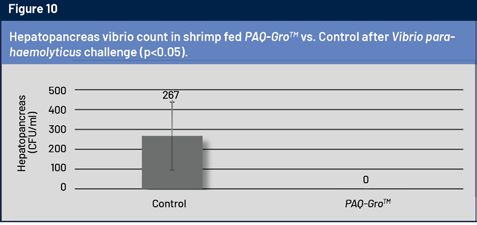
In addition, the vibrio counts were significantly lower in the hepatopancreas and intestine in the shrimp fed PAQ-GroTM (Figures 10 and 11).
This trial demonstrated that dietary supplementation with PAQ-Gro™ at 6 kg/MT can significantly enhance shrimp growth, feed utilization, and immune response under both normal and pathogenic stress conditions.
Under Vibrio parahaemolyticus challenge, PAQ-Gro™-fed shrimp experienced a delayed onset of mortality by six days, and a 16.6% higher survival rate compared to the control. This delay offers a critical intervention window for farmers to detect disease and implement control measures before severe losses occur.
PAQ-Gro’s ability to stimulate immune-related enzymes, including superoxide dismutase, lysozyme, and phenoloxidase, helps neutralize oxidative stress and inhibit pathogens. Overall, this trial reinforces PAQ-Gro’s role as a powerful nutritional strategy for improving shrimp performance and resilience during disease outbreaks.
Conclusion
Shrimp aquaculture faces an unavoidable challenge: stressors. These range from water quality fluctuations to handling practices and disease pressure, all of which can negatively affect shrimp health and reduce farm productivity. Recognizing the importance of this issue, researchers are actively exploring practical solutions, with dietary interventions emerging as a promising and sustainable approach.
This article highlights several potential feed additives, including PAQ-Gro™, a proven stress modulator that shows strong potential in protecting shrimp from various stressors. By incorporating this innovative nutritional additive into shrimp diets, farmers can achieve multiple benefits: reduced stress-related impacts, improved shrimp health and well-being, and increased overall productivity.
This article is sponsored by: PHIBRO ANIMAL HEALTH CORPORATION

* Dafna Israel, Ph.D.
Head of Research & Development.
Phibro Aqua
Allan Heres.
Shrimp Pathologist.
Phibro Aqua
For more information:
Website: https://www.pahc.com/product_services/aqua/
LinkedIn: https://www.linkedin.com/company/phibro-aqua-global
E-mail: info@phibro-aqua.com
References and sources consulted by the author on the elaboration of this article are available under previous request to our editorial staff.